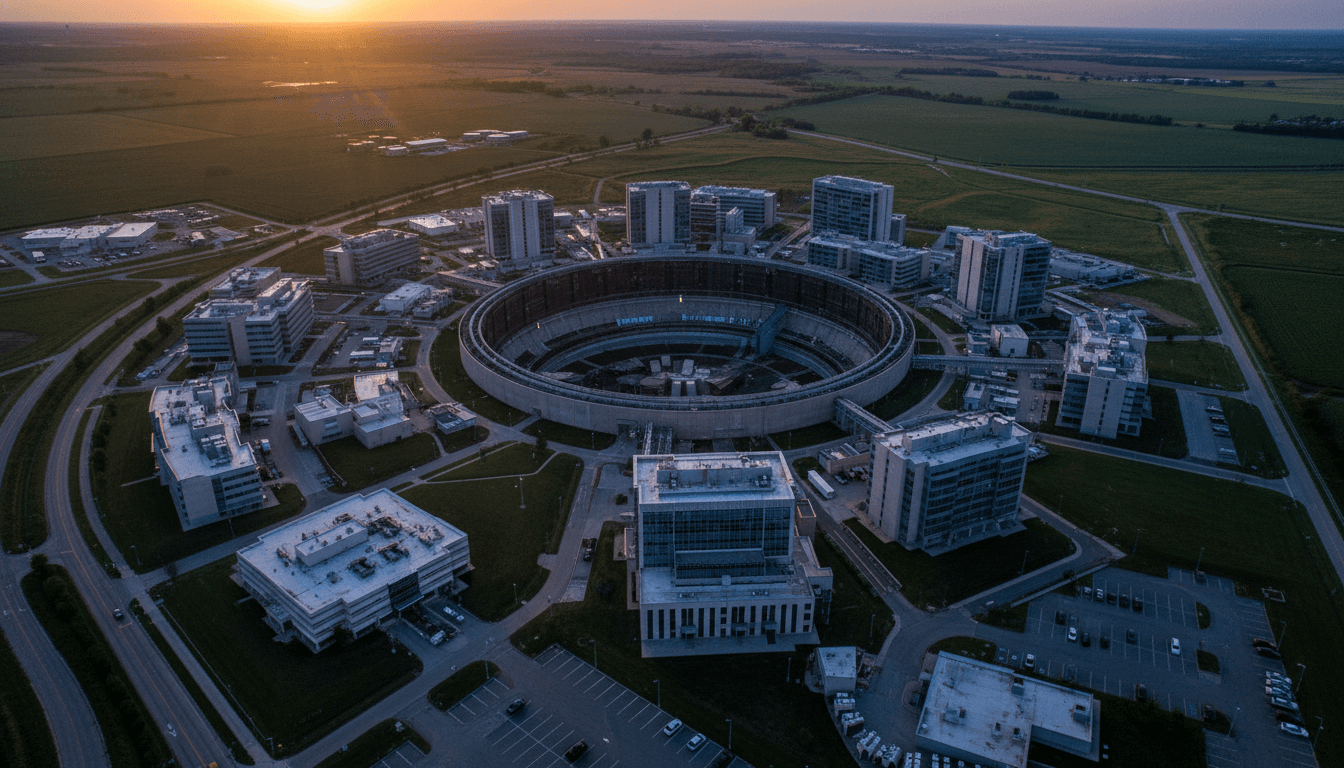
Muon magnetic moment aligns with the Standard Model of particle physics, resolving a long-standing discrepancy that had previously hinted at the possibility of “new physics.” A recent study led by a team at Penn State, published on April 22, 2026, in the journal *Nature*, found this critical alignment, strengthening confidence in our fundamental understanding of the universe.
The Muon: A Tiny Magnet’s Big Mystery
The research, led by Zoltan Fodor, a distinguished professor of physics at Penn State, focused on the “magnetic moment” of the muon. Muons are elementary particles, similar to electrons but about 200 times more massive and unstable, with a mean lifetime of 2.2 microseconds. Their magnetic moment describes how strongly they behave like tiny magnets, a property influenced by interactions with a “sea of virtual particles” that constantly pop in and out of existence. The difference between the experimentally observed value and the theoretical prediction of the Dirac equation is known as the “anomalous magnetic dipole moment” or “g-2.”
For decades, experimental measurements of the muon’s magnetic moment, particularly from landmark experiments at CERN (1959-1979), Brookhaven National Laboratory (1990s-2004), and Fermi National Accelerator Laboratory (Fermilab) (2013-2025), showed a slight but persistent deviation from theoretical predictions. This discrepancy, widely known as the “muon g-2 anomaly,” fueled immense excitement among physicists, suggesting the potential discovery of new particles or forces not accounted for in the Standard Model. The Muon g-2 collaborations at CERN, Brookhaven, and Fermilab were even awarded the 2026 Breakthrough Prize in Fundamental Physics on April 18, 2026, for their multi-decade contributions to measuring this crucial value.
Supercomputers Validate Standard Model with Precision
The international team, utilizing several supercomputers including Europe’s first exascale machine, JUPITER, performed highly precise calculations using lattice Quantum Chromodynamics (QCD) techniques. This rigorous computational analysis, which took over 10 years to complete and involved simulating every aspect from the ground up, brought the theoretical prediction into agreement with experimental measurements to within half a standard deviation. The Penn State-led team’s findings were published on April 22, 2026, building upon previous work, including a landmark calculation in 2021 that also involved Jülich researchers, which significantly narrowed the gap between theory and experiment.
“This alignment between theory and experiment demonstrates a profound understanding of how nature works at an incredibly deep level.”
The final results from the Muon g-2 experiment at Fermilab, which provided the most precise experimental measurement to date, were published on June 3, 2025. The new theoretical calculations now align perfectly with these cutting-edge experimental results. This validation of the Standard Model of particle physics is immensely significant. For years, the discrepancy in the muon magnetic moment was seen as one of the most promising avenues for discovering physics beyond the Standard Model, potentially indicating a “fifth force” or unknown massive particles. This new agreement dramatically narrows the space where new physics could be hiding and strengthens confidence in the Standard Model to an astonishing 11 decimal places.
Implications for Future Physics Research
While the prospect of discovering new physics is always thrilling, the precise alignment of the muon magnetic moment with the Standard Model underscores the remarkable predictive power and robustness of our current understanding of fundamental particles and forces. This research, an important development in scientific industries news, reaffirms the Standard Model as the most successful theory in particle physics. It means that any future discoveries of new physics will likely come from different avenues, perhaps at even higher energy scales or through entirely new experimental approaches. The painstaking efforts of both experimentalists and theorists, culminating in this agreement, represent a monumental achievement in human endeavor to comprehend the universe.