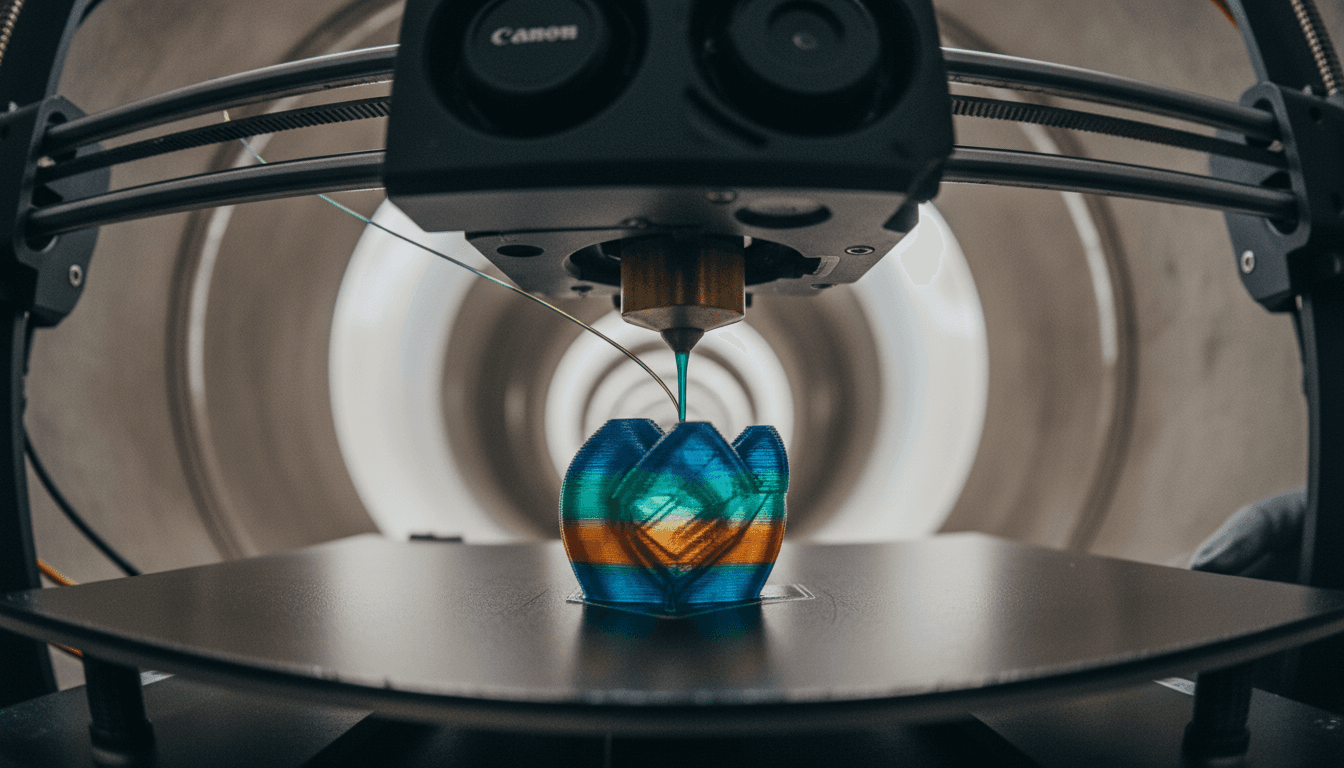
Full Spectrum 3D printing is redefining the color capabilities of desktop 3D printers, as highlighted in a recent Hackaday article. Traditionally, multi-color 3D printing has been constrained by a limited palette, often incurring increased costs and complexity for additional hues. This innovative technique promises to democratize a broader range of colors for prosumer and desktop FFF machines.
The ingenuity behind this advancement lies in its optical mixing approach. Rather than attempting to physically blend different colored filaments within the nozzle – a process fraught with issues like inconsistent flow rates and material incompatibility – Full Spectrum 3D printing leverages the human eye’s perception. By extruding very thin, translucent layers of various colored filaments, the system creates the illusion of blended colors as light passes through these stacked layers. This introduces ‘virtual colors’ into Fused Filament Fabrication (FFF) printing, dramatically expanding the available palette without the need for additional physical mixing hardware.
The Architecture of Innovation
This groundbreaking system was implemented within a fork of Orca Slicer, aptly named “Snapmaker Orca Full Spectrum.” The lead developer, known by the pseudonym Ratdoux on GitHub, spearheaded this project, which was initially inspired by an observation from Reddit user u/Aceman11100. The technology is specifically being developed for advanced tool-changing printers such as the Snapmaker U1 and the Prusa XL, which are well-suited to handle the rapid filament changes required for this optical layering technique.
“Full Spectrum 3D printing moves FFF closer to the chromatic language of digital graphics, enabling continuous gradients and realistic shading.”
The implications for designers and hobbyists are significant. For instance, with just four base filament colors, the software can generate 10 or more distinct and usable colors. At low layer heights, the potential expands even further, allowing for up to 39 different colors from those same four base filaments. This exponential increase in color options opens up new avenues for artistic expression, product prototyping, and detailed model creation that were previously unattainable with standard multi-color FFF printing.
Expanding Creative Horizons with Full Spectrum 3D Printing
The primary motivation behind Full Spectrum 3D printing is to overcome the inherent limitations of traditional multi-color techniques. These often involve substantial material waste generated by purge blocks and towers, slower print times due to frequent material changes, and restrictive combinations of compatible materials. By focusing on optical mixing, the Full Spectrum system aims to significantly reduce both material waste and print downtime, offering a more extensive and vibrant color palette with fewer physical filaments.
This advancement brings FFF printing closer to the rich chromatic language of digital graphics, enabling the creation of continuous gradients and realistic shading that were once the exclusive domain of more sophisticated and expensive printing methods. While challenges in multi-material printing related to material compatibility and process control persist, Full Spectrum 3D printing strategically focuses on expanding color options within compatible filament types, providing a practical and powerful solution for enhanced visual fidelity. This innovation is poised to make a considerable impact on the desktop and prosumer 3D printing space, particularly for users with tool-changing 3D printers like the Snapmaker U1, which is specifically mentioned as a target platform for this development. For more related Industries news, stay tuned to our coverage.
The public accessibility of the Snapmaker Orca Full Spectrum slicer fork as of March 5, 2026, followed by discussions and test videos appearing throughout March, indicates a rapid development and adoption cycle. This trajectory suggests that the technology is quickly maturing and finding its way into the hands of eager users looking to push the boundaries of 3D printing aesthetics.