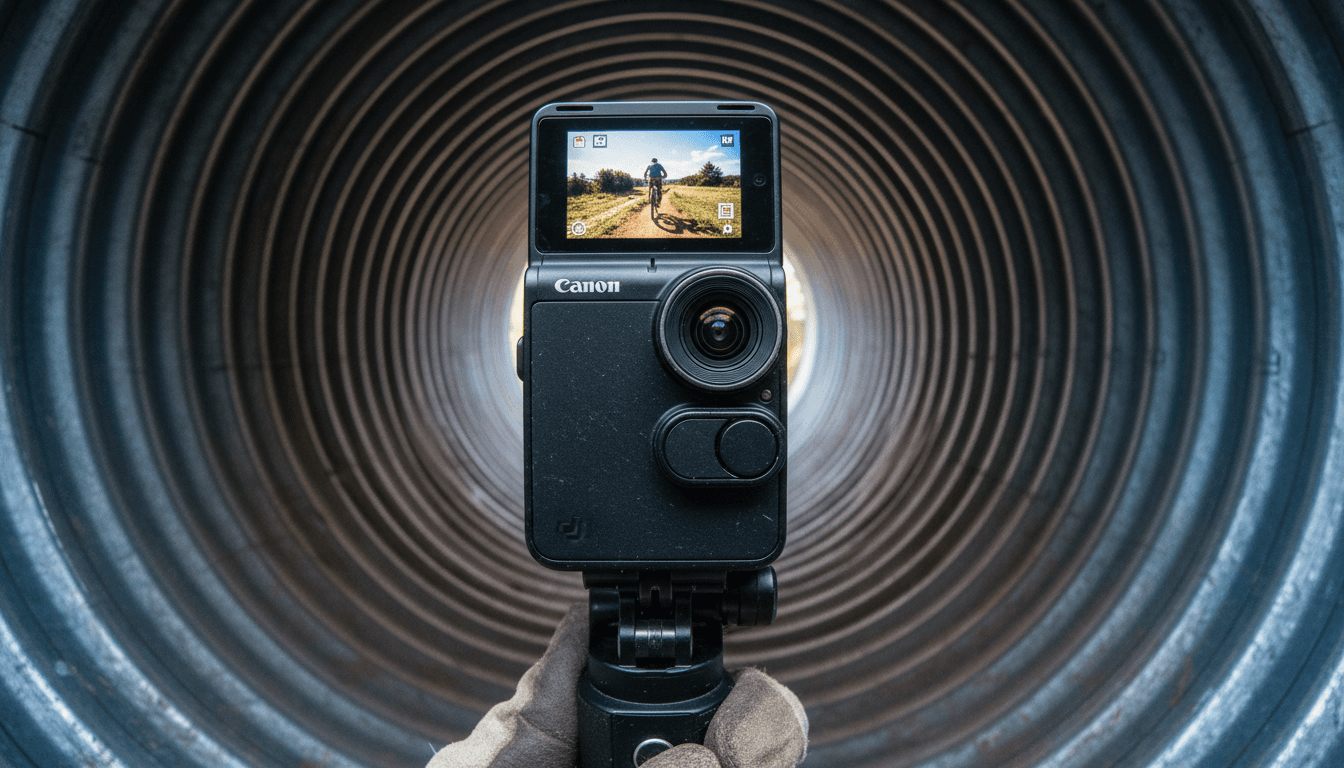
The DJI Osmo Pocket 4, unveiled in April 2026, represents a significant evolutionary leap for DJI’s popular handheld gimbal camera, aiming to transform it into a more serious tool for professional content creators.
Developed by DJI, a global leader in drone and camera technology, the Osmo Pocket 4 maintains the compact, pocketable form factor of its predecessor, the Osmo Pocket 3. It’s built around a familiar rotating screen and a 3-axis mechanical gimbal for unparalleled stabilization. Wayne Grayson is credited for providing insightful details on this new device. While launched globally, early availability in the US market faced temporary hurdles due to pending FCC authorization, a consequence of a December 2025 security audit deadline for DJI products.
Enhanced Performance Redefines the Osmo Pocket 4
The latest iteration brings a host of critical upgrades over the Osmo Pocket 3, particularly in video and imaging capabilities. Content creators will appreciate the ability to capture stunning 4K slow-motion footage at 240 frames per second (fps), a substantial improvement from the Pocket 3’s 4K/120fps. Furthermore, it introduces a true 10-bit D-Log color profile with an impressive 14 stops of dynamic range, offering far greater flexibility in post-production color grading compared to the Pocket 3’s D-Log M.
“The Osmo Pocket 4’s leap to 4K/240fps and true 10-bit D-Log fundamentally changes its utility for professional videographers, providing the raw data needed for cinematic results.”
Under the hood, the Osmo Pocket 4 features an upgraded 1-inch CMOS sensor – a new design within the same class as its predecessor. This translates to higher resolution 37-megapixel photos, a significant jump from 9.4MP, alongside improved low-light performance and superior color accuracy. The expanded ISO range of 50–12,800 for video and photos, and 50–25,600 for low-light video, ensures versatility across diverse shooting conditions. Moreover, the camera now boasts 107GB of built-in storage, effectively eliminating the immediate need for an external microSD card and providing ample space for approximately 600 minutes of 1080p/24fps video or 220 minutes of 4K/60fps video.
Smarter Controls and Tracking for Seamless Creation
User experience sees considerable refinement in the DJI Osmo Pocket 4. The rotating screen now intelligently initiates recording automatically, streamlining the workflow. New physical buttons include a dedicated Zoom button (offering 1x, 2x, and 4x digital zoom) and a customizable preset button for quick access to preferred settings. The improved joystick allows for more precise camera movements, crucial for dynamic shots. ActiveTrack 7.0 represents a major upgrade, delivering more intelligent and ‘stickier’ subject tracking, even at 4x zoom, with the added ability to register and prioritize faces for tracking accuracy. Battery life is rated at 240 minutes from its 1,545mAh battery, supporting extended shoots.
Audio capabilities are also enhanced, with three integrated microphones and support for connecting two DJI wireless microphone transmitters simultaneously. Users can optimize microphone modes for specific scenarios, such as a ‘stereo front and back’ configuration ideal for vlogging. Despite these advancements, the Osmo Pocket 4 is positioned as a refinement rather than a complete overhaul, retaining the core design and the 20mm equivalent f/2 lens of its predecessor. While it offers digital zoom, it notably lacks optical zoom, though whispers of an ‘Osmo Pocket 4 Pro’ with telephoto capabilities suggest future possibilities. Limitations include inconsistent gesture control and tracking performance drops at longer distances. The use of D-Log with digital zoom can also introduce noise in shadows, suggesting the ‘normal’ mode for users not engaged in extensive color grading. The device also lacks dust and water protection, a consideration for adventurers. For more insights into the latest innovations in camera technology, explore our related Industries news.
The Future of Handheld Filming
The DJI Osmo Pocket 4 solidifies its position as a powerful, pocketable solution for videographers and content creators. Its substantial upgrades in video quality, sensor performance, and intelligent tracking make it a highly competitive option in the handheld camera market. While it maintains a familiar form factor, the enhancements collectively push the device closer to professional-grade capabilities, promising greater creative freedom and higher production value for users across various applications.