A diffraction grating clock, a truly novel approach to time-telling, has been unveiled by creator ‘Twisted & Tinned’, marking a rare ‘first’ in the world of inventive chronometers. While Hackaday has chronicled myriad clock designs over the years, this particular innovation stands out for its ingenious use of light and optics to create a seemingly magical display.
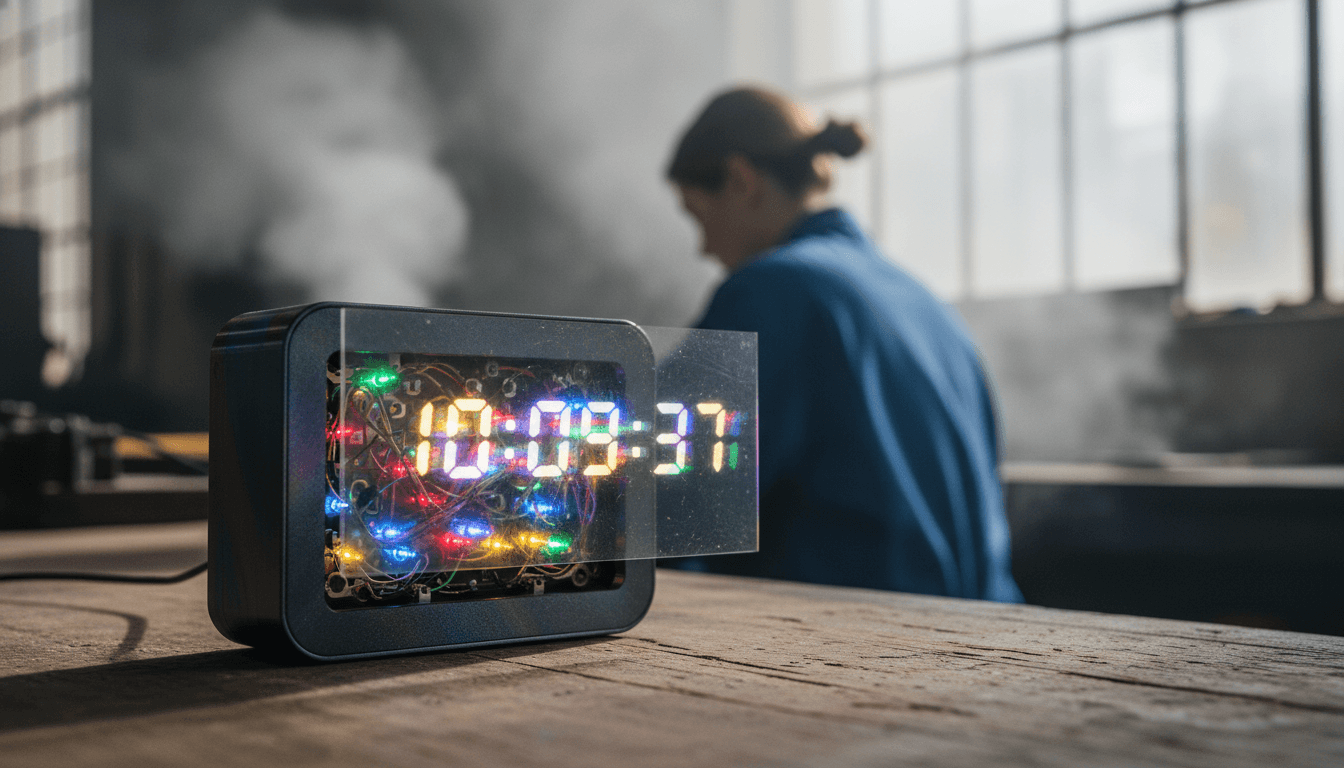
At first glance, the clock’s display appears as an unintelligible cluster of multi-color addressable LEDs. However, the true marvel emerges when a specially designed diffraction grating is placed in front of these lights. This grating masterfully separates the overlapping colors, revealing distinct, ‘floating’ LED digits that clearly display the time. Each digit is generated using a different color, all projected from the same set of LEDs, making the grating indispensable for readability.
The Ingenuity Behind the Diffraction Grating Clock
The core of this project’s brilliance lies not just in its aesthetic appeal but in its clever engineering. While a Raspberry Pi Pico powers the underlying electronics – a role that could be filled by various microcontrollers – it’s the symbiotic relationship between the addressable LEDs and the diffraction grating that truly differentiates this device. This innovative pairing allows for a compact display that transforms into a clear, vibrant readout with the simple addition of the grating. The integration of the grating pattern directly into the 3D-printed surround further enhances the visual experience, creating a shimmering effect that adds to its unique charm. This technique of printing onto a diffraction grating sheet, as highlighted by Hackaday previously, demonstrates a meticulous attention to detail and a commitment to pushing the boundaries of DIY fabrication.
“The use of a diffraction grating to transform a jumble of LEDs into a clear, multi-color time display is a testament to creative engineering and optical physics applied in a delightfully practical way.”
The potential applications of such a display method extend beyond mere timekeeping. Imagine interactive art installations, educational tools demonstrating light principles, or even compact, multi-layered information displays where different data streams are revealed by specific optical filters. The economic implications are also noteworthy; as one commentator observed, this method could allow for multiple ‘characters’ to be displayed by a single physical display, simply by leveraging different colors and a grating. This efficiency could lead to significant savings in display components.
Exploring the Mechanics of Light and Time
The fundamental principle at play here is the phenomenon of diffraction, where light waves bend as they pass through an aperture or around an obstacle. A diffraction grating, essentially a surface with a series of closely spaced parallel lines, separates light into its constituent wavelengths (colors). By assigning a unique color to each digit or piece of information, and then overlaying these colors from the same LED array, the grating acts as a decoder, splitting the light into its individual components and making each distinct color (and thus, digit) visible. This optical trickery turns what would otherwise be a chaotic light source into an organized, readable display.
This pioneering project not only offers a fresh perspective on clock design but also serves as a compelling example of how readily available components, combined with innovative thinking and an understanding of physics, can lead to truly remarkable creations. It underscores the ongoing evolution in related Industries news and the maker community, where ingenuity continues to redefine what’s possible.