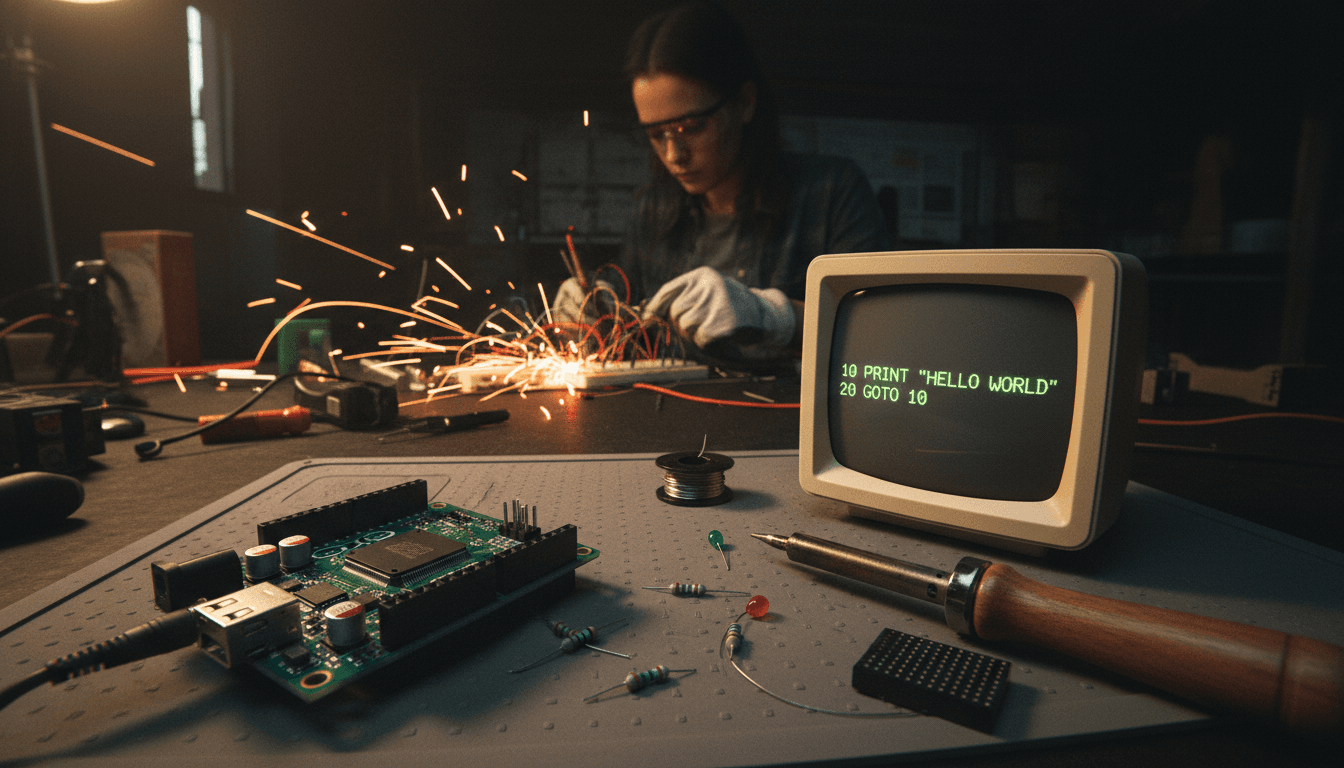
Arduino UNO programming has received a significant boost for enthusiasts and educators alike, with the recent porting of nanoBASIC_UNO, a Basic interpreter, to the ubiquitous ATmega328P microcontroller. This development, highlighted in a Hackaday article published on April 26, 2026, titled “The Arduino UNO, Basically,” offers a nostalgic journey for those who fondly remember the days of programming in Basic on classic computers or with devices like the Basic Stamp.
The nanoBASIC_UNO interpreter, originally conceived by [shachi-lab] for the STM8S microcontroller, now extends its reach to the widely popular Arduino UNO. This allows users to engage with their Arduino boards using a language style reminiscent of older computing environments, bridging the gap between modern maker platforms and classic programming paradigms. Al Williams’ Hackaday piece specifically targets this demographic, appealing to the enduring charm of Basic for microcontroller interactions.
The Enduring Appeal of Basic on Modern Hardware
The Arduino UNO, first introduced in 2010, rapidly ascended to iconic status within the maker community. Replacing the earlier Duemilanove, it became synonymous with accessible electronics, balancing simplicity with robust functionality. Its core, the ATmega328 microcontroller, combined with an open-source ethos and affordability, cemented its position among hobbyists, educators, and even professionals. The platform’s genesis in 2005 at the Interaction Design Institute Ivrea in Italy, spearheaded by Massimo Banzi, David Cuartielles, Tom Igoe, Gianluca Martino, and David Mellis, aimed to democratize microcontroller use, building upon Hernando Barragán’s Wiring project.
While the Arduino typically leverages C and C++ through its Integrated Development Environment (IDE), the nanoBASIC_UNO port offers an alternative for those seeking a different approach to Arduino UNO programming. This interpreter reintroduces a familiar programming environment, simplifying interaction with the board’s 14 digital I/O pins and 6 analog I/O pins. The ability to write “sketches” – Arduino programs typically structured with `setup()` and `loop()` functions – in a Basic-like syntax is a compelling proposition for many.
Bridging Generations: From Basic Stamp to Arduino
The mention of the Basic Stamp in the Hackaday article evokes a sense of nostalgia for a previous generation of hobbyist microcontrollers. The Basic Stamp, known for its on-board Basic interpreter, served as a gateway to electronics for many. However, the Arduino UNO presents significant advancements, boasting increased processing speed, lower cost, greater memory capacity, and the inherent advantages of an open-source ecosystem.
“The nanoBASIC_UNO port on the Arduino UNO represents a fascinating convergence of classic programming paradigms with modern, accessible hardware, unlocking new avenues for creative development.”
The availability of nanoBASIC_UNO for the ATmega328P effectively closes the philosophical gap between these two eras of microcontroller interaction. It allows the current generation of Arduino users, and those new to electronics, to experience the straightforward, line-by-line programming style that captivated early enthusiasts. This initiative not only enhances the versatility of the Arduino platform but also underscores the enduring relevance of foundational programming languages in fostering innovation and learning across related Industries news.
In conclusion, the new nanoBASIC_UNO port for the Arduino UNO offers a compelling blend of nostalgia and practicality. By enabling Basic programming on this widely adopted platform, it caters to a specific desire for simplicity and familiarity in microcontroller development. This development solidifies the Arduino UNO’s position as a versatile tool, capable of adapting to diverse programming preferences while continuing to inspire a new wave of makers and innovators.