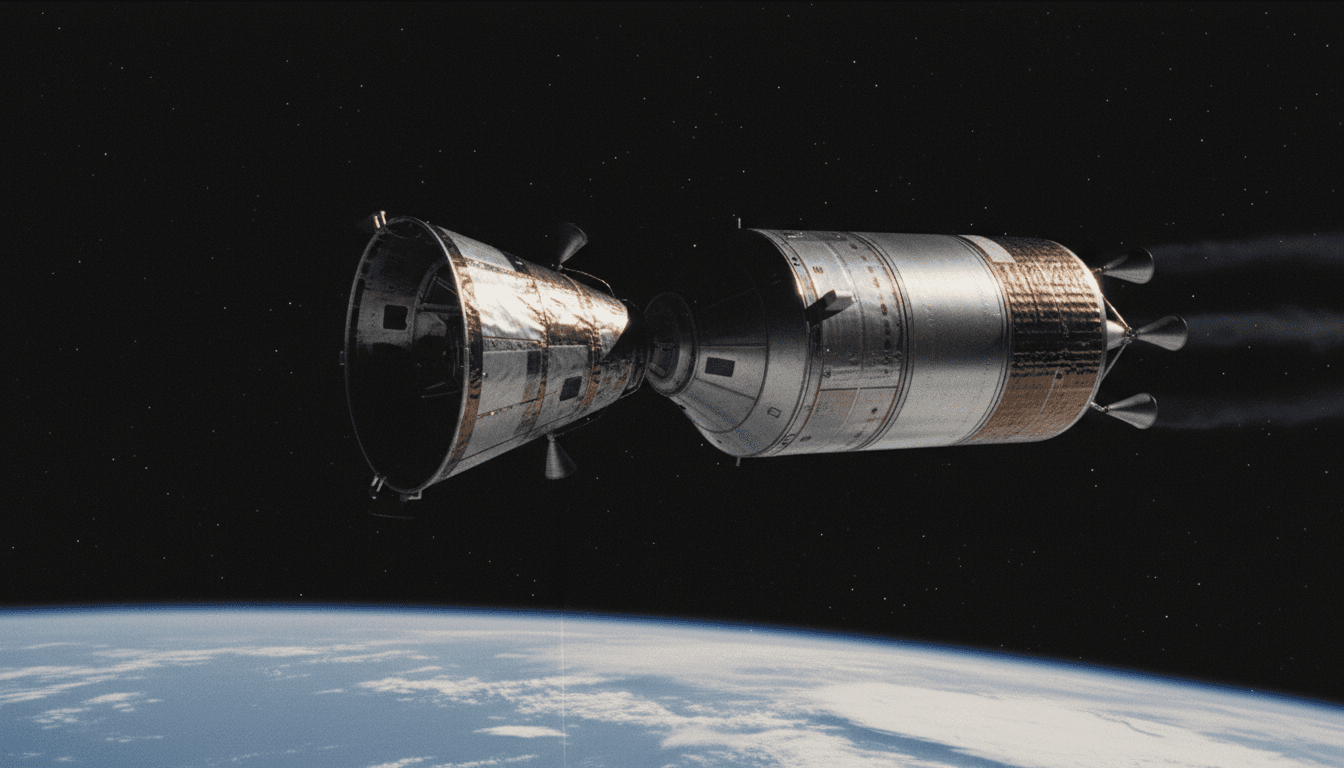
Apollo module separation, particularly the intricate process before re-entry, was a marvel of aerospace engineering, far more complex than simply jettisoning an empty fuel tank. While a large rocket often sheds stages on its ascent – a logical step to avoid hauling unnecessary weight – the return journey presented a unique set of challenges, especially when the command module needed to detach from the service module. This critical maneuver, as detailed in a compelling video by [Apollo11Space], required meticulous planning and execution to ensure crew safety and a successful splashdown.
The primary hurdle lay in the service module’s comprehensive capabilities. It housed essential life support systems, including oxygen, a powerful propulsion engine, vital fuel reserves, and electrical generation. In stark contrast, the command module was remarkably compact, designed to be self-sufficient only for a limited duration. The core task was to prepare the command module for independent operation during its re-entry phase, while simultaneously ensuring the service module was safely propelled away to prevent any collision or interference.
The Intricacies of Orbital Disconnect
Unlike separations during ascent where gravity aids in pulling components apart, the microgravity environment of orbit offered no such assistance. This necessitated a highly specific orientation for the Apollo module separation. Engineers had to devise a system that would impart sufficient relative velocity to the two modules, ensuring a clean and safe departure. This involved carefully timed explosive bolts and precisely calculated thruster firings to push the service module away from the command module’s re-entry path. The success of this delicate procedure underscored the ingenuity of the Apollo program’s design and operational teams.
“The precision required for Apollo module separation in orbit highlights the extraordinary engineering foresight that underpinned the entire lunar mission.”
Beyond the primary separation, other details contributed to the complexity. For instance, the successful landing of Apollo 11 itself drew upon advanced technologies, some even linked to spy tech, demonstrating the cross-disciplinary innovations at play. Similarly, the separation of the Lunar Excursion Module (LEM) before its descent to the moon, while benefiting from the moon’s weaker gravity, likely presented its own set of unique engineering considerations for a safe jettison.
Preparing for Re-entry: A Critical Handover
The transition from the service module’s comprehensive support to the command module’s independent re-entry capabilities was a critical handover. This involved a carefully orchestrated sequence of power transfers, system shutdowns, and life support activations within the command module. Crew members had to meticulously follow checklists to ensure all vital systems were online and redundant backups were ready, preparing their compact craft for the fiery descent through Earth’s atmosphere. This period of isolation, though brief, was a testament to the command module’s robust design and the astronauts’ rigorous training.
Ultimately, the successful Apollo module separation was a testament to the groundbreaking engineering and meticulous planning that defined the entire Apollo program. It was a moment of high stakes, where the lives of the astronauts depended on the flawless execution of a complex series of events, ensuring their safe return to Earth after their historic journeys.