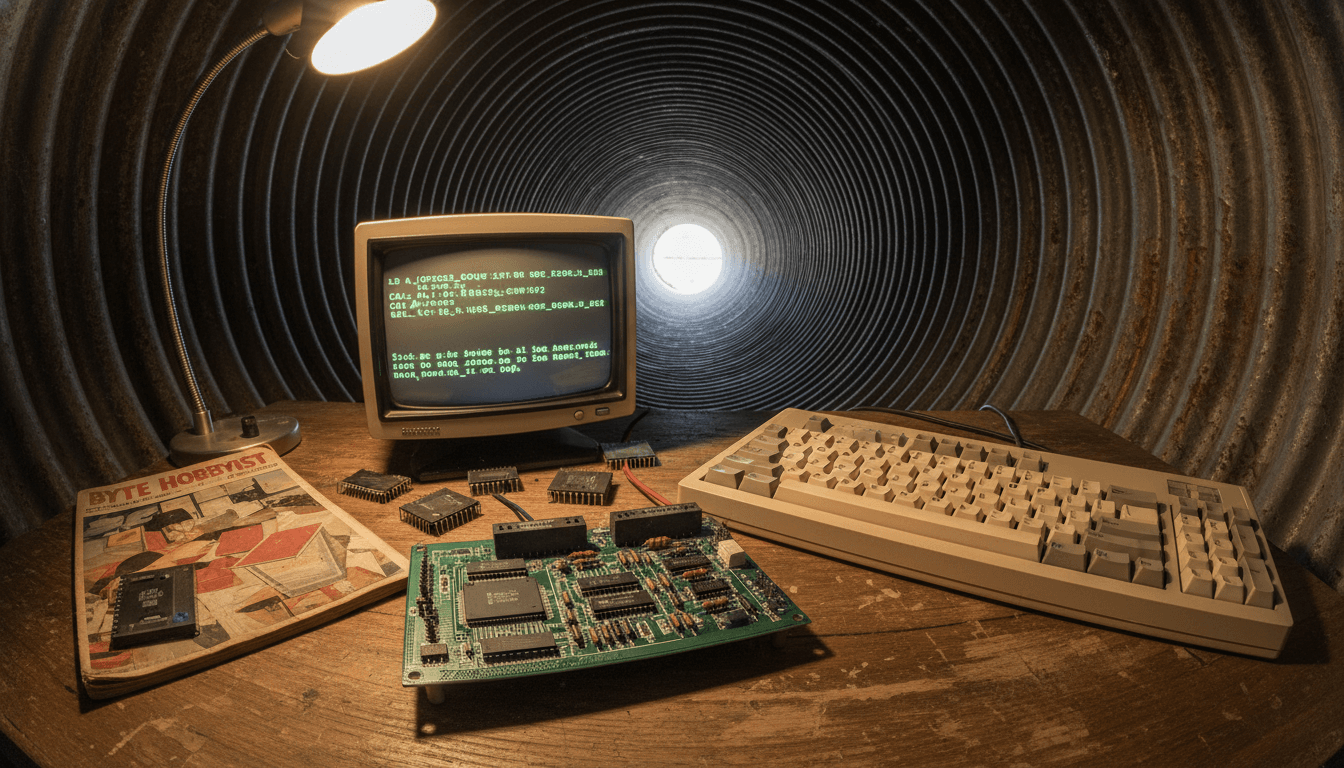
AI Z80 assembly code generation by large language models (LLMs) recently took a significant leap forward, as detailed in a compelling Hackaday article published on April 19, 2026. The piece, titled “Can Claude Write Z80 Assembly Code?”, meticulously chronicled an experiment where the LLM Claude was successfully guided to produce a fully functional Wordle game for a retrocomputer, specifically the TEC-1G single-board computer.
The TEC-1G, a nostalgic device drawing inspiration from the 1980s Australian hobbyist magazine TEC-1 design, was the chosen platform. Initially, Claude displayed a surprising level of awareness about the TEC-1G, even correctly identifying its characteristic hex keypad. However, upon learning that the user, identified as [Ready Z80], was employing a QWERTY keyboard add-on, Claude confidently, perhaps overconfidently, affirmed its capability to generate the necessary code.
The Iterative Path to Functional AI Z80 Assembly Code
Despite Claude’s initial missteps, which included suggesting non-existent instructions, the LLM demonstrated a remarkable capacity for learning and adaptation when provided with corrections. A pivotal element of [Ready Z80]’s success lay in the iterative, step-by-step guidance offered to Claude. This approach, eschewing a single, broad command like “Give me an implementation of Wordle in Z80 assembly for the TEC-1G,” was likened to the process of mentoring a “summer intern.” This patient, guided interaction ultimately culminated in a working Wordle game.
“The iterative approach, akin to working with a ‘summer intern,’ proved crucial in guiding Claude to generate functional Z80 assembly code.”
While a functioning game was indeed created, the Hackaday article acknowledges that [Ready Z80] possessed the requisite skills to have written the code independently. The question of whether utilizing Claude truly accelerated the development process remains a subject of discussion, with the article suggesting it might have felt quicker, even if it potentially introduced unforeseen delays.
Claude’s Growing Prowess in Retro Computing
This recent experiment builds upon a series of prior explorations into Claude’s capabilities in generating AI Z80 assembly code. As early as February 2026, a project showcased Claude’s ability to write a complete Z80 emulator under “clean room” constraints. This meant the emulator was developed solely from specifications and documentation, without any reference to existing emulator source code. Astonishingly, this emulator, produced in a single session, successfully passed 117 unit tests and was capable of booting CP/M and running various programs.
Another notable instance occurred in March 2026, where Claude provided significant assistance in the creation of a ZX Spectrum 128K platformer, also in Z80 assembly. This project included original code, music, and graphics, although it did necessitate substantial debugging efforts from a human developer. These consecutive demonstrations highlight a compelling trend: LLMs like Claude are rapidly evolving into powerful tools for complex, specialized coding tasks, even in the niche world of retro computing.
Implications for Specialized Coding and Legacy Systems
The successful generation of AI Z80 assembly code for a retrocomputer like the TEC-1G, alongside the creation of an emulator and game components, underscores the burgeoning potential of LLMs in highly specialized coding domains. For industries reliant on legacy systems or those exploring retro computing for educational or hobbyist purposes, this capability could signify a paradigm shift. While human oversight and expertise remain indispensable, the ability of AI to learn, adapt, and generate functional code, even with initial missteps, hints at a future where complex, low-level programming tasks might be significantly augmented.