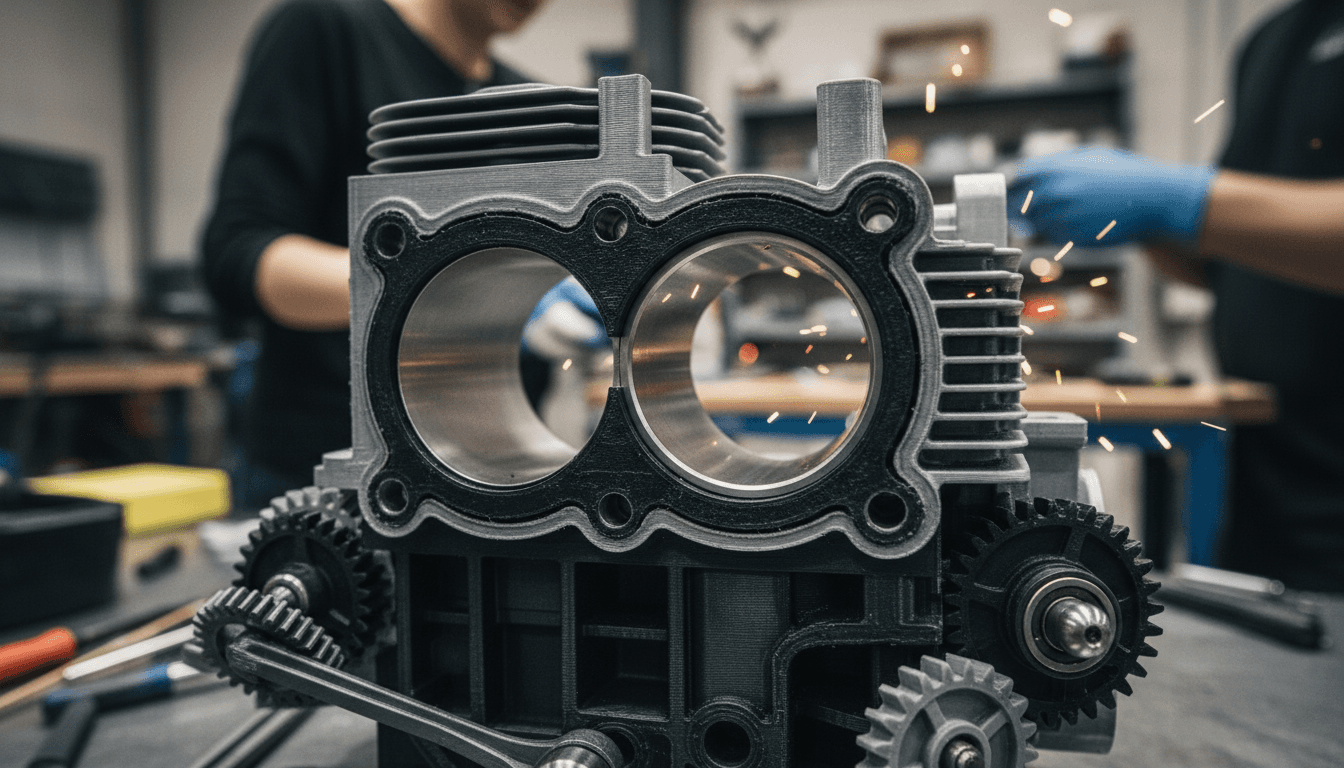
3D prints internal combustion engine: A recent Hackaday article, published on April 25, 2026, details the remarkable ongoing project of an individual named Alexander, who is successfully 3D printing internal combustion engines. This endeavor pushes the boundaries of what is typically achievable with common desktop FDM (Fused Deposition Modeling) 3D printers and standard plastics, marking Alexander’s third generation of such an engine.
The project stands out given that most desktop 3D printers utilize plastics ill-suited for the high temperatures and stresses inherent in an internal combustion engine. Despite these material limitations, Alexander’s engine largely comprises common ASA and ABS plastics, with some components made from CF-Nylon. While not entirely 3D printed, a substantial portion is, showcasing ingenious engineering.
Overcoming Material Constraints in Engine Design
Alexander’s innovative approach involves strategic ‘cheats’ to bolster the engine’s integrity. These include a stainless steel sleeve for the plastic engine block, a CNC’d aluminum head, and an off-the-shelf carburetor. Crucially, the engine also integrates 3D printed pumps for coolant water and oil, featuring clever internal engineering in the head designed to prevent mixing – a significant issue encountered in a previous iteration. Additional essential hardware, such as bearings, belts, and filters, are also required for the engine’s complete assembly.
“The impressiveness of the project lies not in how well the engine runs, but in the fact that it runs at all.”
The Hackaday article underscores that the true marvel of this project is not the engine’s performance, but its sheer functionality. This ‘dancing bear’ phenomenon highlights the ingenuity behind making such a device operational with readily available materials. Hackaday has previously showcased other ambitious 3D printed engine projects, including steam engines, hot-air Stirling engines, and electric motors, each with varying degrees of non-printed components. Another notable instance involved Camden Bowen, who successfully 3D prints internal combustion engine with a single piston, later improving it with a weed eater carburetor, though facing challenges with melting exhaust valves due to timing issues.
The Future of Desktop Manufacturing and Specialty Plastics
While advanced, heat-resistant 3D printing materials like PEEK, PEI, and ceramic resins exist for high-temperature applications in demanding sectors such as automotive and aerospace, Alexander’s project predominantly utilizes more common and significantly less expensive plastics. These specialized materials can withstand temperatures exceeding 200°C, with PEEK offering robust resistance up to 250°C for constant use. However, Alexander’s success with ASA and ABS – plastics typically rated for temperatures up to 100°C – exemplifies innovative design and engineering prowess in overcoming inherent material limitations.
This pioneering work in 3D prints internal combustion engine with accessible technology offers a glimpse into the evolving landscape of manufacturing and rapid prototyping. It demonstrates that with sufficient ingenuity, even conventional desktop 3D printers can be leveraged to create complex, functional mechanical systems, potentially paving the way for new applications in related Industries news and bespoke engineering solutions. The project certainly signals a surge in possibilities for accessible, low-cost fabrication of intricate machinery.