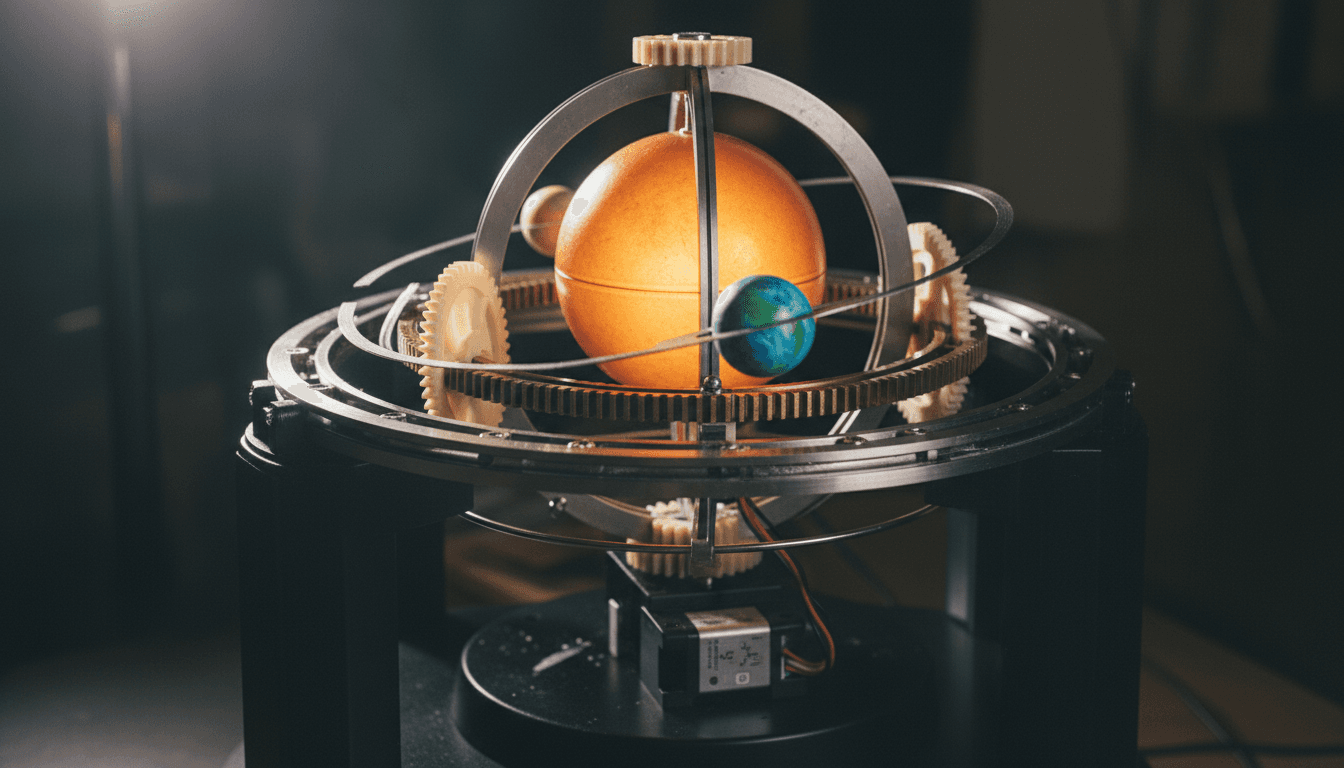
A 3D printed orrery, a mechanical model illustrating the solar system’s celestial motions, has been unveiled by ‘illusionmanager’ on Hackaday, demonstrating remarkable efficiency by operating with just a single motor. This innovative design, highlighted in a May 1, 2026 article, represents a significant leap from traditional orreries, which historically relied on intricate clockwork mechanisms.
This modern rendition meticulously showcases all the planets in our solar system, the Sun, and even Earth’s Moon. What sets this particular 3D printed orrery apart is its ingeniously simplified mechanism. Diverging from conventional gear trains, it employs a clever system where interlocking rings engage when turned in one direction but disengage in the other. This allows a single stepper motor to orchestrate the entire system’s movement, with the Moon’s specific trajectory managed by a separate, dedicated geared mechanism connected to the main rotation.
The Meridian Orrery: Local Calculations, Global Views
At the heart of this device is an ESP32 microcontroller, which diligently runs an astronomical simulation to precisely calculate the positions of all celestial bodies. This data then directs a small stepper motor, controlled by a TMC2209 driver, to move the mechanism back and forth until every component is perfectly aligned. A simple reed switch and magnet establish the initial zero position, ensuring consistent accuracy. The orrery updates itself once daily, performing a sequence of precise movements to set the planets and Moon to their correct locations. Known as “The Meridian Orrery,” its notable simplicity and self-sufficiency stem from its ability to calculate planetary positions locally, eliminating the need for an internet connection. This makes it a robust and reliable educational tool.
“The Meridian Orrery’s local computation capability truly redefines accessibility for educational astronomy models, showcasing complex mechanics with elegant simplicity.”
Innovation in Astronomical Modeling
The creator, illusionmanager, is no stranger to innovative projects, having previously been featured on Hackaday for a reverse sundial. This latest creation serves a dual purpose: it’s both a visually striking decorative piece and an invaluable educational tool. By making the complex, often abstract motions of the solar system tangible and interactive, the 3D printed orrery offers a unique learning experience. It embodies the spirit of related Industries news, where cutting-edge technology simplifies complex real-world phenomena, making them accessible to a broader audience. The integration of readily available components like the ESP32 and stepper motor also highlights the growing potential of DIY and open-source hardware in creating sophisticated scientific instruments.
Ultimately, this single-motor 3D printed orrery is more than just a model; it’s a testament to how modern manufacturing techniques and clever engineering can democratize scientific understanding. It brings the cosmos closer, demonstrating the intricate dance of our solar system with unprecedented simplicity and elegance.