
Crypto funds surge towards human trafficking related services surged by a shocking 85% year-over-year in 2025, reaching hundreds of millions of dollars across identified services, according to a new report from Chainalysis.
The intersection of cryptocurrency and suspected human trafficking activities intensified in 2025, with total transaction volumes reaching hundreds of millions of dollars across identified services, marking an 85% year-over-year (YoY) increase. This figure vastly underestimates the human cost of these crimes. The true cost should be measured not in dollars transferred, but in the lives impacted.
The surge in crypto funds flowing to suspected human trafficking services is not an isolated phenomenon but is intricately linked to the growth of scam compounds, online casinos and gambling sites based in Southeast Asia, and primarily Telegram-operated Chinese Money Laundering Networks (CMLNs) and collateral networks. All of which form a rapidly expanding local fraudulent ecosystem with global reach. Unlike untraceable cash transactions, the transparency of blockchain technology offers unprecedented visibility into these activities, creating unique opportunities for detection and disruption that were impossible with traditional payment methods.
Our analysis tracks suspected crypto-enabled human trafficking activity across four primary categories:
- “International Escort” Services: Suspected human trafficking Telegram-based services
- “Labor Broker” Agents: Telegram-based services facilitating kidnapping and forced labor in scam compounds
- Prostitution Networks: Suspected exploitative sexual service networks
- Child Sexual Abuse Material (CSAM) Vendors: Networks of individuals involved in the production and distribution of CSAM
Payment preferences vary significantly by category. While “International Escort” services and prostitution networks operate almost exclusively in stablecoins, CSAM vendors have historically relied more heavily on Bitcoin. However, even in CSAM-related activity, Bitcoin’s dominance is waning with the rise of alternative Layer-1 networks. Overall, the preference for stablecoins among “International Escort” services and prostitution networks suggests these organizations prioritize payment stability and ease of conversion over the risk of asset freezes by centralized issuers.
As detailed below, “International Escort” services are tightly integrated with Chinese Money Laundering Networks. These networks may quickly convert USD stablecoins to local currency, mitigating concerns about their stablecoin holdings being frozen.
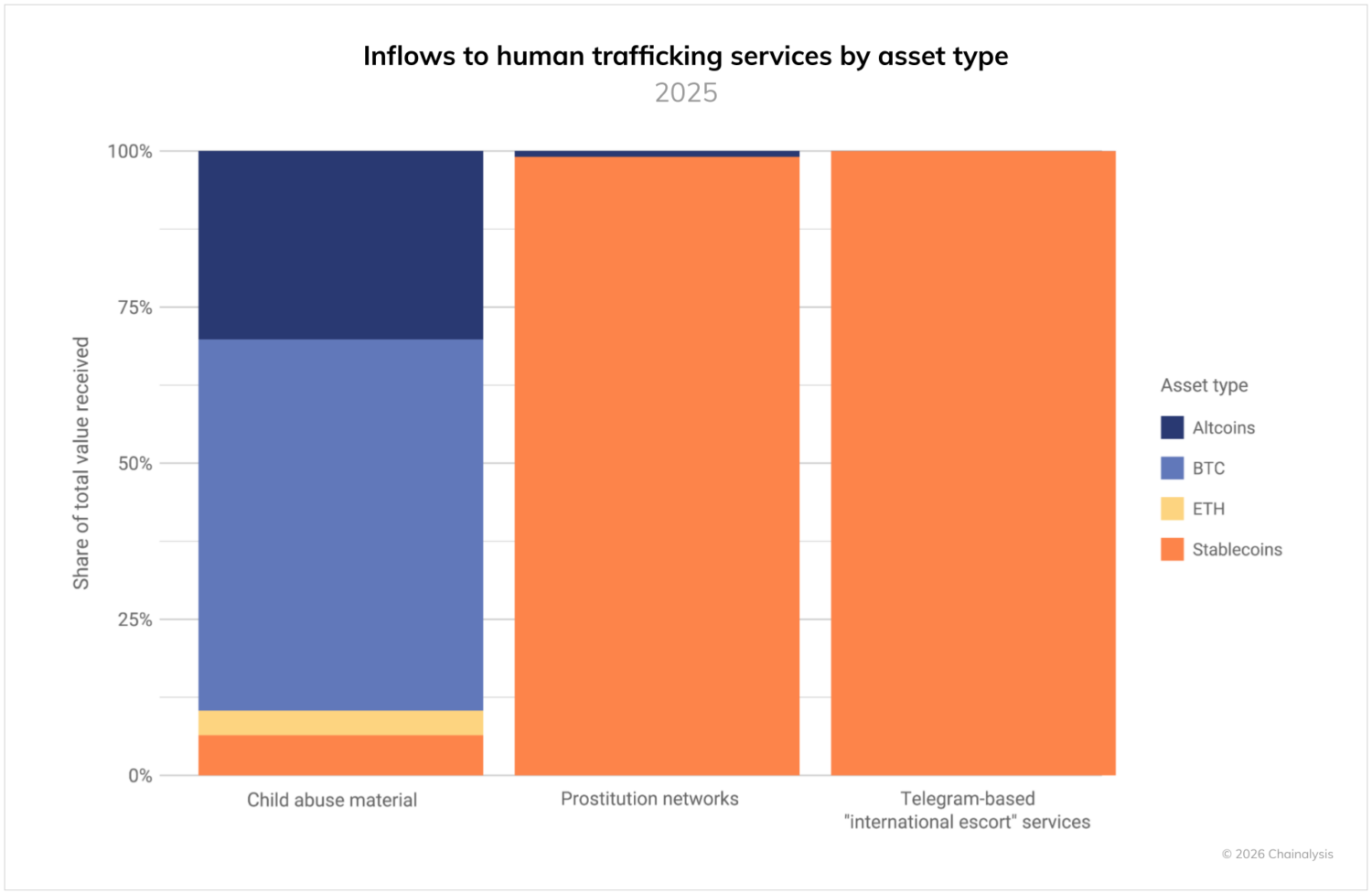
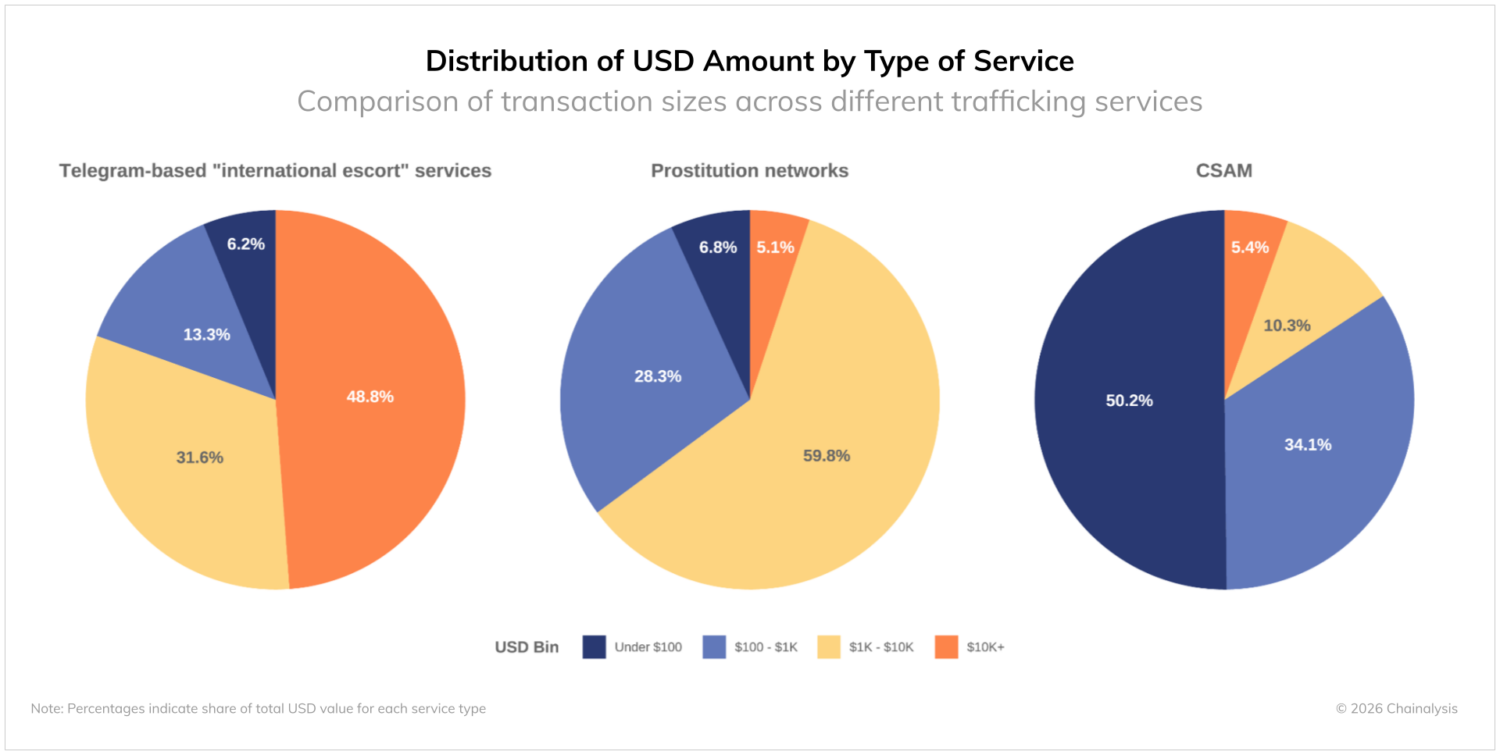
Telegram-Based “International Escort” Services See Nearly Half of Transactions Exceeding $10,000
Transaction size distributions indicate different operating models among the types of suspected human trafficking services. “International Escort” services exhibit the highest concentration of high-value transactions, with 48.8% of transfers exceeding $10,000, suggesting the presence of large-scale organized crime. In contrast, prostitution networks are concentrated in the middle range, with approximately 62% of transactions ranging from $1,000 to $10,000, indicating agency-level operations.
These “International Escort” services operate with sophisticated business models featuring customer service protocols and systematized pricing. For example, one prominent organization advertises in major East Asian cities, offering tiered pricing ranging from 3,000 RMB ($420) for hourly services to 8,000 RMB ($1,120) for extended services, including international transport. Such standardized pricing models create identifiable transaction patterns that investigators and compliance teams can leverage to detect suspicious activity at scale.

CSAM Vendors and Marketplaces
CSAM activity presents a different, though equally concerning pattern. While approximately half of CSAM-related transactions are under $100, CSAM on the internet has, unfortunately, never been more abundant, and the cost of production has never been lower. These activities are evolving into sophisticated financial and distribution strategies. In 2025, it was observed that while these networks still accept payments in major cryptocurrencies, they increasingly use Monero to launder proceeds. Instant exchangers, which provide fast and anonymous cryptocurrency exchanges without KYC requirements, play a critical role in this process.
The CSAM business model is consolidating heavily into subscription-based services rather than pay-per-content transactions, creating a more predictable revenue stream while simplifying management. These subscriptions typically cost less than $100 per month, lowering the barrier to entry while providing operators with stable income.
A troubling trend emerged in 2025: increased overlap between CSAM networks and sadistic Online Extremism (SOE) communities. Following law enforcement actions against groups such as “[764](https://www.justice.gov/opa/pr/764-extremist-group-leader-pleads-guilty-rico-child-exploitation-charges)” and “[cvlt](https://www.europol.europa.eu/media-press/newsroom/news/law-enforcement-targets-online-cult-communities-dedicated-to-extremely-violent-child-abuse),” SOE content, commonly advertised as “hurtcore,” was identified within CSAM subscription services. These SOE groups target and manipulate minors through elaborate sextortion schemes, with the resulting content being monetized through cryptocurrency payments, perpetuating the cycle of abuse.
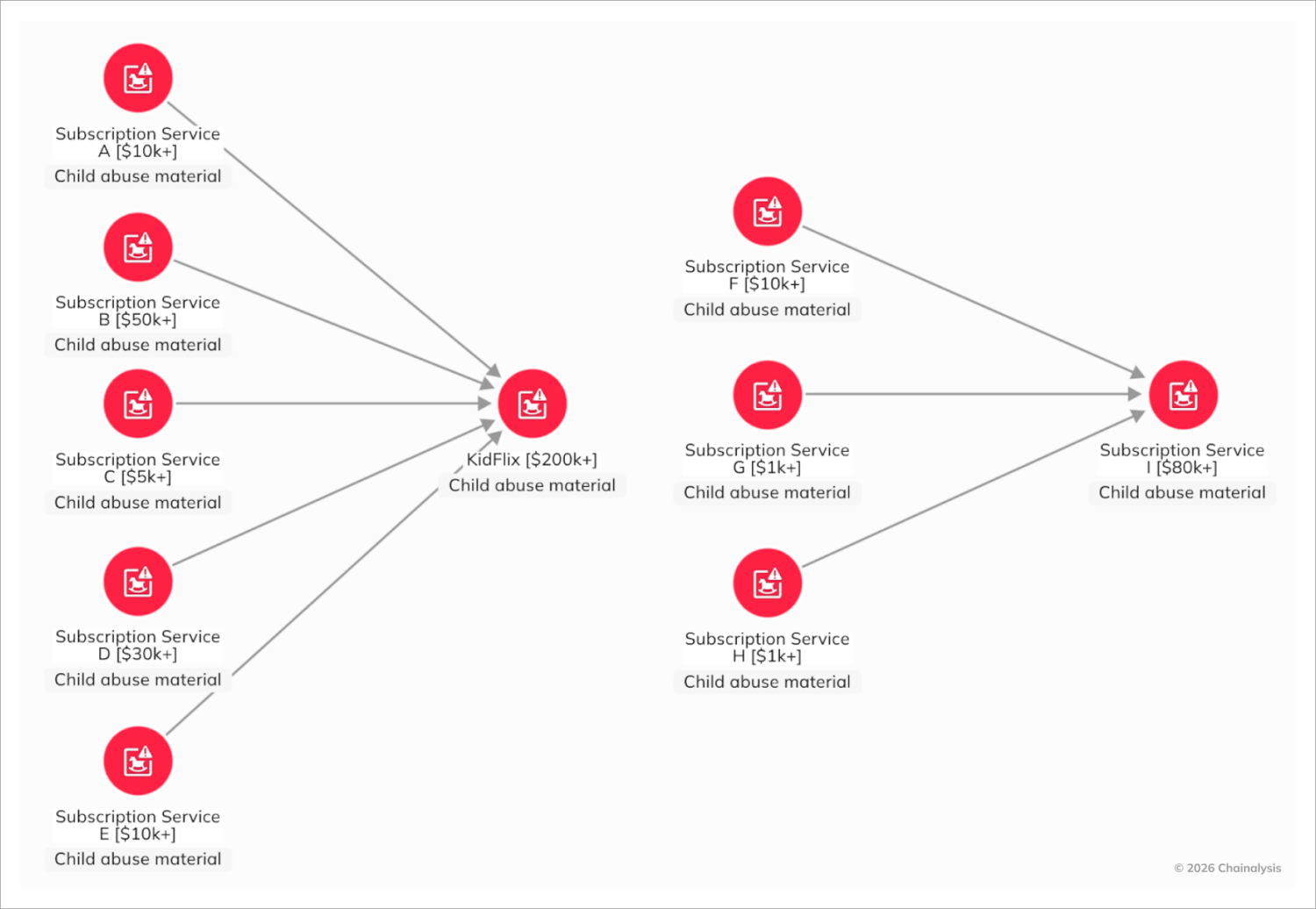
The scale of these activities was particularly highlighted in July 2025, when Chainalysis, acting on intelligence from UK law enforcement, identified one of the largest CSAM websites operating on the dark web. This single operation used over 5,800 cryptocurrency addresses and generated over $530,000 in revenue since July 2022, dwarfing the scale of the infamous 2019 “Welcome to Video” case.
Southeast Asian Organizations Facilitating Human Trafficking Exhibit Global Reach Through Crypto
The geographic analysis of “International Escort” services in 2025 reveals that Southeast Asian services, particularly those of Chinese origin, are expanding their global reach through cryptocurrency adoption. Blockchain transparency provides valuable insights into the broad human trafficking patterns and fund flows of these activities. related Fraudulents news
Based on our data, Chinese services, operating through networks spanning mainland China, Hong Kong, Taiwan, and various Southeast Asian nations, demonstrate sophisticated payment processing capabilities and extensive international reach. Large volumes of cryptocurrency transactions indicate significant fund flows from countries such as Brazil, the United States, the United Kingdom, Spain, and Australia, demonstrating the truly global scale of these activities. The crypto funds surge is facilitating this expansion.
While traditional human trafficking routes and patterns persist, these Southeast Asian services exemplify how cryptocurrency technologies are enabling the facilitation of payments and concealment of cross-border fund flows in human trafficking activities with unprecedented efficiency. The diversity of destination countries suggests these networks are building sophisticated infrastructure for global operations.
Blockchain analysis, combined with traditional anti-trafficking measures, offers a powerful toolkit for disrupting human trafficking networks.
Source: Chainalysis