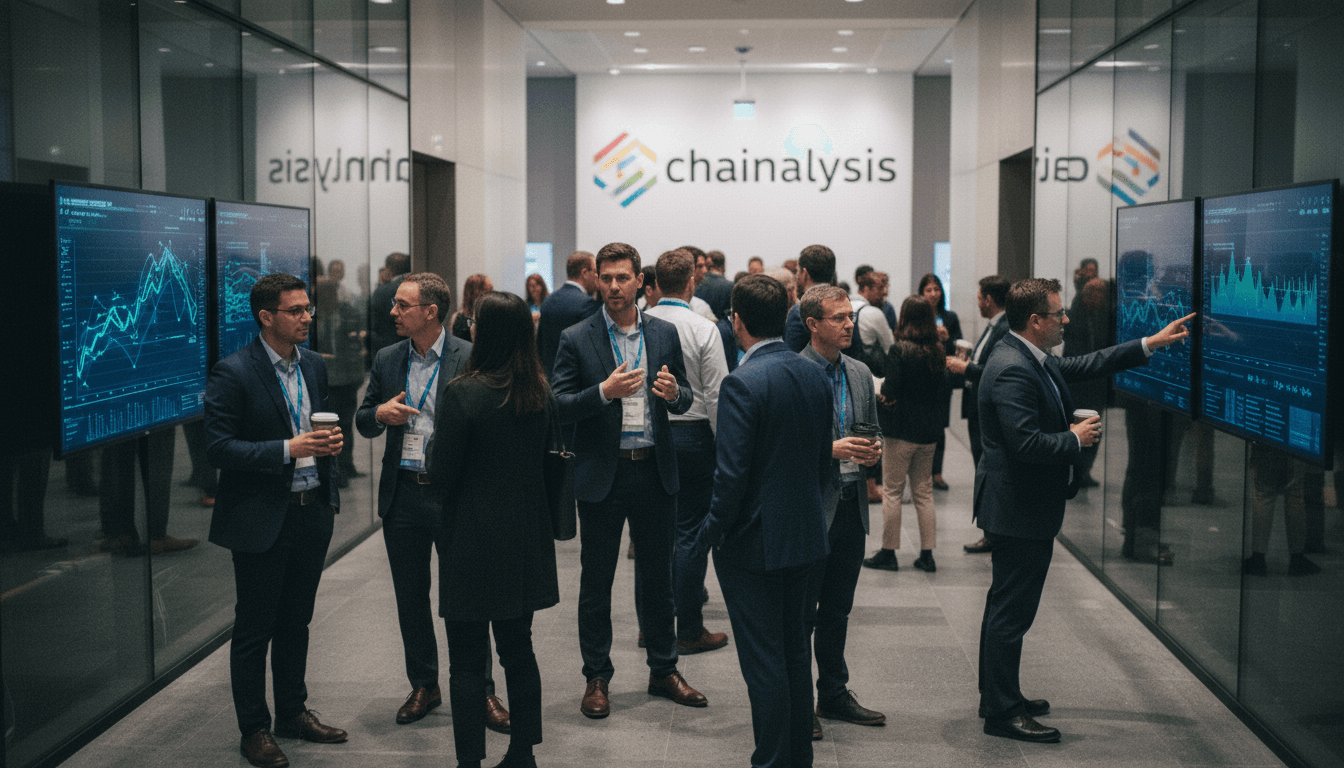
AI amplification at Chainalysis Links NYC 2026 underscored a critical shift in the financial landscape, bringing together a diverse assembly of cryptocurrency exchanges, global law enforcement, and traditional finance (TradFi) leaders. The recent two-day event, Chainsalysis Links 2026, highlighted an overarching message: we are already operating in a new reality where AI acts as a powerful amplifier for both criminal enterprises and those combating them. Three dominant themes resonated throughout the conference: the pervasive role of AI, the undeniable convergence of crypto and traditional finance, and the imperative for networked intelligence to achieve scalable solutions.
Jonathan Levin, Co-founder of Chainalysis, set the stage by emphasizing cryptocurrency’s ascent as a major geopolitical and macroeconomic force. With stablecoins settling over $20 billion daily and Bitcoin ETFs solidifying digital assets within TradFi, the financial world has irrevocably changed. A significant announcement was the launch of Chainalysis AI agents, designed to automate complex workflows and empower investigators and compliance teams with unprecedented speed and scale in parsing on-chain data.
The Dual Edge of AI: Amplifying Both Sides
AI’s presence was ubiquitous at Links 2026, presented as a tangible operational reality. Criminals are already leveraging AI to craft undetectable malicious code and execute sophisticated impersonation schemes. Conversely, investigators are harnessing AI to unearth leads previously beyond reach. The core challenge lies in deploying AI on robust, proven foundations rather than speculative predictions. Jacob Illum, Chief Scientist, and Beth Bisbee, Director of Product Strategy at Chainalysis, firmly stated that actionable, defensible intelligence demands reliable sources of truth; AI built on mere predictions will falter in the courtroom and against regulators.
For Chief Compliance Officers (CCOs) at leading exchanges, AI is revolutionizing compliance workflows:
- Kraken’s Proactive Stance: CJ Rinaldi shared how his team proactively integrated Chainalysis Data Solutions to enhance blockchain monitoring analytics and bolster KYT alerts, boosting efficiency without top-down mandates.
- OKX & Alterya’s Predictive Power: OKX detailed their collaboration with Alterya, utilizing AI for predictive intelligence to identify bad actors faster through a holistic network understanding.
- Binance’s Compliance Commitment: Noah Pearlman reiterated Binance’s full commitment to federal compliance, noting AI’s role in transforming human compliance teams into high-level risk managers, moving beyond manual processes.
TradFi and Crypto: A Converged Reality
The consensus across panels was clear: the convergence of crypto and TradFi is no longer a future prospect but a present reality. The pressing question now revolves around whether existing controls have evolved to match this technological integration. The DTCC and Citi are actively embedding blockchain into core financial infrastructure, with the DTCC outlining a strategy to tokenize over $100 trillion in assets using “Compliance Aware Tokens.” Citi is simultaneously transitioning from legacy batch processing to a 24/7 commerce model. PayPal and SoFi are extending their monitoring to stablecoin ecosystems beyond their own platforms, while Standard Chartered revealed that fiat rails often present more risk than on-chain activities. Global law enforcement, including Brazilian authorities, underscored the urgent need for seamless integration between instant fiat payment systems and blockchain monitoring. OFAC issued a stark warning regarding nation-states leveraging crypto to evade TradFi sanctions, emphasizing that compliance built as an afterthought will face severe regulatory scrutiny. This undeniable convergence highlights the need for robust solutions to manage the new financial ecosystem.
Networked Intelligence: The Power of Collaboration
The most impactful sessions at Links 2026 showcased the immense power of collaborative networks. From street-level phone thieves to sophisticated state-sponsored groups like North Korea’s Reconnaissance General Bureau (RGB), adversaries are already collaborating. The industry must follow suit. A thrilling case study presented by the Microsoft Digital Crimes Unit detailed Operation Trashpanda / Raccoon0365, where Chainalysis Reactor was instrumental in tracing payments to Nigerian exchanges, leading to the seizure of 338 malicious domains and the arrest of the core developer. UK prosecutors highlighted “Operation Man,” which used Chainalysis to trace $47 million in Bitcoin and seize $4.25 billion from a Chinese Ponzi scheme. The Brazil-Binance proactive referral system and Europol data sprints further exemplified the profound impact of seamless public-private data sharing. Jonathan Levin’s closing invitation resonated deeply:
“Build agents. Automate workflows. Engage in rulemaking. Show up in DC. Join the data sprints. Hold the industry accountable. The platform is open, and the invitation to build is here.”
The conference concluded by celebrating excellence with the 2026 Links customer awards. SoFi received The Impact Award for its secure, regulated launch of SoFi USD, powered by the Chainalysis Intelligence layer. The UAE Cybersecurity Council was honored with The Public-Private Partnership Award for its global leadership in cyber threat mitigation. MoonPay earned The Innovation Award for building a best-in-class global payment infrastructure while upholding an unwavering commitment to compliance, proving that mass adoption and safety can coexist. Chainalysis Links NYC 2026 provided critical insights into the evolving landscape of digital finance and the imperative for collaborative, AI-driven solutions.