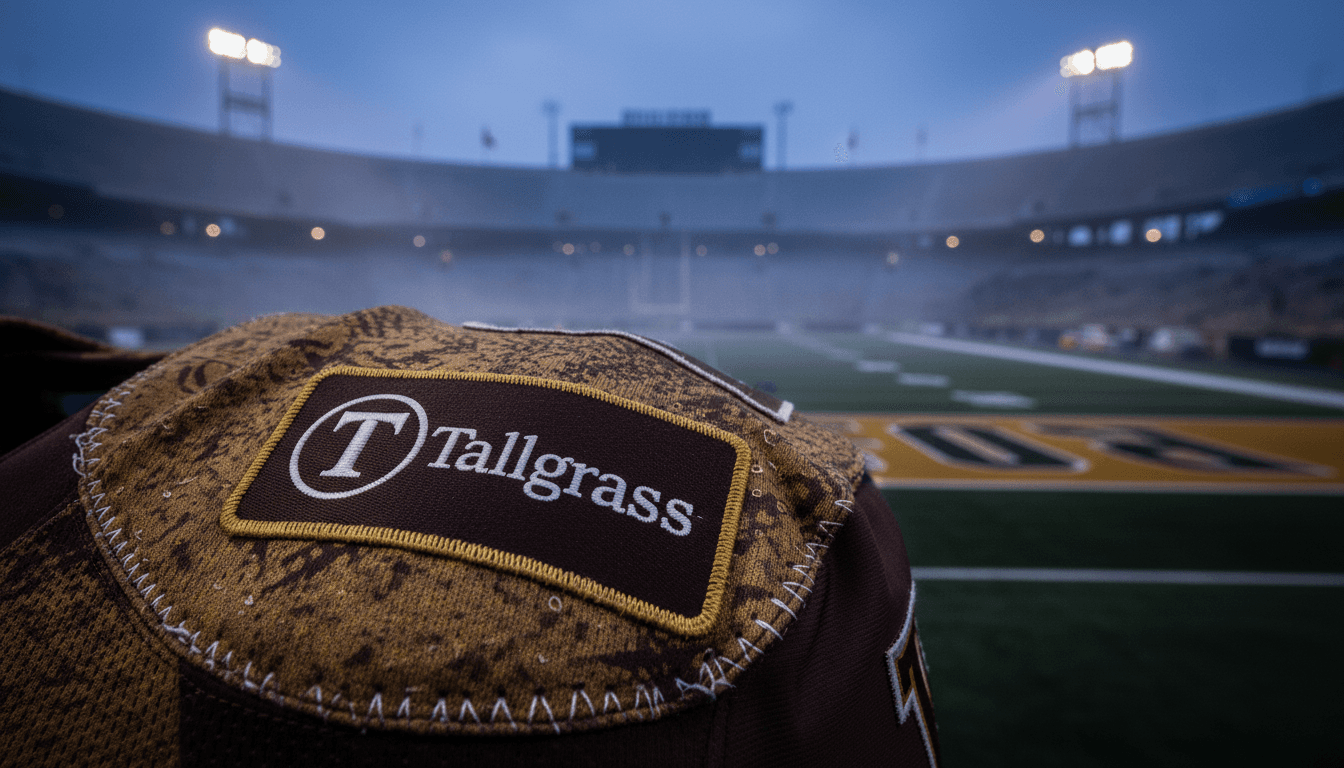
A record UW Athletics Deal, a five-year, multimillion-dollar jersey patch partnership with Tallgrass, has been announced by the University of Wyoming, arriving just days after President Trump signed an executive order aiming to reshape the landscape of college sports. This unprecedented corporate investment, exceeding $4 million over its duration, signals a significant financial injection for the Cowboys, even as the broader collegiate athletic ecosystem grapples with regulatory upheaval and a pressing need for increased revenue sharing.
The agreement, facilitated by Learfield’s Wyoming Sports Properties, will see the Tallgrass logo prominently displayed on the jerseys of the football, men’s basketball, and women’s basketball teams. Furthermore, the Colorado-based energy infrastructure company, which boasts extensive operations across Wyoming, will assume the role of presenting sponsor for the Wyoming Kids Club. Rob DeSoto, general manager of Wyoming Sports Properties, emphasized the deal’s significance, stating,
“This is the largest corporate investment in Wyoming athletics history. Over the five-year window, it’s over $4 million invested to Wyoming athletics.”
DeSoto also highlighted how the partnership reflects a new paradigm in corporate sponsorship, adapting to the emerging revenue-sharing era by directly supporting student-athletes.
Director of Athletics Tom Burman underscored the immediate impact of the Tallgrass commitment, noting it “will have an immediate impact on our ability to recruit and retain our best and brightest.” This financial boost arrives at a critical juncture for UW Athletics, which has publicly stated a need for $8 million in revenue sharing to remain competitive in the evolving collegiate sports arena.
Trump’s “Urgent National Action to Save College Sports”
The timing of the UW-Tallgrass announcement is particularly salient, coming just three days after President Trump issued a sweeping executive order titled “Urgent National Action to Save College Sports.” This executive order leverages the federal government’s contracting and grant authority to compel universities to adhere to NCAA rules, some of which have previously been challenged or overturned by federal courts. Signed on a Friday, hours before the NCAA women’s basketball Final Four, the order directs federal agencies to assess violations of NCAA rules pertaining to eligibility, transfers, revenue sharing, and financial activities. The aim is to determine if such violations render institutions ineligible for federal funding.
At the core of the order is an acknowledgement of the escalating financial crisis within college sports, primarily fueled by massive spending in football and men’s basketball. The order cites examples of major athletics programs carrying hundreds of millions in debt, with one program closing fiscal year 2025 with $535 million in athletics-related debt, and another with $437 million. The University of Louisville, for instance, recently articulated that “the math no longer works” across the collegiate sports landscape.
Key provisions of the executive order include a push to reinstate a version of the one-time transfer rule, allowing athletes a single immediate-eligibility transfer within a five-year window, with subsequent transfers permitted only after degree completion. It also mandates a five-year eligibility cap and prohibits professional athletes from returning to college competition. Critically, the order targets booster-funded collectives, labeling payments exceeding an athlete’s legitimate Name, Image, and Likeness (NIL) market value as “fraudulent NIL schemes.” While legitimate endorsement deals, such as a local car dealership paying a quarterback a fair rate for a commercial, would remain legal, six-figure payments for unseen social media posts would not. Revenue-sharing payments approved under the NCAA’s House settlement framework are explicitly exempted. Furthermore, the order strictly prohibits the use of federal funds for NIL payments, revenue-sharing, or coaching and recruiting compensation.
Protecting Olympic Sports and Future Implications
A significant aspect of the executive order is its inclusion of protections for women’s and Olympic sports. It mandates that any revenue-sharing arrangements must preserve or expand scholarships and roster spots in these programs, aiming to prevent the financial dominance of football and men’s basketball from cannibalizing funding for other sports, as required by Title IX. The Department of Education is also directed to explore requiring universities to publicly report total roster spots and athletically related spending, broken down by gender, to enhance transparency and safeguard non-revenue sports. The administration’s goal is to implement some of these changes before the upcoming college football season.
The immediate reaction from institutions like UW has been cautious. Nick Seeman, UW’s associate athletic director for communications, stated they had “no comment” on the executive order, while Rob DeSoto noted his team was “still digesting” the details and scheduled a call with their legal team for review. NCAA President Charlie Baker, while not having read the full order, indicated that many of its proposals were consistent with ongoing discussions between the NCAA, Congress, and the administration. These discussions have involved key figures like SEC Commissioner Greg Sankey and NBA Commissioner Adam Silver, leading to the formation of five committees focused on various aspects of college sports reform.
For coaches and administrators, the executive order, despite its potential legal challenges, offers a glimmer of hope for imposing order on the current chaos. Dennis Patchin, a veteran sportscaster and the voice of University of Idaho men’s basketball and football, articulated the frustration with inconsistent rules:
“Whatever rule you’re gonna make, make it. But stick by it. Because the rules keep changing, and when you’re trying to put a program together, that’s a really hard way to do it.”
Patchin highlighted the disparity created by varying state NIL laws, such as Mississippi eliminating state income tax on NIL earnings, which creates recruiting advantages. He also raised the critical Title IX question surrounding direct revenue sharing: “If I’m going to pay 25 male athletes an average of half a million dollars a year, do I have to pay 25 female athletes an average of half a million dollars a year? I have yet to have anybody explain that to me.” While the order is susceptible to legal challenges, given courts’ history of striking down NCAA restrictions on antitrust grounds, the underlying problems it addresses are undeniably real and have been consistently voiced by stakeholders across college athletics. The record UW Athletics Deal arrives amidst this turbulent, yet potentially transformative, period for college sports.