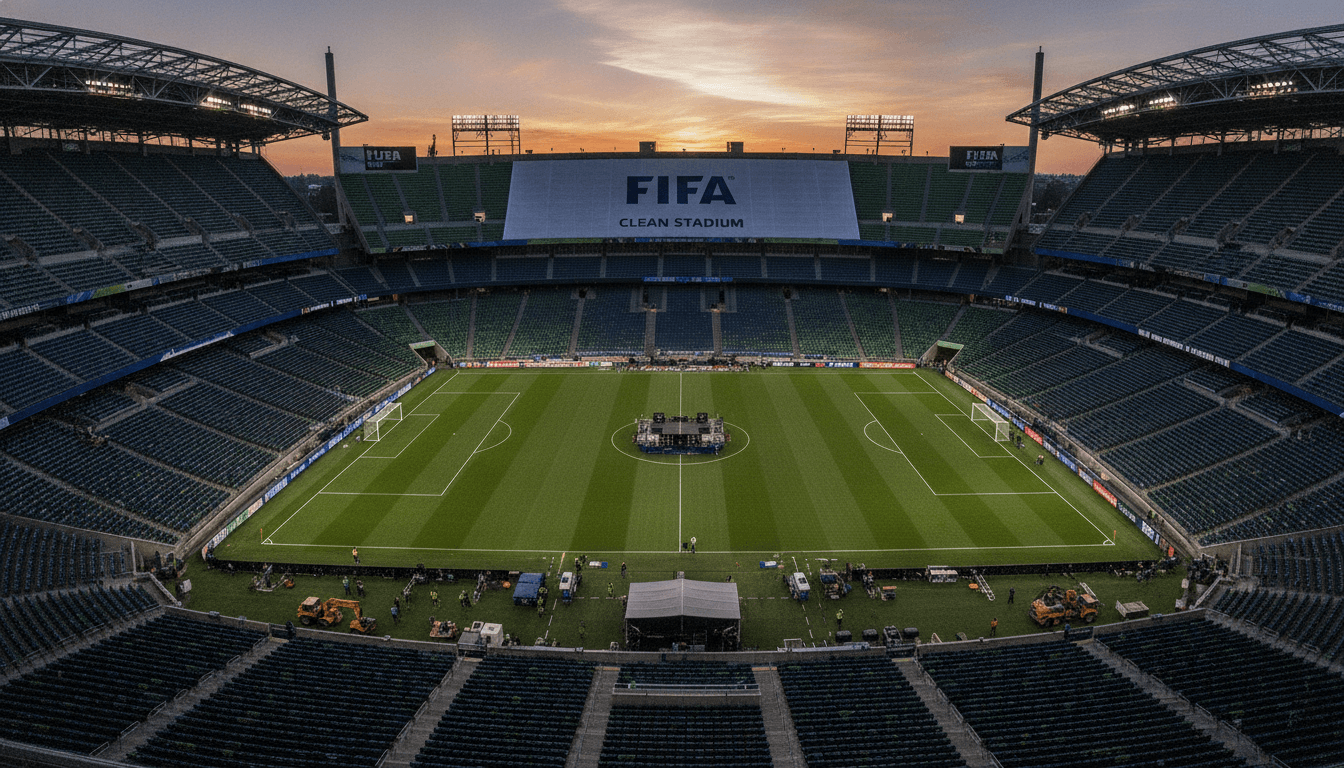
Washington State World Cup costs are projected to reach approximately $120 million, a substantial public investment for the upcoming 2026 FIFA World Cup, according to a recent KUOW analysis. This significant expenditure, primarily channeled into transportation infrastructure and capital improvements at Lumen Field, raises critical questions about the return on investment for taxpayers, even as local officials anticipate considerable economic benefits.
The comprehensive KUOW analysis, which meticulously reviewed budgets from over a dozen major local government agencies, reveals that public funds have already been budgeted or spent on various World Cup-related initiatives. A substantial portion of this funding is directed towards upgrading Lumen Field, which will be rebranded as “Seattle Stadium” during the tournament, and enhancing the region’s transportation network to accommodate an estimated 750,000 visitors.
Local officials, including Governor Bob Ferguson, are optimistic, projecting an $845.6 million economic impact and a $95.8 million boost in tax revenue, as per economic projections commissioned by Visit Seattle and produced by Tourism Economics. However, KUOW’s tabulation indicates that the public entities’ current spending already surpasses the anticipated tax revenue return, sparking debate among stakeholders.
Evaluating World Cup Investment
The strategic approach taken by some cities and organizations is to leverage the World Cup as a catalyst for pre-existing infrastructure needs. Leo Flor, chief legacy officer of SeattleFWC26, the local organizing committee, articulated this philosophy:
“Let’s use this moment, this fleeting moment of global focus, to make lasting local progress.”
This includes projects such as parking lot lighting upgrades and the creation of new public spaces that were deemed necessary irrespective of the tournament.
However, this perspective is not universally shared. Leah Salerno, an organizer with the Protect our Pitch 206 (POP206) community coalition, argues that the perceived economic benefits are often illusory, while the financial burdens and potential social disruptions are very real. “This is all a choice to spend this much money on a one-time event,” Salerno stated, suggesting that the funds could be better allocated to sustainable community development and resident-focused initiatives, such as addressing long-standing maintenance issues like the International District/Chinatown station elevators.
Transportation agencies are a major beneficiary of the World Cup spending. Sound Transit alone is investing over $20 million, with a significant portion dedicated to capital improvements like fixing elevators and escalators at key transit hubs. The Washington state legislature has appropriated $25.25 million in its 2025 transportation budget for grants to local transit agencies, expanded intercity bus services, and additional incident response teams to manage highway traffic. While these upgrades are welcomed, critics like Salerno point out the irony of infrastructure projects being expedited only in the context of a major sporting event.
Lumen Field’s Financial Overhaul
Lumen Field represents the largest single recipient of public funds for the World Cup. FIFA’s stringent requirements necessitate significant financial outlays. This includes $1.85 million in state funds to remove all non-FIFA sponsor branding for the event’s duration and $3.3 million to modify the soccer pitch’s width, according to the Washington State Public Stadium Authority. State grants are also funding the transformation of Lumen Field’s north parking lot into the Gate 1 entrance for “Seattle Stadium,” complete with new gates, security lines, and a “Stadium Fan Experience” area, including infrastructure, lighting, and safety measures.
Not all stadium investments are purely temporary. A state grant-funded storage shed, built after the demolition of old Kingdome cooling towers, will provide valuable long-term benefits. Kathy Brown, managing director of project development at First & Goal Inc., Lumen Field’s operators, noted that this storage space will enable event organizers to be “incredibly” more efficient, allowing for quicker transitions between events. Additionally, the Washington State Legislature appropriated $4.3 million for practice field improvements, including at the University of Washington’s Husky Soccer Stadium.
The local organizing committee, SeattleFWC26, a nonprofit, is tasked with fundraising and reimbursing the City of Seattle for hosting costs. It also funnels donations to community priorities, such as new lighting for a parking lot in the Chinatown-International District, public art, and initiatives supporting the Puyallup Tribe and blind soccer. Despite these efforts, the debate over the overall financial wisdom of the Washington State World Cup costs persists.
As the countdown to the 2026 World Cup continues, the financial ledger for Washington state remains a subject of intense scrutiny. While government officials and tourism bureaus champion the projected economic boon, economists like Wolfgang Maennig, a University of Hamburg expert on mega sporting events, often highlight a discrepancy between initial grand projections and the actual, often more modest, post-event returns. The true financial legacy of the Washington State World Cup costs will only be fully understood once the final whistle blows and the academic analyses begin, offering a sober assessment of whether this significant public investment truly paid off for the state and its residents.