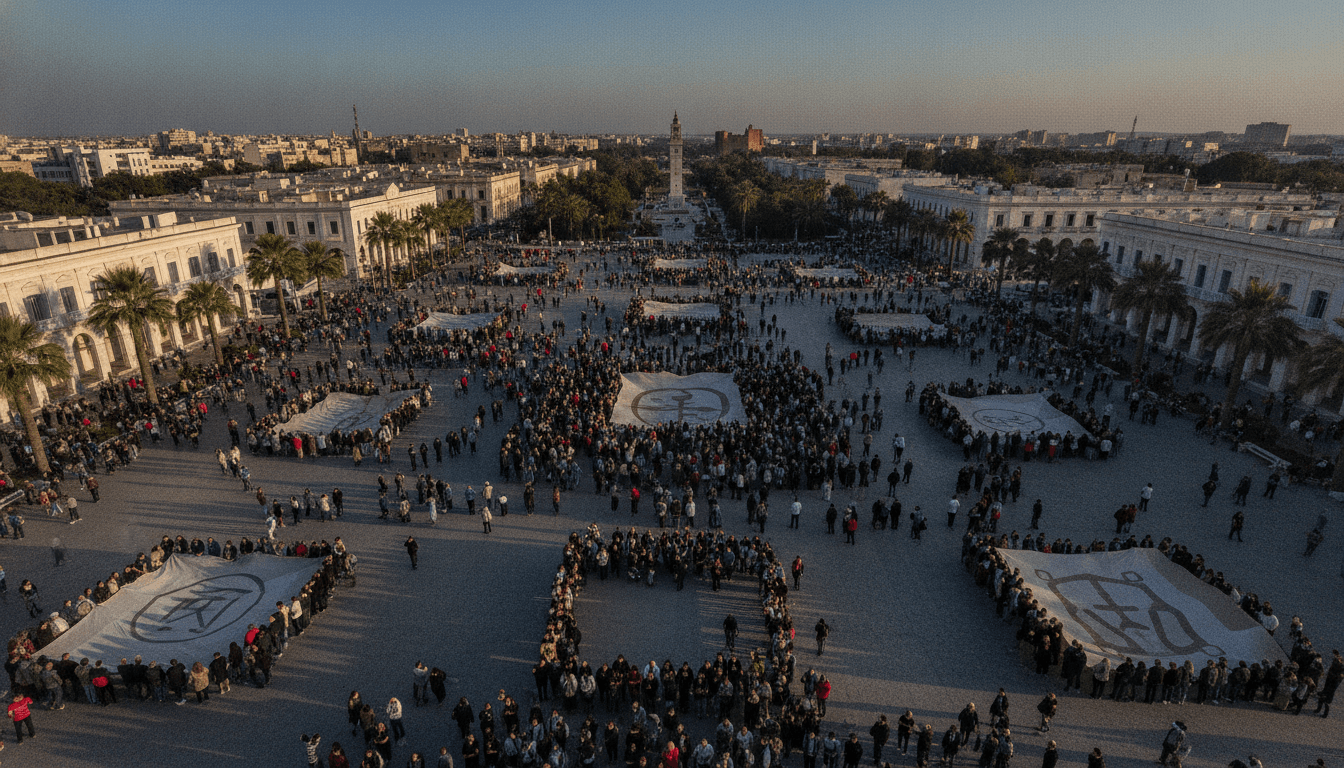
Tripoli protesters grouping in the Libyan capital are drawing international attention, signaling a deepening internal crisis amidst ongoing refugee challenges. On Wednesday, June 10, 2026, reports from the Townpress Newspaper highlighted significant gatherings in Tripoli, underscoring mounting public discontent. These demonstrations are not merely localized grievances but reflect broader frustrations within Libya concerning the management of its substantial refugee population and the humanitarian implications.
The Story: Unpacking Tripoli’s Unrest
The recent surge in public demonstrations in Tripoli centers around the country’s persistent refugee crisis. While specific details on the precise identity of the protesting groups remain sparse in initial reports, their collective action points to widespread dissatisfaction. Libya, a critical transit point for migrants attempting to reach Europe, has long grappled with the immense challenges posed by large numbers of refugees and asylum seekers. The protests suggest a breaking point for segments of the Libyan population, who are likely feeling the direct impact of these demographic pressures, including strains on resources, infrastructure, and social services.
The Townpress Newspaper’s report on June 10, 2026, emphasizes the ‘grouping’ of these protesters, indicating organized or at least coordinated efforts rather than spontaneous, isolated outbursts. This level of organization suggests underlying leadership or a shared grievance strong enough to mobilize significant numbers. The specific focus on the ‘refugee crisis’ as the catalyst is crucial, distinguishing these protests from other forms of political or economic unrest that have periodically plagued Libya since the 2011 uprising. The protests in Tripoli highlight a critical juncture for the transitional authorities in Libya, who are already struggling with political fragmentation and economic instability.
Impact Analysis: A Broader Geopolitical Ripple
The unrest stemming from Tripoli protesters grouping holds significant implications for the broader world news landscape. Libya’s stability is intrinsically linked to regional security, particularly across the Mediterranean and North Africa. Any increase in internal strife, especially that driven by a humanitarian issue like the refugee crisis, can exacerbate existing regional tensions and complicate international efforts to stabilize the country. Europe, in particular, watches Libyan developments closely, given its role as a primary destination for migrants departing from Libyan shores. Renewed instability could lead to an uptick in irregular migration, posing fresh challenges to European border policies and internal politics.
Furthermore, the demonstrations could strain relations between Libya’s interim government and international organizations involved in humanitarian aid and refugee support. If the protests intensify, they could pressure the government to alter its approach to refugee management, potentially leading to more restrictive policies or, conversely, a demand for increased international assistance. The situation could also become a flashpoint for internal political factions, each seeking to capitalize on public sentiment for their own gain, further complicating Libya’s already fragile political transition. Related world news articles often underscore how internal crises in Libya quickly acquire international dimensions.
“The persistent grouping of protesters in Tripoli over the refugee crisis signals a critical domestic pressure point that could unravel fragile international efforts to stabilize Libya and manage migration flows across the Mediterranean.”
Context & Background: Libya’s Enduring Refugee Challenge
Libya’s status as a primary transit country for migrants and refugees from sub-Saharan Africa and the Middle East is well-established. Decades of political instability and porous borders have made it an attractive, albeit dangerous, route to Europe. The post-2011 period saw a significant increase in these flows, overwhelming Libya’s capacity to manage them humanely. Reports from various international bodies have consistently highlighted dire conditions in detention centers and the exploitation faced by refugees and migrants within Libya. This historical context is vital for understanding why the Tripoli protesters grouping are now mobilizing; it is a culmination of years of unaddressed issues.
Previous events include numerous attempts by international organizations to establish more humane processing centers and to repatriate migrants, often with limited success due to the lack of a strong, unified central government. The economic hardship faced by many Libyans themselves, coupled with the perceived burden of a large refugee population, creates a fertile ground for resentment and protest. The current demonstrations are not an isolated incident but rather the latest manifestation of a long-simmering humanitarian and political crisis.
What’s Next: Future Implications and Decisions
The immediate future will likely see increased scrutiny on Libya’s transitional authorities to address the concerns of the Tripoli protesters grouping. There may be calls for clearer policies regarding refugee management, potentially including demands for greater international aid or changes in cooperation agreements with European nations. The international community, particularly the European Union, will be closely monitoring the situation for any signs of escalating violence or further destabilization that could impact migration flows. Upcoming decisions could involve new diplomatic initiatives to bolster Libya’s capacity to manage its borders and provide for refugees, or a re-evaluation of current strategies.
Predictions suggest that if the protests are not adequately addressed, they could evolve into a broader anti-government movement, further jeopardizing Libya’s precarious path to national elections and political unification. The humanitarian aspect of the crisis will remain central, with continued pressure on all parties to ensure the safety and dignity of refugees and migrants. The June 10, 2026, report from Townpress Newspaper serves as a timely warning that the refugee crisis in Libya is not merely a humanitarian challenge but a significant driver of internal political unrest.
Key Takeaway: A Catalyst for Change
The emergence of Tripoli protesters grouping around the refugee crisis underscores a critical intersection of humanitarian concerns, domestic politics, and international relations. This development is not just a local news story but a powerful indicator of the deep-seated challenges confronting Libya and, by extension, the wider Mediterranean region. The protests serve as a potent reminder that unresolved humanitarian issues can quickly become catalysts for social unrest and political instability, demanding a concerted and comprehensive response from both national authorities and the international community to prevent further deterioration and ensure a path towards sustainable peace and stability.