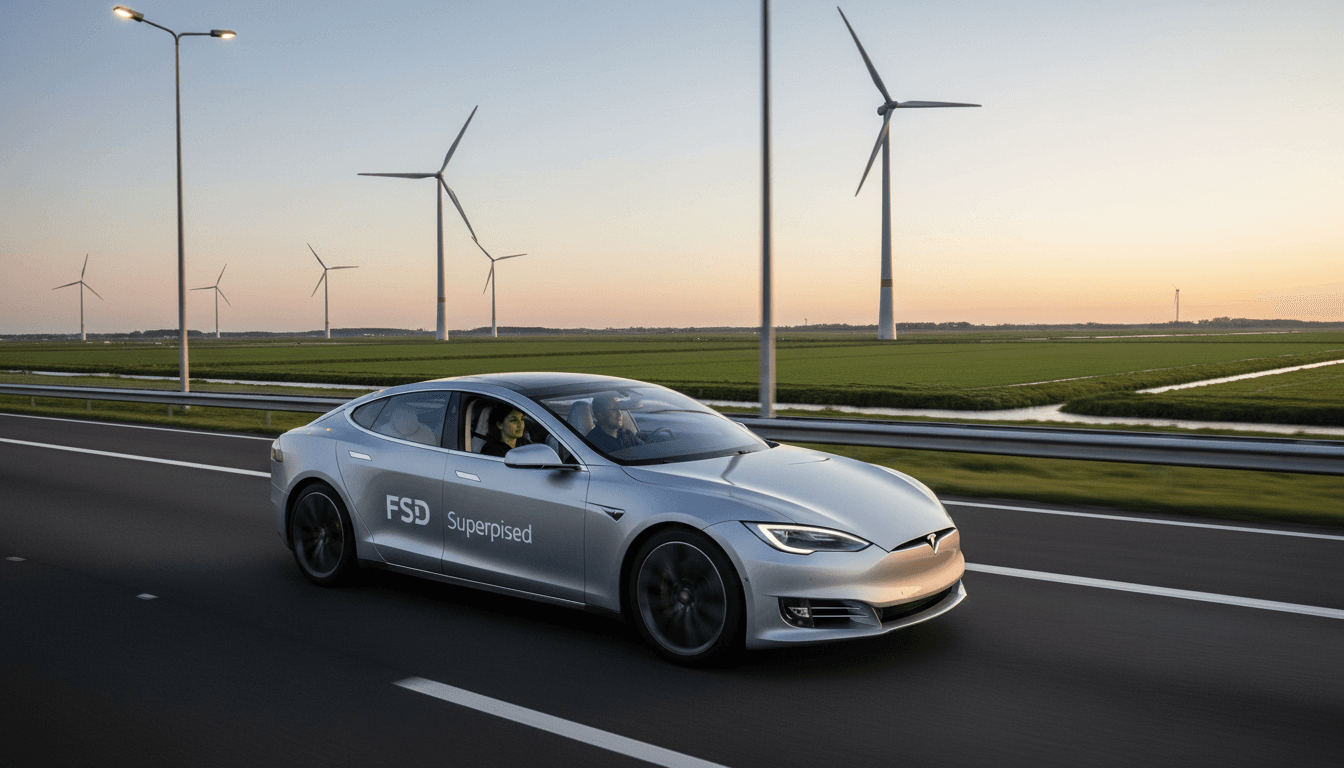
Netherlands approves Tesla FSD Supervised, marking a pivotal moment as the first European country to officially authorize the use of Tesla’s Full Self-Driving (FSD) Supervised technology on its roads. This groundbreaking announcement came from the Dutch regulators, the RDW, following an extensive testing period spanning over a year and a half. The move is anticipated to significantly influence the broader adoption of FSD across the European Union, potentially accelerating the continent’s embrace of advanced autonomous driving systems.
The RDW’s rigorous evaluation process, a standard for vehicle homologation in the Netherlands, focused on ensuring the safety and reliability of Tesla’s FSD Supervised system under various real-world driving conditions. This approval is not just a win for Tesla but a significant leap for the entire autonomous vehicle industry in Europe, demonstrating a clear regulatory pathway for advanced driver-assistance systems (ADAS) to transition from testing to widespread consumer use.
The Path to European Adoption
The Netherlands’ decision could act as a crucial precedent for other EU member states. Given the harmonized regulatory environment within the European Union, an approval in one key country often paves the way for similar authorizations elsewhere. Tesla’s European headquarters, strategically located, is likely to leverage this Dutch approval in discussions with other national transport authorities, aiming to streamline the regulatory process across the bloc. The economic implications for the automotive sector and related industries, such as insurance and urban planning, are substantial.
“This RDW approval is a game-changer for autonomous driving in Europe, setting a clear benchmark for safety and regulatory compliance.”
As the technology matures, the debate around the societal impact of autonomous vehicles, including job displacement in the transportation sector and ethical considerations, will intensify. However, the immediate focus remains on the safety benefits and potential for increased efficiency and reduced traffic congestion that FSD promises.
Netherlands Approves Tesla FSD Supervised: What’s Next?
The immediate impact of the Netherlands approves Tesla FSD Supervised decision will be felt by Tesla owners in the country, who will now have legal access to the supervised FSD features. For the rest of Europe, this signals a potential acceleration of FSD availability. Regulators across the continent will be closely observing the Dutch experience, evaluating the practical implementation and public reception of the technology. This could lead to a domino effect, with more countries granting similar approvals in the near future.
This development is particularly relevant for the related Tech news sector, highlighting the increasing convergence of software and automotive engineering. The regulatory framework for such advanced systems is still evolving, and the Dutch model offers a valuable blueprint for future approvals.
Economic and Technological Implications
The economic implications of widespread FSD adoption are vast. From reducing logistics costs for businesses to transforming personal mobility, the technology holds the potential to reshape industries. Tesla’s valuation and market position could see a significant boost if European expansion for FSD Supervised proves successful. The competition among automakers to develop and deploy their own autonomous driving solutions will undoubtedly intensify, driving further innovation in the sector.
The RDW’s thorough testing included evaluations of the system’s ability to handle complex urban environments, varying weather conditions, and interactions with human drivers and pedestrians. This comprehensive approach ensures that the Netherlands approves Tesla FSD Supervised with a robust understanding of its capabilities and limitations, fostering public trust in the technology.
The approval of Tesla’s FSD Supervised by the Netherlands marks a crucial regulatory milestone, not just for Tesla but for the entire autonomous vehicle industry in Europe. This decision is poised to accelerate the adoption of advanced self-driving technology across the continent, prompting a significant shift in transportation, regulation, and technological innovation. The coming months will be critical in observing how other European nations respond to this pioneering move.