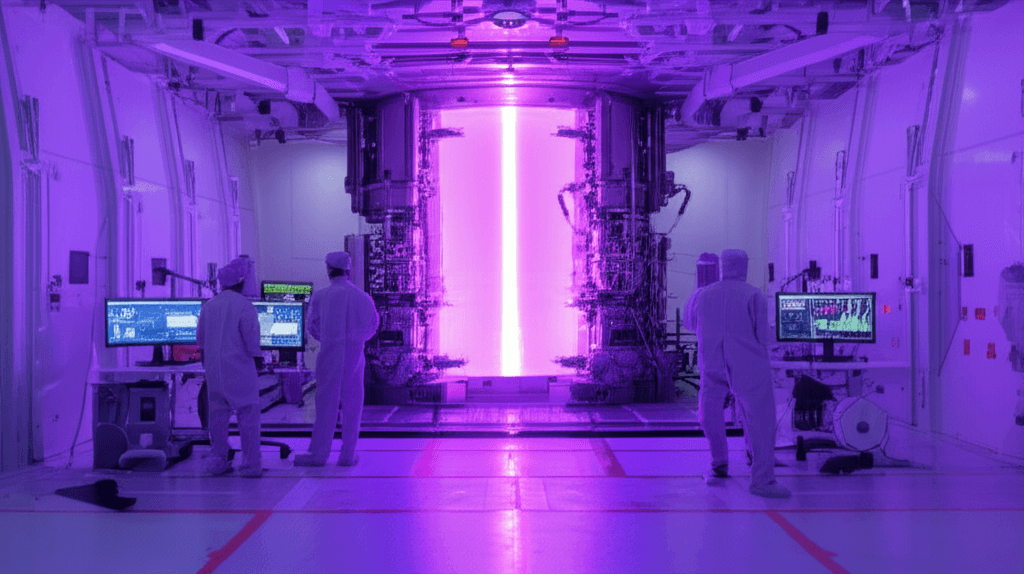
Fusion power is inching closer to reality, and a major milestone was just reached. Fusion power plant developer Helion announced Friday that its Polaris prototype reactor has achieved plasma temperatures of 150 million degrees Celsius, a critical step toward commercialization. The Everett, Washington-based company is racing to meet its ambitious 2028 deadline for delivering power to Microsoft.
“We’re obviously really excited to be able to get to this place,” David Kirtley, Helion’s co-founder and CEO, told TechCrunch. This achievement positions Helion as a frontrunner in the quest for a potentially unlimited source of clean energy.
Helion Hits Blistering Temperatures
Helion’s Polaris reactor is also notable for operating using deuterium-tritium fuel, making it the first fusion company to do so. Kirtley noted that this allowed them to observe a dramatic increase in fusion power output in the form of heat.
The race to commercialize fusion power is attracting significant investment. Inertia Enterprises recently secured a $450 million Series A round, while Type One Energy is in the process of raising $250 million. Helion itself raised $425 million last year. While most fusion startups aim for the early 2030s, Helion’s contract with Microsoft sets a much earlier target.
The Unique Approach to Fusion Energy
Helion’s reactor design, a field-reversed configuration, differs from tokamaks used by companies like Commonwealth Fusion Systems. The hourglass-shaped chamber injects and turns fuel into plasma, which is then accelerated and compressed by powerful magnets. Instead of extracting energy as heat, Helion aims to directly convert the fusion reaction’s magnetic field into electricity. This approach promises higher efficiency.
“We focus on the electricity piece, making electricity, rather than the pure scientific milestones.”
Over the past year, Helion has refined the reactor’s circuits to improve electricity recovery. While currently using deuterium-tritium fuel, the company plans to transition to deuterium-helium-3, which produces more charged particles and is better suited for direct electricity generation.
Fueling the Future: Helium-3 Production
Helion’s ultimate goal is to achieve plasma temperatures of 200 million degrees Celsius, optimizing power plant operation. The company is also actively working on refining its fuel cycle, including producing helium-3, which is scarce on Earth but abundant on the Moon. Helion plans to initially produce helium-3 by fusing deuterium nuclei, then purify and reuse it from deuterium-on-deuterium reactions.
Kirtley hinted at the possibility of selling helium-3 to other fusion companies in the future, anticipating increased demand as they pursue direct electricity recovery methods. Alongside Polaris, Helion is building Orion, a 50-megawatt fusion reactor needed to fulfill its contract with Microsoft. “Our ultimate goal is not to build and deliver Polaris,” Kirtley said. “That’s a step along the way towards scaled power plants.”
The Financial Implications of Fusion Power
The success of companies like Helion has significant financial implications. The promise of clean, abundant fusion power is driving investment and innovation in the sector. Achieving scientific breakeven is a key goal, but Helion is focused on generating electricity and scaling up its technology. The potential for direct electricity recovery offers a competitive advantage, making fusion power a potentially disruptive force in the energy market. The race to harness fusion power is not just a scientific endeavor, but also a financial one, with billions of dollars at stake and a potential to reshape the global energy landscape. You can find more related Tech news on our website.
Source: TechCrunch