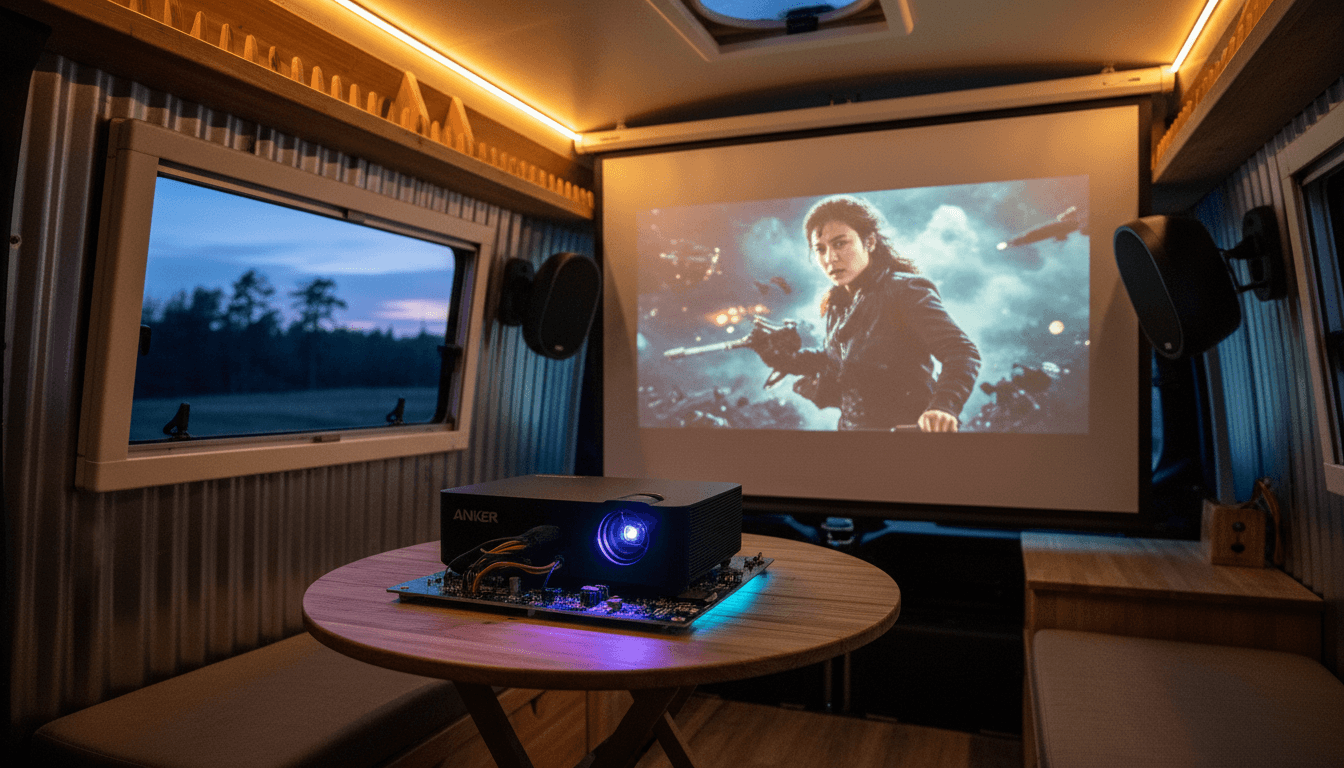
The Anker Nebula P1 is the portable sound king, redefining expectations for compact projectors by prioritizing immersive audio experiences over raw brightness or battery life. While not the brightest or most battery-independent Google TV projector on the market, the Nebula P1 distinguishes itself with an unparalleled sound system, featuring unique detachable speakers that deliver true left- and right-channel separation.
Launched by Anker’s Soundcore brand, the Nebula P1 is currently priced at $799, with a promotional sale bringing it down to $639. This device caters to a niche but growing market of users who prioritize rich audio in their mobile entertainment setups, such as ‘vanlife’ enthusiasts or those seeking flexible outdoor movie nights. Unlike competitors like the TCL PlayCube or Xgimi MoGo, which offer integrated, often less robust sound, the P1’s innovative speaker design sets a new benchmark for portable audio quality.
Unpacking the Anker Nebula P1’s Audio Prowess
The standout characteristic of the Anker Nebula P1 is undeniably its audio system. The projector features a pair of 10W speakers that magnetically detach from the main unit. This ingenious design allows users to position the speakers strategically, creating a much wider and more immersive soundstage than is typically possible with all-in-one portable projectors. This separation ensures that audio emanates from where the visual action is taking place, rather than from the projector itself, which is often positioned near the viewer.
“The detachable speakers of the Nebula P1 genuinely transform the portable viewing experience, delivering a sound quality that far surpasses typical integrated projector audio systems.”
While the sound profile is excellent for its size, offering clear highs and mids, bass-heavy tracks might feel a little thin due to the absence of a built-in subwoofer, a feature found in Anker’s larger, more expensive Nebula X1 and X1 Pro models. However, for most genres, the audio clarity and spatial separation are remarkable for a device weighing just 5.3 pounds. Furthermore, the speakers boast an IP54 resistance rating, protecting them from dust and splashing rain, making them suitable for outdoor use, while the projector itself carries a more modest IP33 rating.
Connectivity and Performance: A Trade-off for Sound
Despite its audio focus, the Nebula P1 delivers a respectable 1080p image from its 650 ANSI Lumens LED light source. This resolution remains the standard for portable projectors in its class, providing an enjoyable viewing experience in dark environments. While it struggles against strong ambient light, it can still produce a watchable image in a partially lit setting, such as inside a van during the day when focused tightly.
A notable omission, however, is the lack of a built-in battery. This means the Anker Nebula P1 requires a continuous power source, whether a wall outlet or a substantial USB-C power bank capable of delivering 100W. This dependency on external power is a significant trade-off for its enhanced audio capabilities and compact design, distinguishing it from truly self-contained portable projectors like the TCL PlayCube. For a two-and-a-half-hour film, a typical 99Wh power bank would likely fall short, necessitating a charging break.
Discover more related Tech news covering the latest innovations.
Smart Features and User Experience
The Nebula P1 runs on Google TV, offering official Netflix support and a familiar, user-friendly interface. It boots from a cold start in about 50 seconds and wakes from sleep in a swift 5 seconds, consuming a minimal 6W in sleep mode. The projector also doubles as a Bluetooth speaker, allowing users to enjoy its superior audio without needing the projection lamp active. This versatility adds significant value, making it a great option for music lovers on the go.
Anker claims the P1 features Intelligent Environment Adaptation (IEA) 4.0 for automatic focus, keystone correction, obstacle avoidance, and screen fitting. However, real-world testing suggests these automated features can be inconsistent, particularly with screens lacking black borders. Users may find themselves relying on Anker’s ‘VisionFit’ tech via the Nebula Connect app for more reliable calibration, which can feel less seamless than anticipated.
In conclusion, the Anker Nebula P1 is the portable sound king, offering a compelling proposition for those who prioritize audio fidelity in their mobile projection setup. While its reliance on external power and occasional quirks in automated setup might deter some, its exceptional detachable speakers and Google TV integration make it a strong contender for vanlife adventurers and anyone seeking a superior sonic experience from a compact projector.