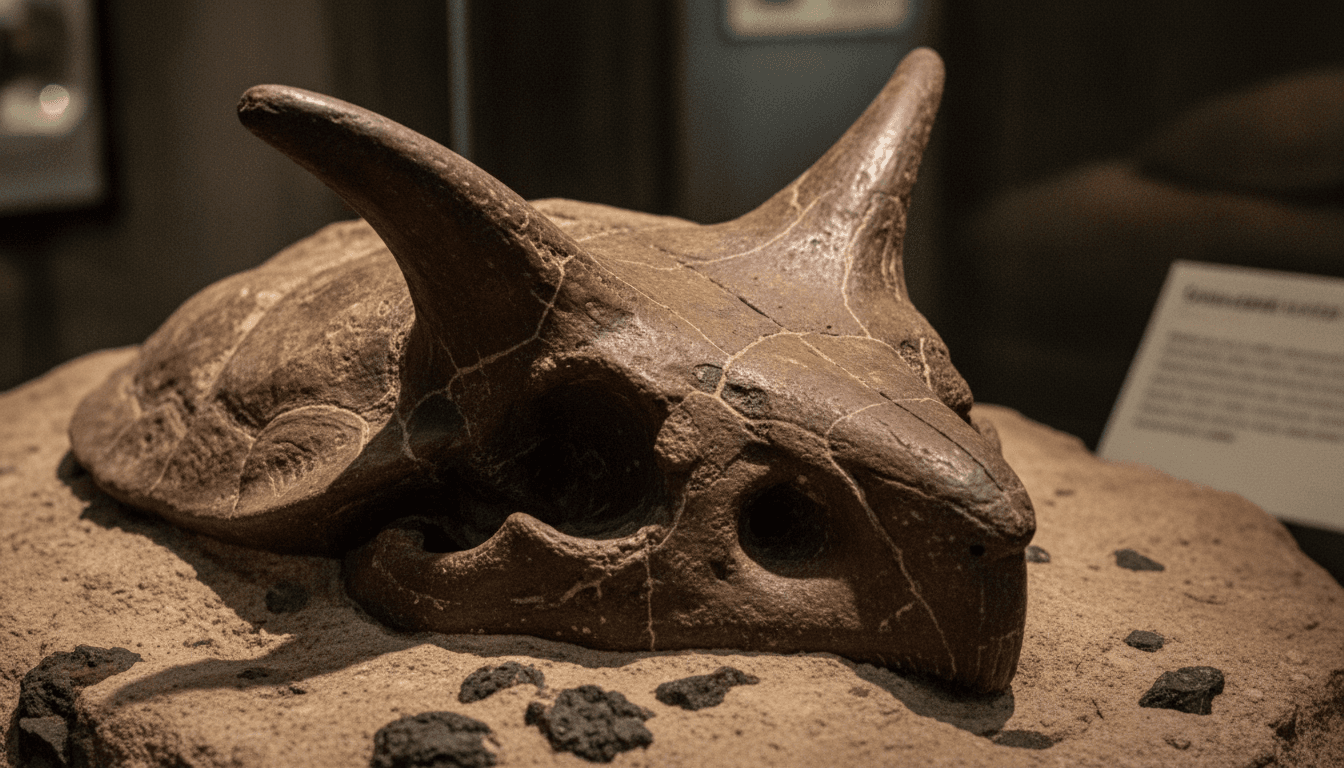
A new horned turtle species has been unearthed in Patagonia, marking a significant advancement in our understanding of ancient chelonian evolution. The discovery, announced on Wednesday, June 10, 2026, by Sci.News, provides crucial insights into the biodiversity of South America during prehistoric eras and challenges existing timelines for the diversification of these armored reptiles. This fossil discovery in Patagonia underscores the region’s continued importance as a hotbed for paleontological research, revealing previously unknown lineages that once roamed its ancient landscapes.
The Unveiling of an Ancient Resident
The recent fossil discovery in Patagonia details the identification of a previously unknown species of horned turtle. While specific names of researchers or institutions were not detailed in the initial announcement, the nature of such a find typically involves international collaborations between paleontologists, geologists, and evolutionary biologists. The discovery itself involved the meticulous excavation and subsequent analysis of fossilized remains, likely including carapace fragments, skull elements, and potentially limb bones, which collectively allowed for the definitive classification of a new species characterized by distinct horn-like protrusions – a feature common among certain extinct turtle lineages but always noteworthy for its implications on defense mechanisms and environmental pressures.
This new horned turtle species adds a fascinating chapter to the paleontological record of Patagonia, a region renowned for its rich fossil beds. The exact age of the fossil was not specified, but the context of such discoveries in Patagonia often places them within the Mesozoic or Cenozoic eras, periods known for significant reptilian diversification. The presence of horn-like structures suggests adaptations to specific predatory pressures or perhaps even intraspecific display behaviors, offering tantalizing clues about its ecological role in ancient Patagonian ecosystems.
Impact Analysis: Reshaping Chelonian Phylogeny
The identification of a new horned turtle species in Patagonia carries substantial implications for the broader fields of paleontology and evolutionary biology. This find contributes directly to refining the phylogenetic tree of chelonians, the order encompassing all turtles and tortoises. Each new species discovered acts as a data point, helping scientists to trace evolutionary pathways, identify common ancestors, and understand the timing and mechanisms of diversification across different continents.
Furthermore, the unique characteristics of this horned turtle, particularly its defensive cranial adornments, offer insights into the co-evolutionary arms race between predators and prey in ancient South American environments. Understanding these adaptations can shed light on the pressures faced by these animals and how they evolved to survive. This discovery not only enriches our knowledge of past biodiversity but also provides comparative data for studying extant species and their conservation challenges. Related science & space articles often highlight how ancient discoveries inform modern ecological understanding.
“Every new species unearthed in a region as historically rich as Patagonia offers a fresh perspective on the complex tapestry of life that once thrived, pushing us to re-evaluate our established models of evolution and biogeography.”
Context and Background: Patagonia’s Paleontological Riches
Patagonia, a vast geographical region shared by Argentina and Chile, has long been a treasure trove for paleontologists. Its unique geological history, characterized by ancient marine transgressions, volcanic activity, and uplift, has created ideal conditions for the preservation of fossils spanning hundreds of millions of years. The region has yielded an extraordinary array of dinosaur fossils, ancient mammals, and marine reptiles, establishing it as a critical site for understanding Gondwanan ecosystems.
Previous discoveries in Patagonia have included some of the largest dinosaurs ever found, such as Argentinosaurus, as well as remarkably preserved early mammals and diverse avian species. The consistent unearthing of new species, like this horned turtle, reinforces Patagonia’s status as a ‘living laboratory’ for evolutionary studies. The geological strata of Patagonia often provide excellent temporal resolution, allowing scientists to place discoveries within precise chronological frameworks, which is crucial for building accurate evolutionary narratives. This latest fossil discovery in Patagonia continues a long tradition of significant finds.
What’s Next: Further Research and Exhibition
The immediate next steps following such a fossil discovery in Patagonia typically involve extensive laboratory work. Researchers will likely conduct detailed morphological analyses, comparative studies with known turtle species, and potentially isotopic analyses to infer diet and habitat. Further field expeditions in the same region may also be planned to search for additional specimens or associated fauna that could provide a more complete picture of the ancient ecosystem this horned turtle inhabited.
Beyond scientific publication, there is a strong possibility that this new species will eventually be prepared for public exhibition in museums, allowing the general public to witness a tangible piece of Earth’s ancient past. Such exhibitions play a vital role in science communication, inspiring future generations of scientists and fostering a deeper appreciation for natural history. The implications of this discovery could also prompt a re-evaluation of existing theories on turtle migration patterns and their geographical distribution across ancient landmasses.
Key Takeaway: Expanding the Tree of Life
The fossil discovery in Patagonia of a new horned turtle species is more than just an addition to a species list; it is a critical piece in the grand puzzle of life’s evolution. It underscores the immense biodiversity that once existed on Earth and the continuous process of scientific discovery that expands our understanding of the planet’s history. Each such find refines our models, challenges our assumptions, and highlights the invaluable role of regions like Patagonia in preserving the fossil record. This particular discovery reinforces the idea that even in well-explored regions, significant new insights into ancient life forms, like this horned turtle, are still waiting to be unearthed, providing a richer, more detailed narrative of life’s enduring journey.