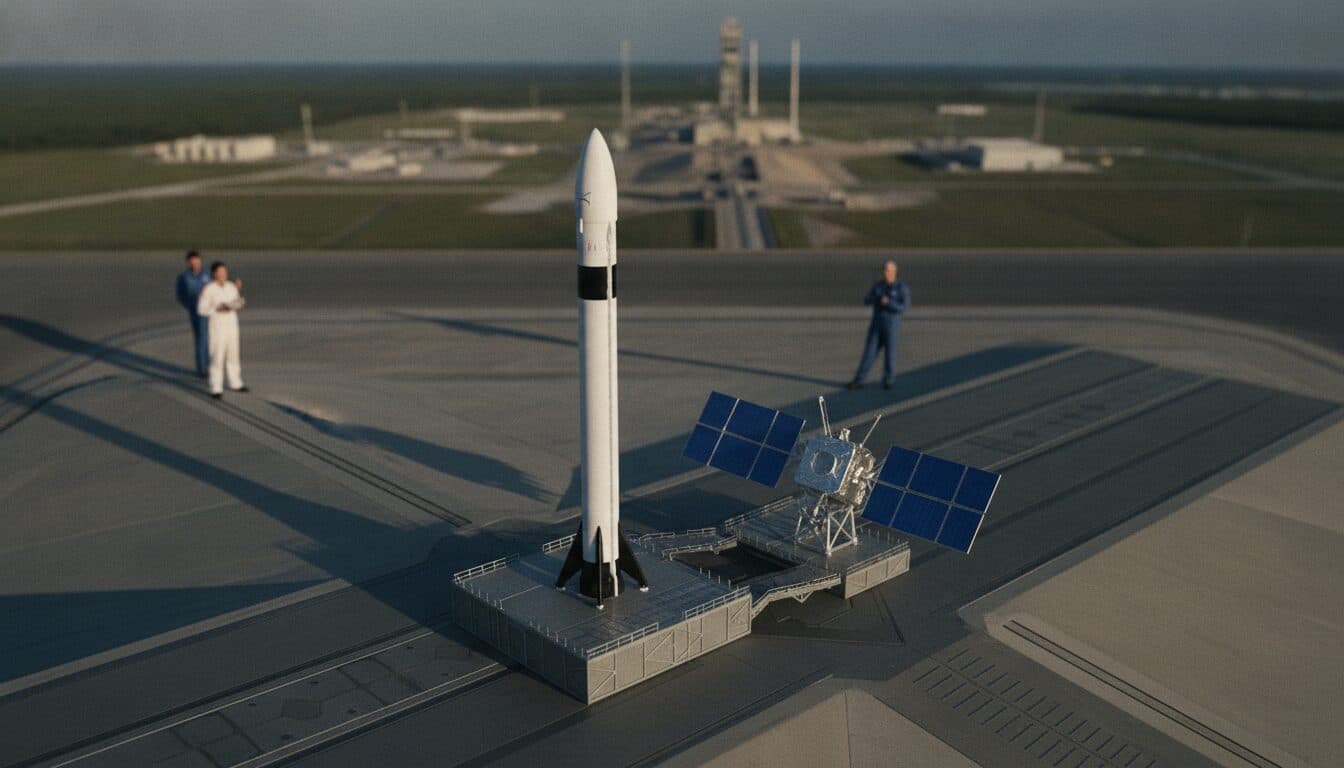
Cryptocurrency billionaire Chun Wang, a prominent figure in private spaceflight, has been tapped to lead an ambitious Mars flyby mission for SpaceX, marking a significant stride towards interplanetary human exploration. This announcement, made by SpaceX in May, positions Wang, who successfully commanded the Fram2 mission in 2025, at the forefront of humanity’s deepest venture into space yet. The planned two-year voyage aims to send a crew of private astronauts around Mars without landing, before their eventual return to Earth, representing the first crewed interplanetary spaceflight ever.
Who is Cryptocurrency Billionaire Chun Wang?
Chun Wang’s name gained international recognition in April 2025 when he led the trailblazing Fram2 mission. Launched aboard a SpaceX Falcon 9 rocket and Dragon capsule from the Kennedy Space Center in Florida, Fram2 undertook a four-day journey around Earth’s poles. This pioneering polar voyage made Wang and his crew the first humans to fly in orbit over both the North and South poles, culminating in a water landing off the coast of California. Wang, a Malta-based entrepreneur of Chinese origin, amassed his fortune through Bitcoin mining pools, and personally financed the Fram2 mission with an undisclosed sum. His vision extends beyond Earth orbit, as evidenced by his recent statement during a scrubbed Starship launch attempt webcast:
“Mars will no longer become a distant place, it will become a reality. It will light the fire, it will ignite the imagination and it will build momentum.”
SpaceX’s Interplanetary Ambitions and Starship’s Role
The Mars flyby mission is not SpaceX’s only deep-space endeavor. Prior to the Martian expedition, the company plans a separate lunar flyby mission, aiming to send a private crew much closer to the moon’s surface – less than 125 miles from the ground – significantly closer than NASA’s Artemis II mission’s 4,067 miles. Both these ambitious missions will leverage SpaceX’s massive Starship rocket. This 407-foot spacecraft, which made its 12th overall flight test in May 2026, is central to Elon Musk’s long-held dream of “making life interplanetary.” While Musk recently revealed plans for building a self-growing city on the moon in the next decade, his interplanetary objective for Mars remains firmly on the agenda. However, a specific timeline for these missions has not been announced, and the Starship has yet to achieve orbit on any of its test flights. The Version 3 (V3) design of the rocket is expected to achieve orbit and demonstrate mid-flight refueling capabilities crucial for deeper space missions.
Broader Implications for Private Spaceflight and NASA Partnerships
The selection of a private citizen like Chun Wang to lead such groundbreaking missions underscores the accelerating shift towards commercial entities playing a pivotal role in space exploration. This move by SpaceX highlights the growing intersection of private capital, technological innovation, and ambitious spacefaring goals. It also positions SpaceX as a key partner for governmental agencies, particularly NASA. SpaceX is currently under contract with NASA to develop a lunar lander configuration of Starship’s upper stage for upcoming Artemis moon landings. NASA aims to potentially test this lunar lander in Earth orbit during Artemis III in 2027, with a landing attempted during Artemis IV, targeted for 2028. This synergy between private ventures and public space agencies is reshaping the future of human presence beyond Earth. For more on the evolving landscape of space exploration, read our related science & space articles.
The Path Ahead: Starship’s Development and Florida Launch Prospects
While the prospect of a human-led Mars mission is electrifying, critical developmental milestones remain. Starship’s repeated test flights from SpaceX’s Starbase headquarters in South Texas have yet to culminate in an orbital success. The successful demonstration of orbital flight and in-space refueling is paramount for enabling missions to Mars and the moon. In parallel, SpaceX is actively expanding its Starship operations to Florida’s Space Coast. The U.S. Space Force has indicated that Florida’s first landmark Starship launch from NASA’s Kennedy Space Center could occur in late summer or early fall of 2026. This expansion includes readying long-term launch and landing operations at Kennedy Space Center’s Launch Complex 39A and Launch Complex 37 at the neighboring Cape Canaveral Space Force Station. The potential for future interplanetary missions to launch from Florida adds another layer of excitement to the state’s storied space history.
The announcement of Chun Wang leading a Mars flyby mission represents a bold declaration of intent from SpaceX, pushing the boundaries of human endurance and technological capability. While significant engineering and operational challenges lie ahead, the commitment to such a monumental undertaking, spearheaded by a private individual, signals a new era in space exploration where audacious visions are increasingly within reach. The convergence of private funding, cutting-edge rocket technology, and a renewed human desire to venture further into the cosmos promises to redefine our place in the universe.