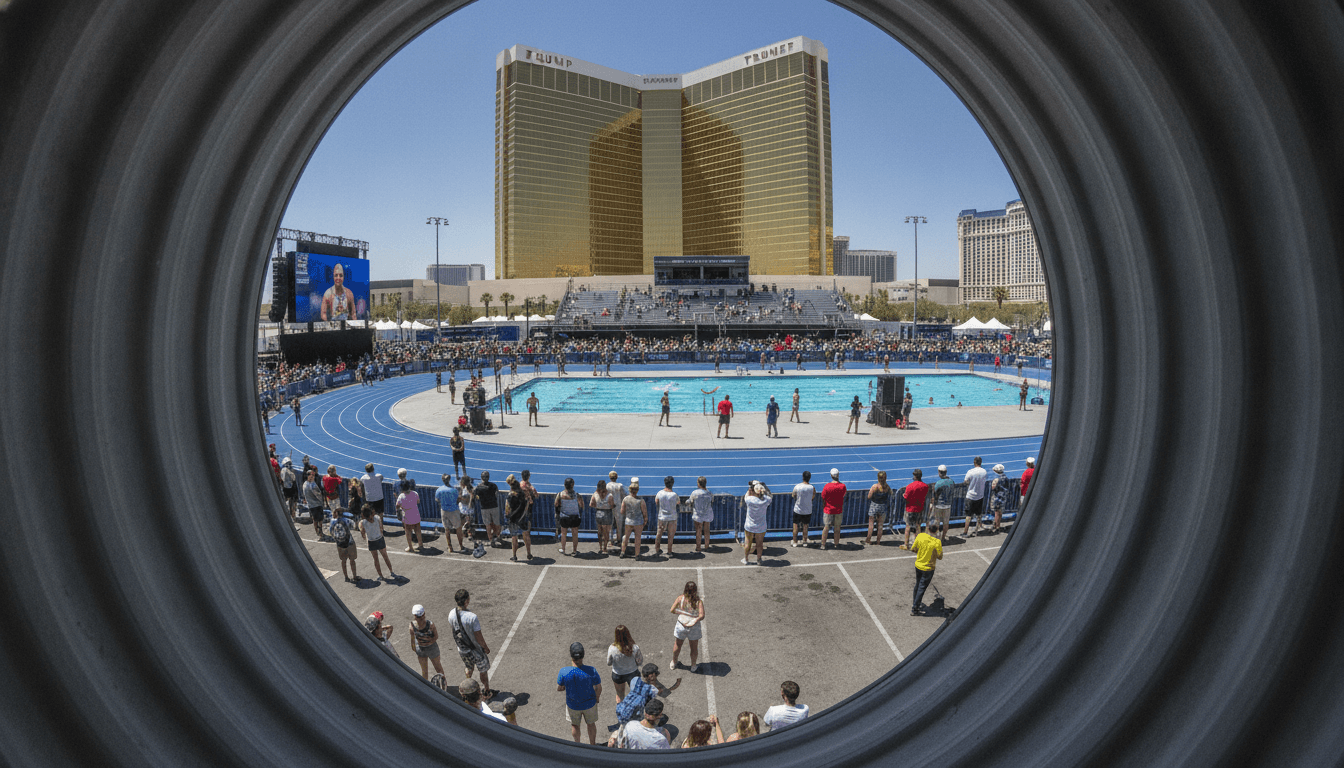
Enhanced Games ignite debate on human enhancement, sporting ethics, and the future of athletic competition, as a libertarian thought experiment comes to life in a Las Vegas casino parking lot. The inaugural event, held on Sunday, May 24, encouraged participants to use performance-enhancing drugs, challenging long-held sporting norms and sparking intense discussion among critics and proponents alike.
A galaxy of substances, from testosterone and human growth hormone to Meldonium and various synthetic hormones, coursed through the bloodstreams of swimmers, sprinters, and weightlifters. Millions of dollars were on the line for athletes who could break world records, potentially ushering in an age of ‘superhumanity.’ While founders claim to be building a world where people can live ‘better, longer lives,’ detractors decry the event as an embarrassment that glamorizes dangerous substances and risks lives.
The Spectacle of Enhanced Performance in Las Vegas
The open-air venue was a vibrant blue spectacle, featuring a six-lane track, an Olympic-length swimming pool, and a weightlifting platform, all set against the backdrop of the Trump Hotel. The atmosphere mimicked an NFL game, complete with loud music, crowd work, and a ‘flex cam’ for muscled athletes. Between events, adverts promoted the Enhanced company’s performance products, including injectable peptides for cellular energy and skin elasticity, and daily supplement powders like ‘Stronger’ and ‘Longer.’ Australian swimmer James Magnussen, the first athlete to sign up, finished last in his two events, failing to break any world records.
The day began with weightlifters under the blazing sun, but by 4 p.m., only one had attempted a world-record lift, and two had pulled out injured. Interestingly, some athletes competed without drugs purely for the prize money. As the competition progressed, these ‘natural’ athletes often outperformed their enhanced peers. Hunter Armstrong, a 25-year-old American triple Olympic medalist, won the backstroke by over a second. Fred Kerley, a non-enhanced US sprinter, easily won the men’s 100-meter sprint, quipping, “Man, they gotta do better than that. They need to train a little harder, get on that shit a little bit more.”
“What I saw in Las Vegas probably wasn’t the future of sport. But it was a perfect encapsulation of our present moment, as Silicon Valley biohackers, alt-right looksmaxxers, Make America Healthy Again boosters, and longevity-obsessed scientists all vie to remake reality in their own image.”
The event drew a diverse crowd, from bodybuilders discussing their ‘stacks’ to VCs and finance bros exchanging LinkedIn details. Lukas Lakutsin, a 6-foot-10, 354-pound Russian bodybuilder, claimed not to use performance-enhancing drugs, except for testosterone replacement therapy, which he didn’t believe counted. “I’m almost 34 years old,” he stated, “I need to do this to stay strong.” The ‘protocol’ for Enhanced athletes only included FDA-approved drugs, with individuals having the final say on their chosen substances.
From Disruptive Idea to $1.2 Billion Company
The journey of the Enhanced Games began in December 2022 when Australian entrepreneur Aron D’Souza pitched his disruptive idea to Peter Thiel. Inspired by the open secret of steroid use in workout culture versus its taboo in official sports, D’Souza envisioned a grand sporting event where competitors could take any substance they desired. His initial, provocative pitch aimed to challenge the International Olympic Committee and reinvent sports.
The project gained significant momentum with the involvement of German biotech billionaire Christian Angermayer, who saw an opportunity to redefine medicine by shifting its focus from disease treatment to active health enhancement. Angermayer brought in anti-aging expert Dr. Michael Sagner to head the medical commission and Max Martin to manage event logistics. While D’Souza’s freewheeling style sometimes clashed with the more sensible image the new team sought to project, his outrageousness often garnered more attention, propelling the concept forward.
The notion of a “steroid Olympics” had been discussed for decades, but two key factors brought the Enhanced Games to fruition. First, the 2024 re-election of Donald Trump created a more receptive political environment, leading to a new funding tranche led by 1789 Capital, a venture capital firm associated with Donald Trump Jr. Second, in February 2025, a crucial moment arrived when Bulgarian-Greek swimmer Kristian Gkolomeev, an enhanced athlete, broke the 50-meter freestyle world record, securing a million-dollar payout from Enhanced. This achievement, two-hundredths of a second under the previous record, served as a powerful validation of the enhancement project’s core premise.
The Enhanced Games ignite debate about the intersection of sport, science, and ethics, offering a glimpse into a future where medical advancements push human limits. While the event’s long-term impact on mainstream sports remains uncertain, it undeniably reflects a broader cultural moment where biohacking and longevity pursuits are gaining significant influence. The question remains: what does this mean for the rest of us, and are the founders truly right about the future of human potential?