
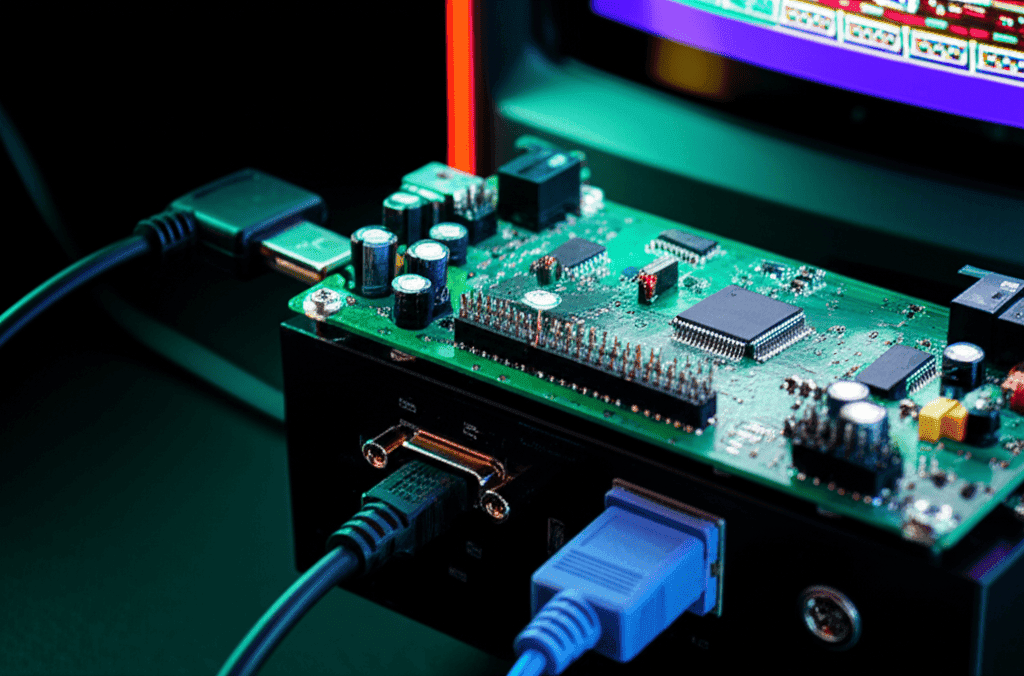
The **USB to VGA** converter market is seeing exciting innovations, and one recent project highlights the potential for customized solutions. Adapters and dongles are commonplace for connecting various display standards, but what happens when you need something truly unique? [Stephen] tackled this challenge by creating a custom USB to VGA converter for an arcade cabinet with an unusual resolution of 336 by 262 pixels. His journey, detailed in his blog, offers valuable insights for anyone working with display technology.
Stephen’s project involved exploring RP2040 PIOs, resistor ladder DACs, and even creating custom kernel modules. Eventually, he landed on GUD, a USB display protocol with its own upstreamed Linux kernel driver. While GUD is typically used with Raspberry Pis to drive LCD or HDMI displays, Stephen implemented it on an STM32 series microcontroller. The result? A standalone GUD-based **USB to VGA** converter capable of delivering excellent color depth at the required resolution, and potentially others as well.
The Quest for Perfect Display Resolution
The initial problem was the arcade cabinet’s non-standard resolution. While a resolution of 320 by 240 could be forced, the visual quality suffered. Most readily available dongles simply couldn’t handle the specific requirements of this vintage display. This sparked the need for a custom solution and a deep dive into display technology and interfacing.
Understanding GUD for Video Output
GUD, or Generic USB Display, is a protocol designed to allow simple devices to act as displays via USB. It provides a standardized way for a host computer to send video data to a device, which then handles the actual display output. Stephen’s clever adaptation demonstrates its versatility beyond its original intended use case. It is a testament to open-source and ingenuity.
Building the Best USB to VGA Converter
The project wasn’t without its challenges. PCB routing proved particularly tricky, and there were several false starts along the way. However, Stephen’s persistence paid off, resulting in a converter that delivers exceptional 34-bit color at the arcade cabinet’s unusual resolution. The project highlights the importance of understanding the underlying technology when dealing with non-standard display requirements. Furthermore, it may have applications beyond arcade machines.
The successful creation of this **USB to VGA** converter underscores the power of custom solutions when off-the-shelf products fall short. The open-source nature of the project also allows for further development and adaptation by others facing similar display challenges. While the path to building the **USB to VGA** converter was complex, the result is a testament to ingenuity and a deep understanding of display technology. If you are looking for related related Industries news, you’re in the right place.
The ability to adapt existing protocols like GUD for unique applications showcases the potential for innovation in the display technology space.
Future of USB to VGA Technology
While the market for VGA is shrinking, the need to connect older equipment to newer systems persists. This project suggests a future where adaptable **USB to VGA** solutions, driven by open-source technology and microcontroller advancements, become increasingly common. The demand for niche solutions like this will continue to exist. The need for a reliable **USB to VGA** converter is clear.
Source: Hackaday


