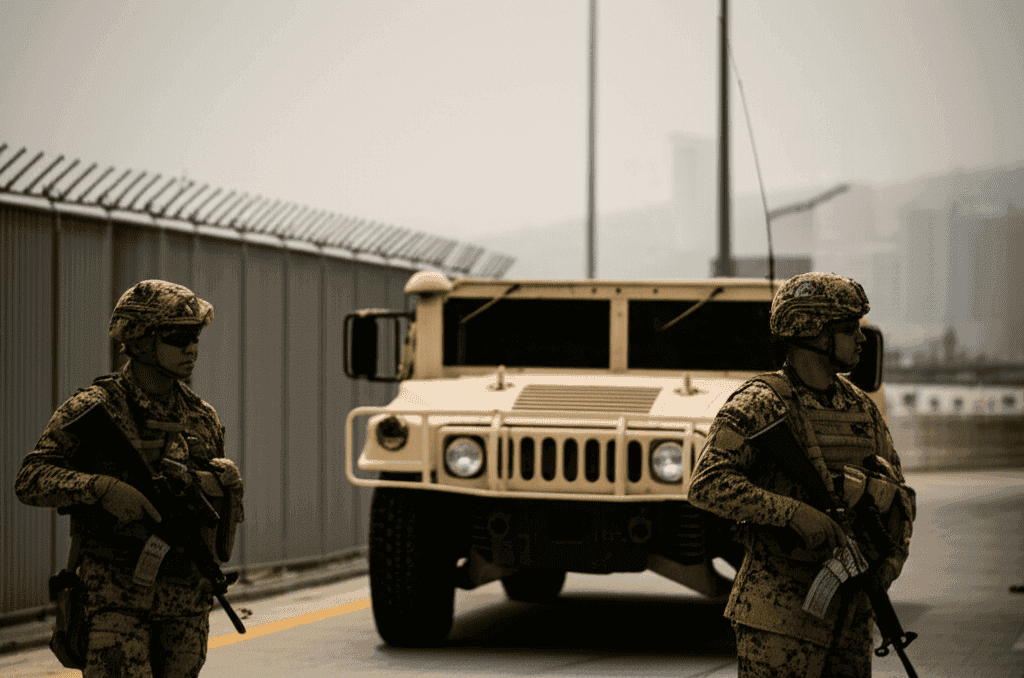
U.S. forces in Mexico are becoming increasingly visible, raising critical questions about sovereignty and the future of U.S.-Mexico relations. As President Claudia Sheinbaum attempts to manage domestic opinion amidst growing threats from the U.S., the extent of existing CIA involvement in Mexico severely limits her options.
FBI Director Kash Patel’s announcement on January 23 regarding the arrest of Canadian drug trafficker Ryan Wedding in Mexico sparked immediate diplomatic tension between Washington and Mexico. Wedding, a former Olympic snowboarder turned international drug trafficker, was taken into custody in Mexico City before being flown to the United States in what U.S. officials described as a joint operation.
Mexican President Claudia Sheinbaum instead declared that Wedding had voluntarily surrendered at the U.S. Embassy in Mexico City, adding that this information had been provided to her government by the United States. Wedding’s lawyer disputed this, saying his client was arrested and handcuffed by U.S. personnel, which was a violation of Mexican law prohibiting foreign officers from participating in law enforcement operations on the country’s soil.
The conflicting narratives reveal Washington’s increasingly assertive approach to security operations in the Americas and a willingness to carry out unilateral military action. Weeks before, on January 3, U.S. forces carried out a high-profile operation to abduct Venezuelan President Nicolás Maduro from a Venezuelan military base.
The trajectory is worrying for Mexico, which last faced direct U.S. military intervention during the 1916-1917 Punitive Expedition against Pancho Villa. The country has long prohibited the establishment of U.S. military bases but shares a 2,000-mile border with the U.S. and is home to some of the world’s most powerful criminal networks that Washington is eager to target.
Days before Wedding’s arrest became public, President Sheinbaum sought to calm domestic concerns after the U.S. Federal Aviation Administration warned airlines to “exercise caution” over airspace near Mexico, as well as parts of Central and South America, “citing military activities,” according to the Associated Press. Viral images of a U.S. military transport plane on a Mexican runway fueled further speculation of U.S. military action.
President Trump’s threat, on January 29, to impose “new tariffs” on any country importing oil to Cuba, which Mexico does, added to the anxieties over escalating U.S. pressure. “Sheinbaum is in a particularly tough spot… She has to appease Trump but also keep the peace within her left-wing party Morena, which has historically aligned with Cuba’s communist regime,” stated the Quincy Institute for Responsible Statecraft.
Deepening Security Ties: U.S. Forces in Mexico
U.S.-Mexico security ties have traditionally been quiet and cooperative since the mid-20th century, first in the context of the Cold War and later to combat drug trafficking. After Mexico formally declared war on the cartels in 2006, cooperation intensified with the 2007 Mérida Initiative, a multibillion-dollar security partnership involving training, intelligence sharing, and institutional reform. U.S. agencies helped professionalize select Mexican units while creating long-term dependency on U.S. logistics and intelligence.
Over time, Washington began applying lessons from the war on terror to Mexico’s drug war. Private military and security contractors were incorporated into Mérida-related programs, expanding notably after 2011. That same year, Operation Lowrider began using aerial surveillance techniques refined in Iraq and Afghanistan to track cartel movements.
Concerns about cartel evolution quickly grew. Groups such as Los Zetas, whose members included former Mexican “elite military troops” trained in the U.S., became notorious due to their brutality as well as growing connections with Hezbollah. Despite these dangers, U.S. involvement in Mexico continued to deepen through new deployments. For related Finance news, see our archives.
“The CIA is generally considered the primary U.S. agency operating in Mexico. It concentrates on signals intelligence, aerial surveillance, and liaison with vetted Mexican units that are trained and equipped by the U.S., according to former U.S. and Mexican officials.”
Cooperation Between Agencies in the U.S. and Mexico
The U.S. has forged strong ties with agencies in Mexico to combat the flow of arms, weapons, and illegal immigrants. The FBI has traditionally focused on fugitives, kidnappings, and transnational criminal cases, particularly those involving U.S. citizens. Its Hostage Rescue Team was responsible for capturing Wedding in January. The Drug Enforcement Agency (DEA) is also active in Mexico. Having developed a strong relationship with the Mexican Army and Navy special forces, it participates in arrests and raids alongside them.
Other agencies like Customs and Border Protection (CBP), Immigration and Customs Enforcement (ICE), the Bureau of Alcohol, Tobacco, Firearms, and Explosives (ATF), and local police departments maintain extensive cooperation with Mexican counterparts on smuggling routes, weapons flows, and financial crimes.
Corruption and Complicity
Corruption has complicated efforts to reduce the power of organized crime networks. Mexican political and security institutions have been deeply infiltrated by cartels, but there is no shortage of U.S. complicity in intelligence, political, and law enforcement circles for decades. Corruption on both sides has made it essential to rely on tightly vetted special units and to strictly compartmentalize sensitive operations so that only a small number of trusted officials know the full details.
A Harder American Stand and the Future of U.S. Forces in Mexico
Operations like Fast and Furious (2009-2011), run by the ATF, meanwhile, allowed weapons to pass into cartel hands in a failed tracking effort, resulting in civilian deaths and those of government officials in both countries.
Even scandals of this magnitude were not enough to disrupt bilateral cooperation until the Trump administration. Rising cartel violence and fentanyl deaths were deemed national security issues and have prompted a more aggressive American approach aimed at reducing U.S. drug fatalities but have often come at the cost of greater instability in Mexico. The presence of U.S. forces in Mexico raises serious concerns.
As pointed out in a January article in the Americas Quarterly, “Over the past year, Washington has increased pressure on Mexico to take decisive action against drug cartels, including proposals that could involve some form of U.S. military presence on Mexican territory. These demands have been paired with repeated warnings from the White House that the status quo is no longer acceptable. The question isn’t whether U.S. pressure will intensify, but how far it might go—and whether Mexico is ready for the scenarios now being openly discussed.”
When former Mexican President Andrés Manuel López Obrador took office in 2018, he pledged to de-escalate the drug war and reduced DEA-Mexican Navy cooperation. In October 2019, a CIA-vetted Mexican army unit called GAIN captured major trafficker Ovidio Guzmán, but after cartel gunmen threatened mass violence and an assault on a housing complex…
Source: Naked Capitalism