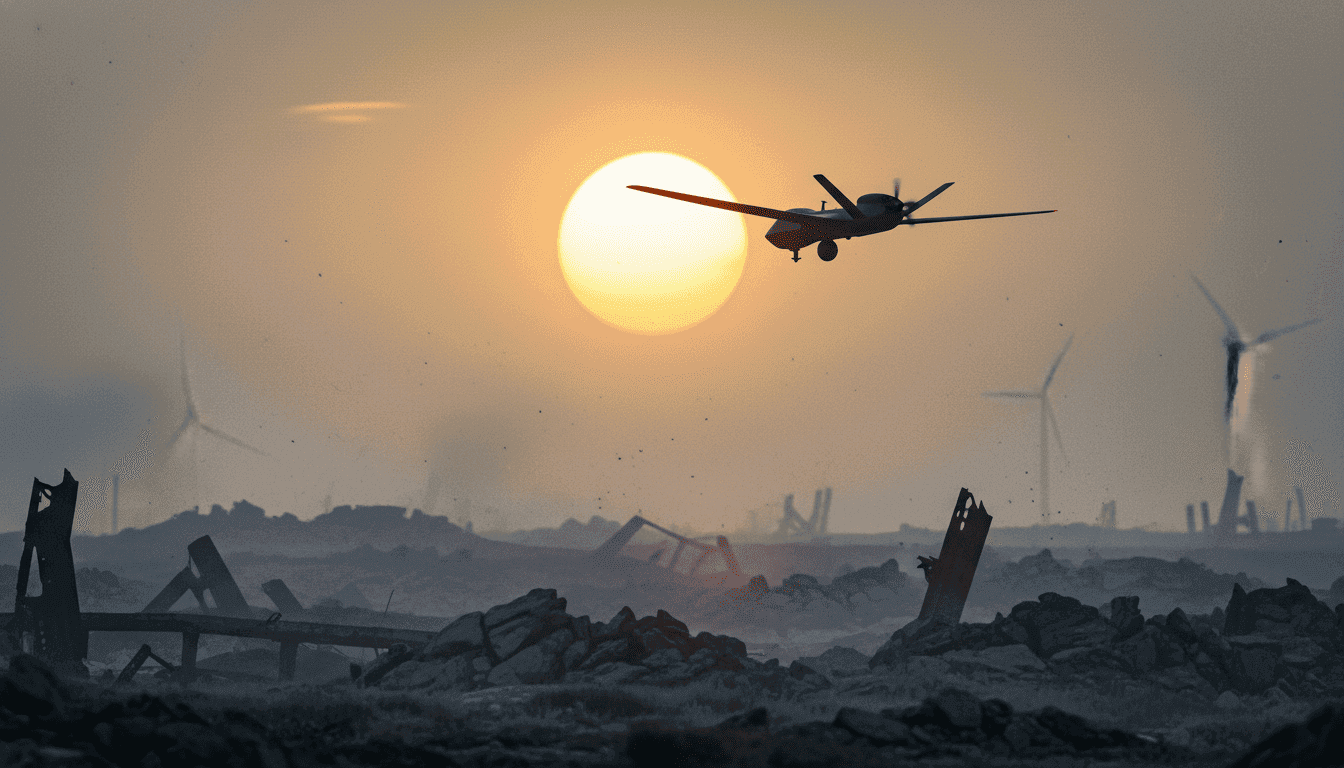
Ukraine drone escalation peril is intensifying strategic risks in the ongoing conflict, as evidenced by recent long-range drone strikes deep into Russian territory. Between May 16 and 17, Ukraine launched approximately 1,500 long-range drones into Russia, showcasing a burgeoning capability to strike sensitive targets. This evolution from tactical battlefield weapon to strategic strike asset carries profound implications for the trajectory of the Ukraine war and the nature of future military conflicts. Long-range drone warfare is transforming escalation from a series of discrete, identifiable steps into a continuous process of adjustment, where strikes can be incrementally expanded in range, frequency, payload, and target selection. This ‘smooth ramp’ rather than ‘escalation ladder’ dynamic heightens the danger of military miscalculation as escalation thresholds become increasingly uncertain.
Western debates on supplying Ukraine with long-range strike capabilities initially focused on complete weapons systems like ATACMS, Storm Shadow, and Taurus. These systems carried significant escalatory sensitivity due to their overt and politically legible extensions of NATO deep-strike capacity. Moscow could interpret direct transfers as a visible crossing of a red line. However, the architecture of enablement has shifted towards a distributed model utilizing modular drone technology, decentralized assembly, commercial components, and satellite integration. This allows strategic capability to emerge incrementally through aggregation, reducing political visibility and preserving a degree of formal separation between NATO governments and Ukrainian deep-strike operations.
Incremental Deep-Strike Capability
From Ukraine’s supporters’ perspective, this distributed enablement strategy offers several advantages. It reduces vulnerability to Russian interdiction by decentralizing production and assembly, lowers the political visibility of escalation, and maintains a degree of formal separation. This ambiguity allows supporting states to argue they are assisting Ukraine’s domestic defense industry, rather than directly supplying strategic offensive weapons. Yet, from Moscow’s perspective, this distinction may appear less meaningful as sophisticated long-range strikes penetrate deeper into Russian territory, relying heavily on Western components, intelligence, and logistical ecosystems. Russia will likely evaluate the situation based on operational outcomes rather than legal distinctions.
“The distributed enablement strategy significantly lowers the political visibility of escalation, allowing strategic strike capability to expand without the overt signatures of direct weapons transfers.”
Ukraine’s growing ability to strike high-value targets deep inside Russia poses increasingly serious strategic problems. Despite Russia’s highly capable layered air defense systems, defending a vast national territory against persistent and distributed drone attacks presents severe difficulties. Air defense resources are finite and geographically constrained, necessitating constant allocation tradeoffs. With Western intelligence and targeting support, Ukraine can increasingly direct deep strikes against vulnerable points within Russia’s strategic infrastructure. Low-cost drones can also be launched in numbers sufficient to saturate local defenses, especially when attacks combine multiple vectors and varying flight paths.
Recent Ukrainian attacks have demonstrated the growing reach and adaptability of this strategy. Drone strikes have repeatedly targeted Russian oil refineries, fuel depots, aviation facilities, and industrial infrastructure hundreds of kilometers from the battlefield. Fuel production facilities are particularly vulnerable due to their economic, military, and physical fragility. Even temporary disruption creates logistical strain and forces Russia to redistribute air defense assets. Russian strategic aviation infrastructure has also become exposed, with strikes against airbases demonstrating that rear-area sanctuary is no longer assured. The cumulative effect extends beyond physical destruction, creating persistent uncertainty across a broad strategic rear area and forcing increased resource allocation towards protection and adaptation. This ongoing Ukraine drone escalation peril underscores the evolving dynamics of modern warfare.
The Interdiction Challenge for Russia
Ukraine’s distributed drone enablement strategy creates a severe interdiction problem for Russia. Disrupting the transfer or production of complete strike weapons is theoretically possible by targeting major depots or centralized production facilities. However, distributed drone warfare fundamentally alters this equation. Ukraine’s western logistical interface with NATO spans an enormous and fragmented frontier, with numerous road and rail crossing points across Poland, Romania, Slovakia, and Hungary. This broad logistical membrane makes interdiction exceptionally complex. Drone components can be transported incrementally through ordinary commercial logistics networks, and many possess legitimate civilian applications, making selective interdiction extraordinarily difficult.
The distributed nature of assembly further complicates the problem. Modern long-range drone capability no longer requires a single large manufacturing complex. Components can be dispersed across numerous workshops and subcontractors, allowing production capacity to regenerate even after successful attacks. Consequently, effective interdiction would increasingly require Russia to contemplate strikes not only against key Ukrainian targets but against the broader logistical ecosystem enabling the flow of components and technical support. This creates a dangerous escalation dynamic: the more successful distributed enablement becomes, the more the distinction between the battlefield and the NATO rear area begins to erode.
Escalation Threshold Opacity
One of the most destabilizing characteristics of distributed drone warfare is the growing opacity surrounding actual escalation thresholds. Traditional escalation frameworks relied on politically visible threshold events, such as mobilization or the transfer of major weapons systems. Distributed drone enablement blurs these distinctions by allowing strategic strike capability to emerge incrementally through dispersed technological ecosystems. From the Western perspective, these distinctions preserve formal separation between NATO governments and Ukrainian operational control. From Moscow’s perspective, however, the distinction between “Ukrainian-made” and “NATO-enabled” systems may appear increasingly artificial if the strategic effects are functionally identical. The danger is not merely uncertainty about where the red lines are located, but that prolonged ambiguity encourages continuous probing behavior. If repeated incremental escalation produces no immediate catastrophic response, decision-makers may incorrectly infer that future escalation will remain equally manageable, even when actual retaliatory thresholds remain uncertain, adaptive, or deliberately undisclosed.
Russia is unlikely to remain passive in the face of expanding deep-strike campaigns against its strategic rear areas. Potential responses could range from broader mobilization and expanded targeting doctrine to attacks on NATO reconnaissance systems and logistical infrastructure, possibly culminating in strategic nuclear signaling. The danger lies not only in the immediate impact of strikes but in the unpredictable responses they provoke. The ongoing Ukraine drone escalation peril highlights a new era of warfare where technological advancements and distributed capabilities create complex, ambiguous, and highly risky pathways for conflict expansion, necessitating careful strategic calculus from all parties involved. For more insights into global financial impacts of geopolitical events, explore our related Finance news.