Tesla Model 3 PC transformation is the focus of a recent Hackaday article, published on March 28, 2026, detailing the ambitious efforts of security researcher David Schütz. Schütz undertook this intricate project to convert a Tesla Model 3’s computer into a functional desktop PC, primarily to participate in Tesla’s lucrative bug bounty program, which actively encourages researchers to uncover and report vulnerabilities within their advanced vehicle systems.
Tesla’s bug bounty program stands as a significant industry initiative, offering substantial rewards to ethical hackers. These incentives have previously included a Tesla Model 3 vehicle itself and a hefty US$35,000 for exposing critical infotainment system vulnerabilities. Furthermore, Tesla operates a unique “Root access program” within its bug bounty, granting researchers who discover a valid “rooting” vulnerability a permanent SSH certificate for their own car, thereby providing them with root access for further, in-depth research and experimentation.
Sourcing Components for the Tesla Model 3 PC Transformation
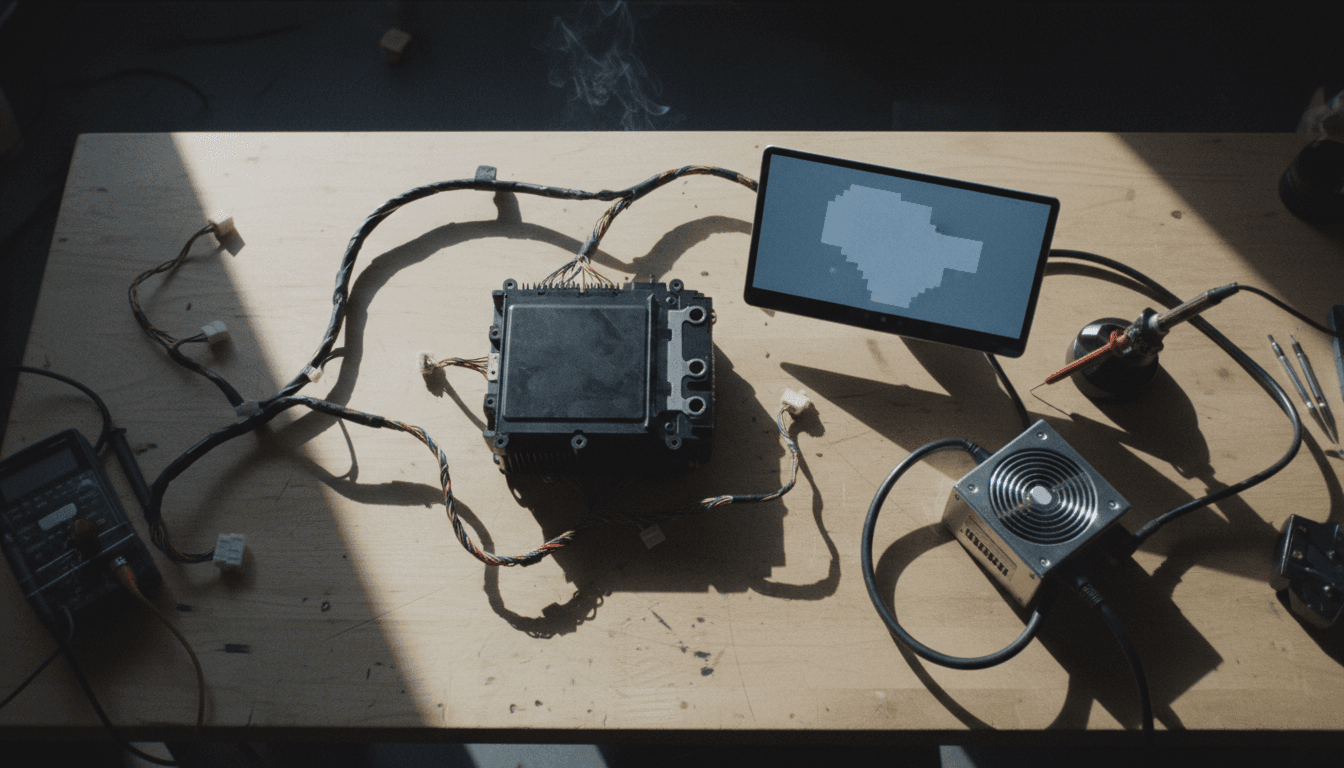
To kickstart his project, Schütz, who was not a Tesla owner, ingeniously acquired the necessary components from crashed Model 3 vehicles. His quest specifically targeted the combined Media Control Unit (MCU) and Autopilot computer (AAP) assembly, a compatible power supply, and the proprietary Tesla display. The Model 3’s computer itself is a formidable piece of hardware, roughly the size of an iPad and as thick as a 500-page book, encased in a water-cooled metal housing. It is typically found in front of the passenger seat, discreetly located behind the glovebox.
Schütz encountered numerous hurdles during the component assembly phase. The salvaged parts frequently came with their cables severed, leaving only short, challenging stumps. After an initial, unsuccessful attempt to utilize an incompatible BMW LVDS cable, he endeavored to patch the original cable stumps. This method briefly yielded results, but unfortunately, debris caused a power rail IC on the MCU board to fail. Ultimately, Schütz replaced the damaged IC and opted to purchase a new Model 3 computer, alongside a Dashboard Wiring Harness cable loom. This loom proved crucial as it contained the specific Rosenberger connectors required to properly interface the display with the main unit. The display cable itself is a 6-pin cable (two pins for 12V and ground, four for data) and employs a Rosenberger 99K10D-1D5A5-D connector.
“The ingenuity in repurposing advanced automotive hardware for desktop functionality underscores the evolving intersection of vehicle technology and personal computing.”
Booting the Tesla OS on a Desktop
With the correct wiring harness finally in place, Schütz achieved a significant breakthrough: he successfully booted the car’s operating system on his desk. This pivotal moment enabled him to fully interact with the user interface, explore the network interfaces, and probe the CAN buses, opening up avenues for potentially extracting valuable firmware and further understanding the system’s architecture. This successful Tesla Model 3 PC transformation demonstrates the deep level of integration and complexity of modern vehicle systems.
Evolution of Tesla’s In-Car Computer Hardware
Tesla’s in-car computer hardware has undergone substantial evolution. Model 3s manufactured between 2017 and 2023 are generally outfitted with Hardware 3 (HW3). This iteration features a Samsung Exynos-IP based processor with 12 CPU cores clocked at 2.2GHz, 8GB of RAM, 64GB of storage, and two neural net processors running at 2.0GHz, delivering an impressive 36 TOPS of processing power. HW3 also utilizes 1.2MP cameras. More recent Tesla models, notably the updated 2024 Model 3, are equipped with Hardware 4 (HW4). HW4 introduces significant advancements, including higher-resolution cameras (2896×1876 pixels for front cameras), substantially increased computing power (estimated to be 3-5 times faster than HW3), and new electrical and wiring harnesses designed for enhanced cooling and stability. HW4 further boasts 16GB RAM, 256GB storage, 20 CPU cores at 2.35GHz, and three neural net processors at 2.2GHz, collectively delivering a formidable 50 TOPS of processing power.
This remarkable project by David Schütz not only highlights the sophisticated engineering within Tesla vehicles but also showcases the potential for security researchers to delve into these complex systems. The successful Tesla Model 3 PC transformation provides valuable insights into both the hardware capabilities and the security landscape of cutting-edge automotive technology, further solidifying the importance of robust bug bounty programs in the industry. related Industries news