
Tech hiring trends reveal a surprising resilience in the workforce numbers at tech giants like Alphabet and Amazon. Despite four years of mass layoffs, Alphabet & Amazon’s headcount rose in 2025, nearly flat with its peak, as hiring continued. This comes after a period of unprecedented expansion during the pandemic years.
Amazon and Alphabet – and other tech companies – keep announcing serial layoffs and buyout-encouraged departures. But they’re still hiring too.
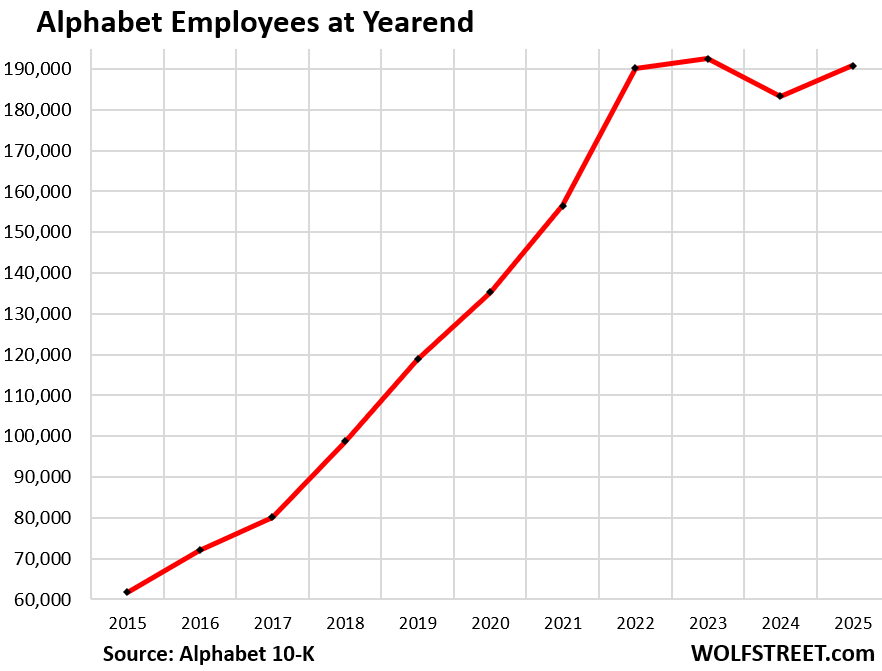
Alphabet’s global headcount on December 31, 2025, reported in its 10-K filing, rose by 7,497 year-over-year, was a hair above where it had been at the end of 2022, when these layoffs started, and only a hair below peak headcount at the end of 2023.
But in the two years 2020 and 2021, its headcount had surged by 60%, as it hired helter-skelter and in massive numbers people who worked remotely, amid stories that began circulating of people having two or three full-time remote jobs and pulling in huge amounts of money while skiing or whatever. Exaggerated or not, what was clear is that there would be a lot of sorting out and cleaning up to do afterwards.
The afterwards began in late 2022. Turns out, the cleanup included sweeping out 35% of its managers that were overseeing small teams, Brian Welle, VP of Analytics & Performance Management at Google, told employees in August last year. “So a lot of fast progress there,” he said.
Lots of people gone, and the headcount is up. So what is clear is that Google is swapping out workers, pushing lots of people out, and hiring lots of people, with the effect that the headcount had remained roughly unchanged for four years, after the biggest and wilders hiring binge ever in 2020 and 2021.
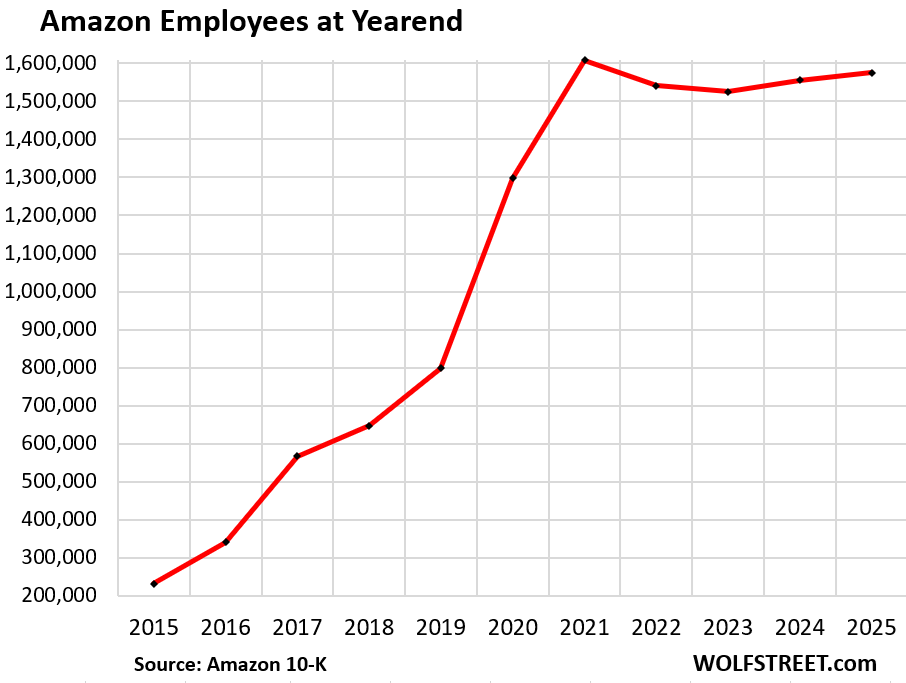
And Amazon’s gigantic headcount at the end of December 2025 rose by 20,000 year-over-year, to 1.576 million, according to its 10-K filing on Friday. In the prior year, it had risen by 31,000.
But in 2022 and 2023, headcount had dropped by 16,000 and 67,000.
Its headcount at the end of 2025 was down by 32,000, or by just 2.0%, from the peak year 2021.
But in the two years of 2020 and 2021, its headcount had shot up by 810,000 people, from 798,000 at the end of 2019 to 1.608 million at the end of 2021, having more than doubled (+102%) in two years.
In the seven years 2015 to 2021, its headcount exploded by 1.377 million, or by 600% (headcount had multiplied by 7).
In 2020 and 2021, Amazon overhired in one of the most amazing hiring binges ever seen, increasing its staff by 810,000 people in just two years. Many of its workers also quit during that time, so the hiring to replace the quits and add the 810,000 must have been gigantic and chaotic.
And since then, it has been trying to sort through who it really needs and who it doesn’t need, trying to get rid of the deadwood, the recalcitrant remote workers, the workers in projects that it shut down, the workers that it replaced with automation, etc., while hiring where it needed fresh blood.
So it’s not like there is no movement in employment at these companies. There is lots of movement, with big layoffs and buyouts, accompanied by lots of hiring.
Intuit was an explicit example of that in July 2024, when it announced 1,800 layoffs, about 10% of its workforce, including 1,000 for not meeting performance expectations, while it also announced plans to hire 1,800 people to accelerate its push into AI. Layoffs are quicker to pull off than hiring workers for AI-related roles. So one came first, and the other has been slower to materialize.
“Key insight: Tech companies are strategically reshaping their workforce, focusing on AI and automation.”
Tech Hiring Trends: A closer look
The continuous cycle of layoffs and hiring points to a fundamental shift in how these companies are managing their talent. related Finance news suggests that this trend is not unique to Alphabet and Amazon, but rather a broader phenomenon across the tech industry.
The AI Factor in Tech Employment
The need for AI specialists is driving a significant portion of the new hiring. Companies are looking to bolster their AI capabilities, even if it means restructuring existing teams. This highlights the growing importance of AI in the future of tech.
Analyzing Alphabet’s Headcount
Despite the layoffs, Alphabet’s headcount has remained relatively stable. This suggests that the company is not necessarily shrinking, but rather reallocating resources to more strategic areas. Tech hiring trends at Alphabet point to a focus on innovation and new technologies.
Amazon’s Workforce Management
Amazon’s strategy involves a constant evaluation of its workforce, optimizing for efficiency and innovation. The company’s massive hiring spree during the pandemic was followed by a period of consolidation and strategic realignment. The shifts in tech hiring trends at Amazon reflect a commitment to long-term growth and profitability.
It’s clear that tech hiring trends are dynamic, shaped by technological advancements and economic pressures. While layoffs may grab headlines, the underlying story is one of continuous adaptation and strategic workforce management. The data from Alphabet and Amazon show that even amidst restructuring, the demand for talent in key areas remains strong. Tech hiring trends are here to stay.
Source: Wolf Street