
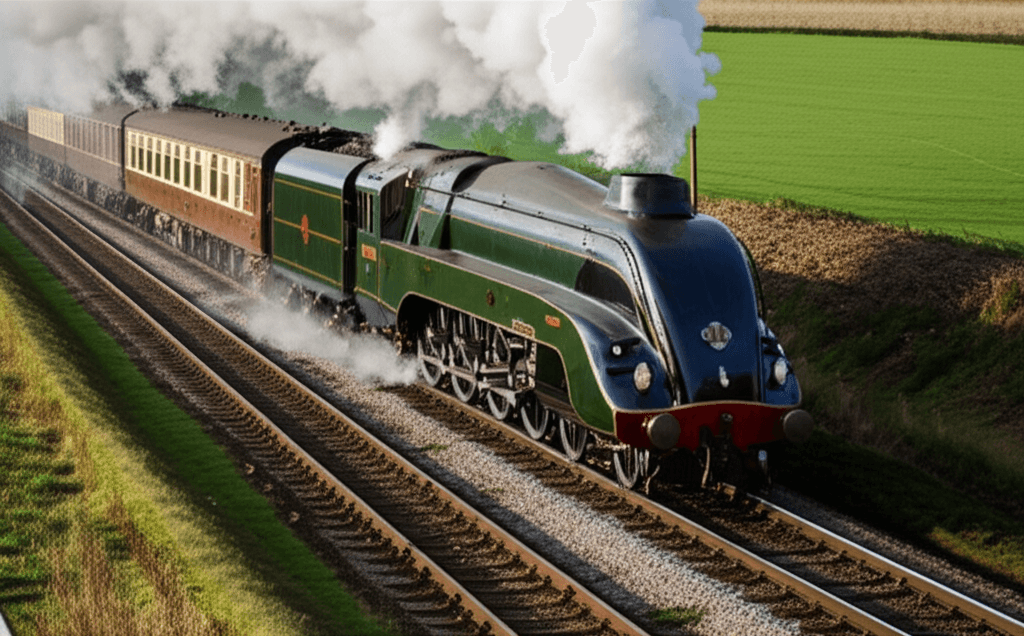
The **steam locomotive speed record** remains one of the most enduring feats of engineering from the age of steam. While many speed records are broken within years, the fastest steam locomotive record has stood for almost a century. The official record holder is the A4 Pacific _Mallard_, which allegedly reached 126 mph in 1938 on the London & North Eastern Railway. However, serious questions are being raised about the accuracy of that measurement.
Analyzing the 1938 Speed Measurement
The Institute of Mechanical Engineers has released a video analyzing the original dynamometer roll that recorded the _Mallard’s_ speed. Their investigation reveals inconsistencies and noise within the recording. After a thorough examination, they suggest a more conservative and reliable speed of 124 mph.
This raises questions about the motivations behind the original 126 mph claim. The London & North Eastern Railway was in fierce competition with the London Midland and Scottish Railway. It’s plausible that the LNER sought to maximize publicity by emphasizing the highest momentary speed achieved. The quality of the jointed track in the 1930s, coupled with the limitations of the dynamometer car, would have made precise measurement incredibly challenging. Accurately measuring the **steam locomotive speed record** was a monumental feat given the technology of the time.
The Role of Rivalries and Publicity
The competitive landscape of the British railway system in the 1930s played a significant role in shaping the narrative around the **steam locomotive speed record**. Each company sought to outdo the other, leading to potential embellishments of achievements. The desire for publicity and prestige likely influenced the interpretation and presentation of the speed data.
Examining the Steam Locomotive Speed Record
The challenge of measuring speed accurately in 1938 cannot be overstated. Mechanical instruments operating within a vibrating train car at high speeds would have been prone to errors. While modern electronics could provide more precise measurements, the LNER likely placed greater trust in their mechanical instruments. related Industries news
“The LNER sought to maximize publicity by emphasizing the highest momentary speed achieved.”
Could 1930s electronics have offered a solution? Perhaps, but the reliability and trust in mechanical instruments were paramount at the time. The **steam locomotive speed record**, therefore, remains both a testament to engineering ingenuity and a product of its historical context.
Legacy of the Mallard and the Future of Rail Technology
Even with the questions surrounding the exact speed, the _Mallard’s_ achievement remains significant. It represents the pinnacle of steam locomotive technology and a moment of national pride. As technology continues to advance, the pursuit of speed and efficiency in rail transport will continue, building upon the legacy of these early pioneers. The **steam locomotive speed record** highlights the relentless human drive for innovation.
In conclusion, while the official 126 mph figure for the _Mallard_ may be subject to some scrutiny, the achievement itself cannot be denied. The **steam locomotive speed record** stands as a remarkable feat of engineering from an era of groundbreaking innovation and fierce competition, a time when railway companies pushed the boundaries of technology to capture the public’s imagination and achieve lasting recognition.


