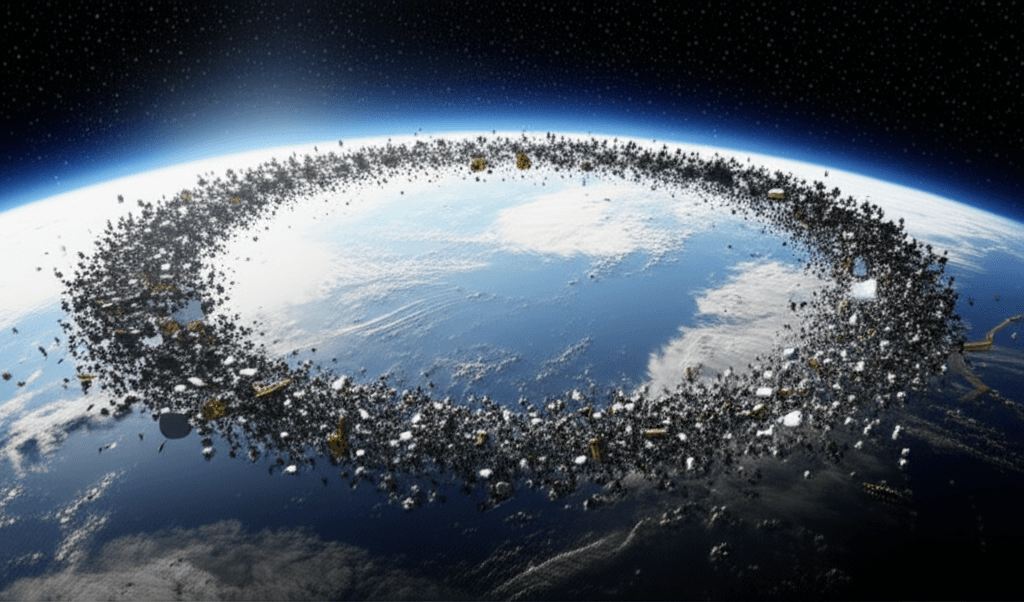
The **space junk problem** is rapidly escalating as we launch more satellites and equipment into orbit. Just beyond Earth’s atmosphere lies a growing layer of human-made objects, from operational satellites to defunct equipment and dangerous debris.
Since the dawn of the space age in 1957, humanity’s presence in orbit has exploded. Telescopes peer into the cosmos, humans inhabit the International Space Station, and increasingly, massive constellations of satellites provide global internet access. The number of active satellites has surged from approximately 3,000 to 14,000 in just five years, largely due to projects like Elon Musk’s Starlink, which alone accounts for nearly 10,000 satellites.
However, this rapid expansion comes at a cost. Alongside active satellites, an estimated 50,000 pieces of debris larger than a baseball and millions of smaller objects orbit Earth. These objects pose a significant collision risk to operational satellites, including those crucial for weather forecasting and digital communication.
Here’s a closer look at some key elements of Earth’s growing anthroposphere:
The International Space Station (ISS)
Orbiting at an altitude of 370-460 km, the ISS is the largest human-made structure in space, spanning 109 meters in length. Around 300 people have spent time on the ISS, conducting scientific research and pushing the boundaries of human exploration. However, its lifespan is limited, with plans to deorbit it in 2031, resulting in a fiery demise over the Pacific Ocean.
Hubble Space Telescope
At an altitude of 480 km, the Hubble Space Telescope, with its 13.2-meter length, has revolutionized our understanding of the universe. Launched in 1990, it has provided unprecedented views of galaxies, exoplanets, and other celestial phenomena.
GPS Satellites
The 31 active Global Positioning System (GPS) satellites orbit at a high altitude of 20,000 km. Since 1978, these satellites have provided precise positioning, altitude, and time data to users worldwide.
Addressing the Space Junk Problem
The **space junk problem** is a serious concern. Starlink satellites, orbiting at 340-570 km, are launched in batches of up to 60 at a time. Earth-based astronomers are increasingly worried that the sheer number of these satellites is obstructing their observations.
Even relics of the past contribute to the problem. Vanguard 1, the oldest satellite still in orbit, is a tiny sphere launched by the US. Despite its small size (0.25 meters in length and 1.47 kg in weight), it will remain in orbit for another 200 years, adding to the ever-growing accumulation of space debris. Addressing the **space junk problem** requires international cooperation and innovative solutions to mitigate the risks of collisions and ensure the long-term sustainability of space activities.
“The growing amount of space debris poses a critical threat to the future of space exploration and utilization.”
The increasing amount of debris highlights the urgency of developing effective solutions for space debris removal and prevention. Without proactive measures, the **space junk problem** could severely limit our ability to access and utilize space in the future. The financial implications of satellite damage or loss due to collisions could also be substantial, affecting various sectors, including communication, navigation, and defense. The **space junk problem** needs immediate attention. You can read more on related Industries news here.
Source: MIT Technology Review