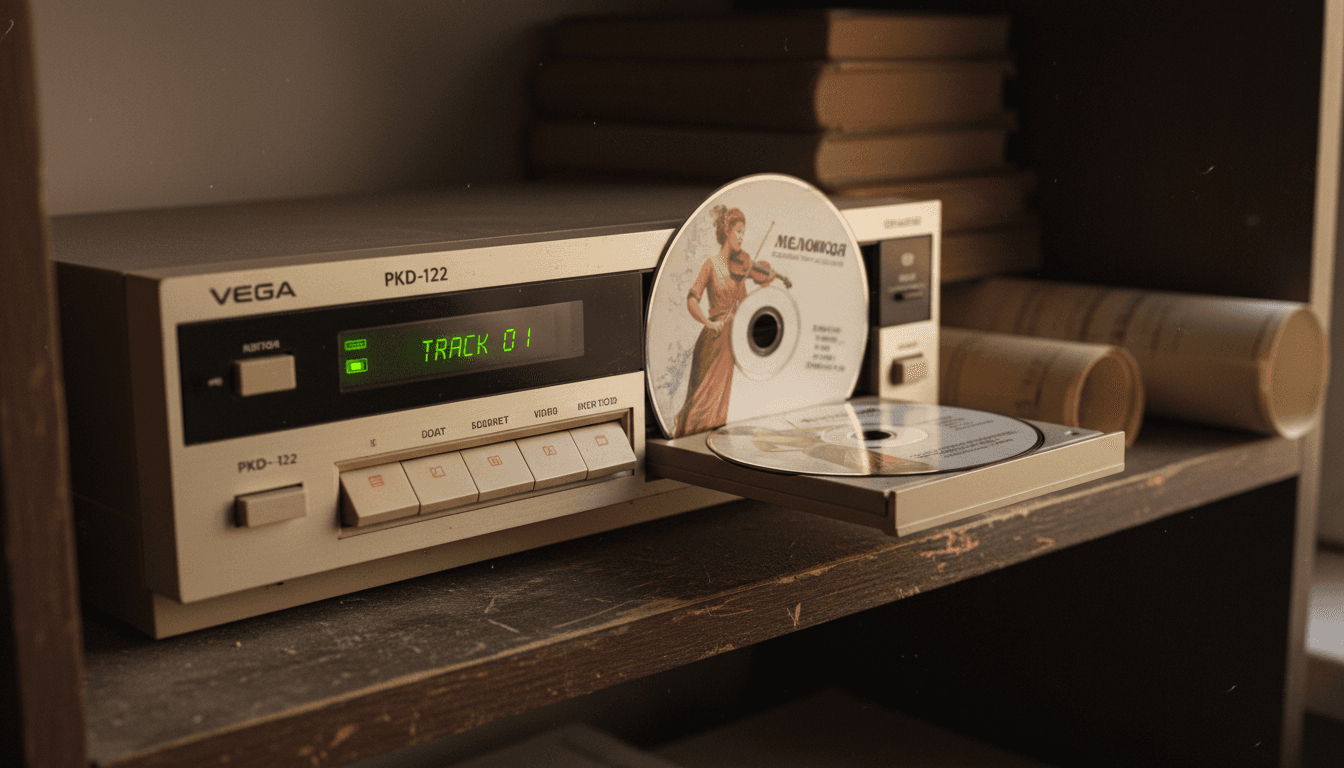
Soviet CD players and CDs existed, though their development and availability lagged significantly behind Western technology due to a combination of sanctions, bureaucracy, and a focus on military rather than consumer technology. This fascinating chapter in technological history offers a unique glimpse into the challenges and ingenuity within a centrally planned economy attempting to keep pace with global innovation.
Early Digital Audio Ambitions
Soviet engineers began working on digital audio technology in the late 1970s, a testament to their early recognition of its potential. In 1979, the Luch-001 digital audio player was developed, utilizing glass discs with an 11-bit quantization and a 44.1 kHz sampling rate. These discs were similar in diameter to modern CDs but notably thicker. This development occurred a few years before the commercial introduction of CD players by Sony and Philips in 1982. However, these early Soviet efforts, including the Luch-002 and Corvette LP-001 prototypes, never reached mass production due to a lack of manufacturing capabilities and persistent bureaucratic hurdles. The Corvette LP-001, for instance, reportedly used Philips laser heads and integrated circuits, with only two units ever assembled, highlighting the reliance on foreign components even at the prototype stage.
Limited Production and Foreign Integration
During the late 1980s, some limited production of CD players did occur, primarily in Soviet Estonia. The Estonia LP-010 is a prime example, incorporating Philips internals. Approximately 3,000 units of the Estonia LP-010 were manufactured between 1988 and 1990. However, sanctions on the USSR eventually hindered these efforts to integrate foreign components, underscoring the geopolitical challenges that impacted consumer technology development. The struggle to secure reliable supply chains for advanced components was a recurring theme in the Soviet Union’s attempts to produce sophisticated electronics.
Mass Production and the Vega PKD-122
The first truly mass-produced Soviet CD player, the Vega PKD-122, emerged in 1991, just as the Soviet Union was on the brink of collapse. This model is notable for its blend of localized and imported components. While the power supply, display, and logic board (using Soviet TTL ICs) were domestically produced, critical components like the DAC and optical-mechanical assembly were initially imported from Japan, specifically Sanyo. Over time, efforts were made to replace imported components, with the control board being redesigned in 1994 using domestic processors. A video showcasing a teardown of the Vega PKD-122 revealed a production date of 1994 for one unit, indicating its continued, albeit brief, manufacturing post-Soviet dissolution. A peculiar design flaw in the Vega PKD-122 was the direct coupling of front buttons to the mainboard without ESD protection, making them susceptible to damage from static electricity, a particular issue in dry Siberian winters. The factory producing the Vega PKD-122 ultimately went bankrupt in 1995, marking the end of significant domestic production of Soviet CD players and CDs.
The Birth of Soviet CD Production
Soviet CD production itself began in 1989 at the Gramzapis experimental plant in Moscow. This factory utilized outdated West German CD pressing equipment and employed specialists trained in West Germany and Sweden. The production required extremely clean and dry air conditions due to the hygroscopic nature of the Japanese polycarbonate used for the discs. These CDs were sold under the iconic Melodiya brand. A Soviet-produced CD from 1991, featuring recordings from 1974 and 1989, was priced at 20 rubles, significantly more expensive than a vinyl record, reflecting the advanced nature and limited availability of the format.
“The story of Soviet CD players and CDs is a microcosm of the broader technological struggles within the USSR, where innovation often outpaced manufacturing capacity and geopolitical realities dictated component sourcing.”
The development and limited success of related Industries news occurred against the backdrop of the impending dissolution of the Soviet Union. The USSR formally ceased to exist on December 25, 1991, following a period of economic stagnation, declining living standards, and rising nationalist sentiments. The lifting of the Iron Curtain around 1990 exposed the vast technological gap in consumer electronics between the USSR and the West, making the domestic production of Soviet CD players and CDs an increasingly challenging and ultimately unsustainable endeavor. This historical footnote reminds us of the complex interplay between technology, economics, and political systems.