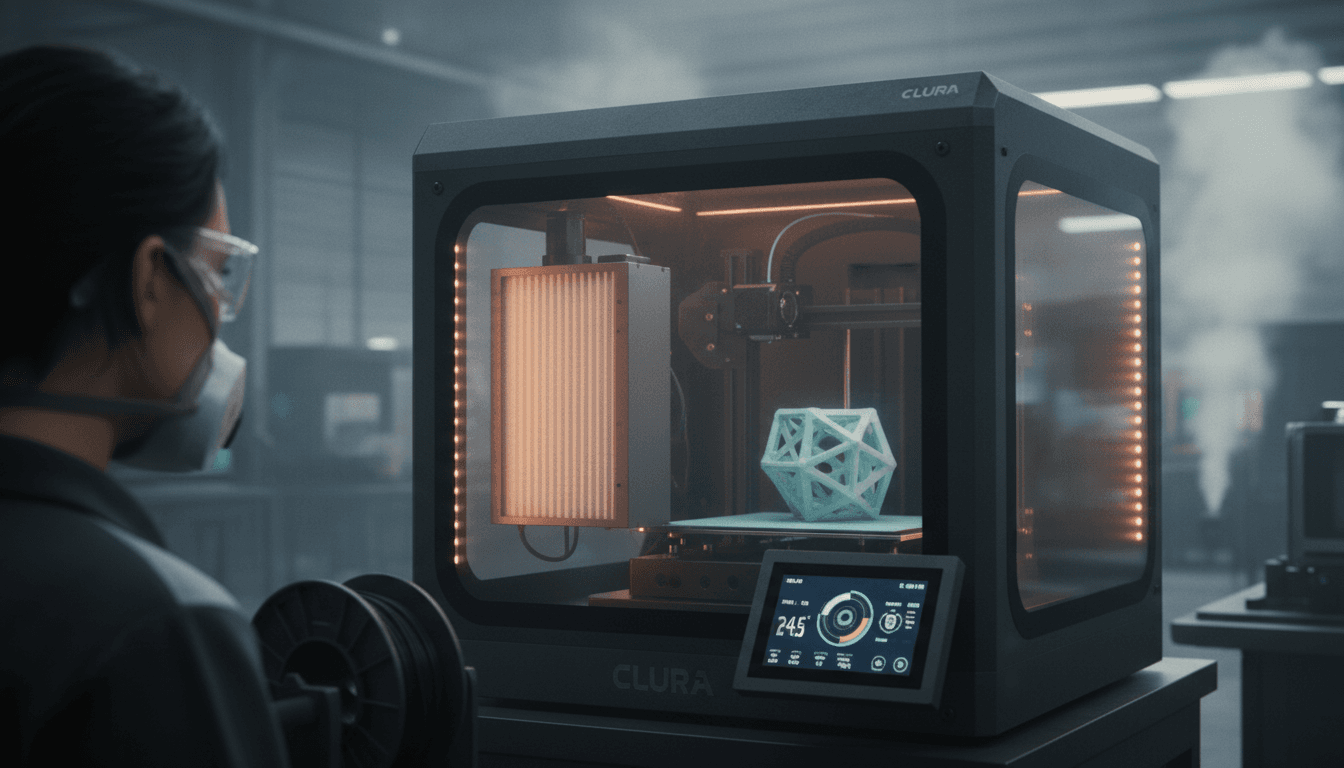
A new smart printer enclosure, named ‘Clura’, is set to revolutionise 3D printing safety by addressing the critical issue of toxic volatile organic compounds (VOCs) and ultrafine particles (UFPs) released during in-home and workshop additive manufacturing. The Hackaday article, published on March 15, 2026, underscores the vital importance of proper ventilation, a factor often overlooked in many home 3D printing setups, allowing these harmful emissions to escape freely.
Developed over the past year by aerospace engineering student Fabrizio Blasio and his team at TU Delft in the Netherlands, the Clura enclosure represents an open-source, affordable, modular, and user-friendly solution for safer 3D printing. Blasio initiated the project due to a growing concern that the broader 3D printing community frequently neglects health and safety protocols, particularly regarding airborne pollutants.
Key Innovations for Safer 3D Printing
The Clura enclosure integrates several cutting-edge features designed to create a significantly safer printing environment. Its advanced filtration system, a cornerstone of its design, incorporates a HEPA + carbon filter combination. This system intelligently adjusts airflow based on live sensor data, capable of filtering the entire enclosure volume in approximately 60 seconds. HEPA filters are specifically engineered to capture minuscule particles, while activated carbon filters excel at trapping hazardous VOCs.
Beyond filtration, Clura boasts comprehensive safety sensors, including triple-redundant smoke and gas detectors for early fire detection. Additional sensors monitor particulate matter (PM0.3/PM2.5), temperature, humidity, and pressure, providing a holistic view of the internal environment. This multi-sensor approach ensures proactive monitoring against potential hazards.
Enhanced User Experience and Open-Source Philosophy
The innovation extends to smart features that significantly enhance the user experience. Clura includes load-cell spool holders that track filament weight in real-time, offering users crucial data to determine if a print can be completed without a filament change. Customizable RGB LED lighting further adds to its appeal and functionality. The user interface, driven by a custom STM32 PCB and presented on a 4.3-inch touchscreen, provides live environmental data, controls lighting, and manages other enclosure functions seamlessly.
The commitment to an open-source philosophy is central to Clura’s mission. All design files and assembly guides are freely available under a CC NC license on GitHub. This empowers users to replicate, adapt, or enhance the enclosure to suit their specific needs. For those seeking convenience, kits for custom PCB boards with smart features like filament weighing and fume detection are available for purchase, though Gerber files are also provided for DIY enthusiasts. The modular frame is designed for broad compatibility, adapting to popular 3D printers such as Prusa (MK4/MK3/Mini), Bambu A1/A1 mini, and Ender 3 style printers, making this smart printer enclosure accessible to a wide audience.
“The release of VOCs and UFPs during 3D printing, particularly from materials like ABS, Nylon, and resin, can lead to health issues such as respiratory irritation, headaches, and in the long term, potentially more serious conditions like lung and heart disease.”
While materials like PLA are generally considered safer, they still release UFPs, underscoring the universal need for proper ventilation across all filament types. The Clura smart printer enclosure directly addresses these risks, providing an accessible and effective solution for cleaner and safer 3D printing environments. This development marks a significant step forward in promoting health and safety within the rapidly expanding 3D printing industry. The widespread adoption of such solutions could dramatically reduce exposure to harmful emissions, safeguarding enthusiasts and professionals alike.
This innovative smart printer enclosure is set to redefine safety standards for home and workshop 3D printing, offering a sophisticated yet user-friendly answer to persistent health concerns. Its open-source nature promises continuous evolution and community-driven improvements, ensuring its relevance and effectiveness for years to come. For more insights into technological advancements impacting various sectors, explore our related Industries news.