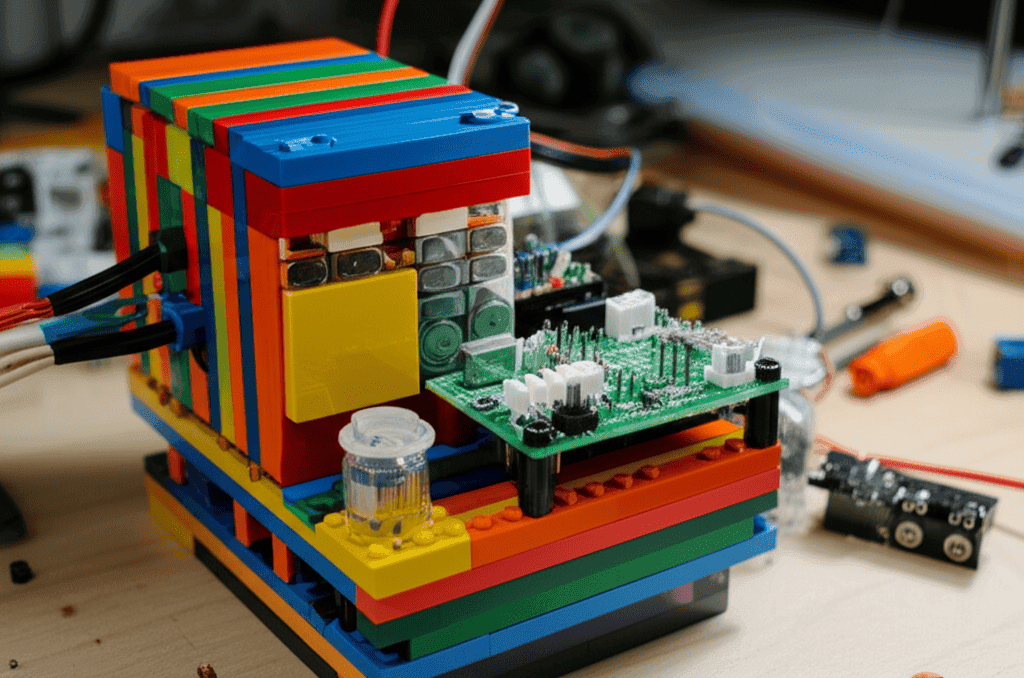
Simplest LEGO motor is now a reality, thanks to a clever design by Jamie’s Brick Jams that uses minimal parts to create a functional motor from LEGO bricks and basic electronic components. This ingenious creation demonstrates how fundamental engineering principles can be applied using readily available materials, offering a fascinating glimpse into the world of DIY electronics and LEGO construction.
Building the Simplest LEGO Motor
The design starts with a driver coil and a magnetic rotor featuring two neodymium magnets. The magnets are carefully balanced on either side of an axis to ensure smooth rotation. Initially, the driver coil is energized with a 9V battery, confirming its ability to spin when power is briefly applied. However, continuous spinning requires pulsed power.
To achieve this, a second coil is added to sense when a magnet passes by. This sense coil is connected to a small circuit incorporating a TIP31C NPN power transistor and an LED. While the transistor might be considered overkill, it effectively serves its purpose. The circuit configuration, as shown in the original article, uses the transistor’s Base-Collector-Emitter pins to trigger the driver coil.
When a magnet passes the sensor coil, it activates the transistor, sending a surge of power through the driver coil. This pushes the rotor in a kicker configuration, maintaining its rotation. Polarity is crucial here, so reversing the leads of one of the coils may be necessary if the motor fails to spin. The LED, while optional, provides a visual indication of activity. From this foundation, a larger LEGO motor can be constructed, incorporating more magnets in a disc and two circular coils. Even the basic version proves powerful enough to propel a small car.
“This simple motor design highlights the potential for creative problem-solving and innovation using readily available materials, making it an accessible project for enthusiasts of all skill levels.”
Financial Implications of DIY Innovation
While this project may seem purely recreational, it exemplifies the spirit of innovation that drives technological advancements across industries. The ability to create functional devices from simple components can lead to cost-effective solutions and foster entrepreneurial ventures. Understanding the fundamentals of electronics and mechanics is invaluable in a world increasingly reliant on technology. The principles demonstrated in creating the simplest LEGO motor can translate to larger-scale projects and innovations in various sectors. Access to related Industries news can help investors and business leaders spot trends and potential disruptions.
Investing in Educational Toys and Kits
The popularity of educational toys and kits, such as LEGO, reflects a growing interest in STEM (Science, Technology, Engineering, and Mathematics) education. Companies that produce and distribute these types of products are positioned to benefit from this trend. Furthermore, the open-source nature of many DIY projects encourages collaboration and knowledge sharing, accelerating the pace of innovation. The simplest LEGO motor serves as a tangible example of how play and learning can converge to inspire future engineers and entrepreneurs. The simplest LEGO motor is more than just a toy; it’s a lesson in applied physics. Building the simplest LEGO motor opens a world of possibilities. The simplest LEGO motor can lead to bigger things.
Source: Hackaday