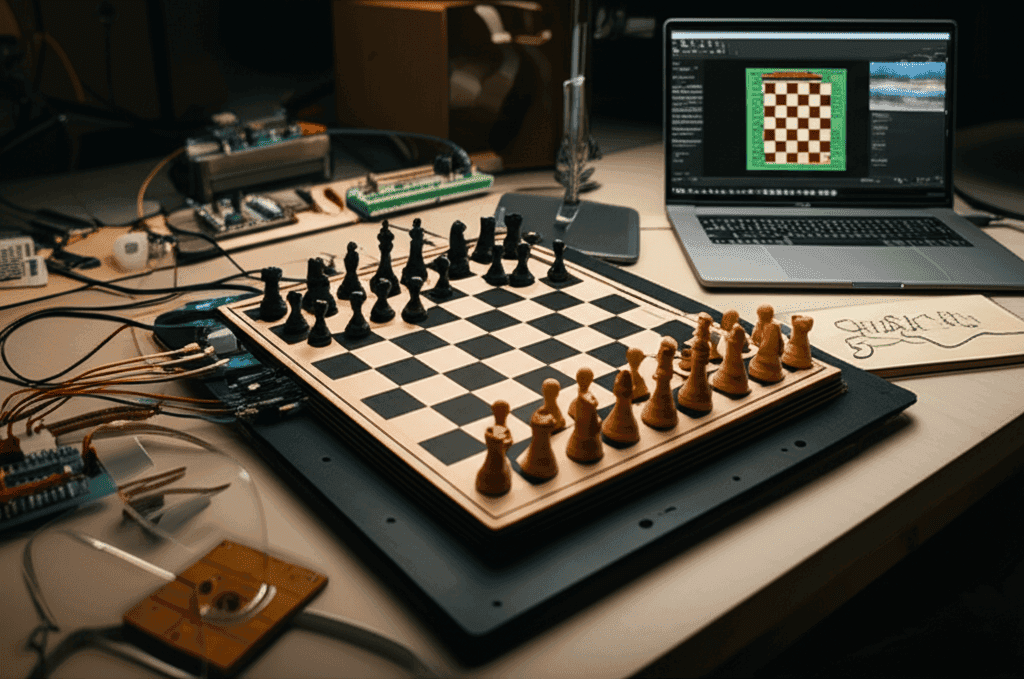
Self playing chess is a fascinating intersection of technology and strategy, and one ambitious maker has brought it to life. Joshua Stanley recently demonstrated a self-made, self playing chess board robot in a video, showcasing his innovative approach to merging the physical and digital worlds of chess.
For chess enthusiasts, the allure of a physical board is undeniable. The tactile sensation of moving pieces and the visual appeal of a well-crafted set offer a unique experience that digital interfaces often struggle to replicate. However, finding an opponent can sometimes be a challenge. Stanley’s project elegantly addresses this issue by automating the movement of pieces, allowing players to enjoy the game against a computer without sacrificing the physical board.
The Tech Behind Automated Chess
Stanley’s design cleverly integrates hardware and software components. He chose to use Hall magnetic sensors to detect the magnets embedded in the 3D printed chess pieces. These sensors, mounted on the back of a PCB that also serves as the playing field, register the presence or absence of pieces. The playing field also uses the silkscreen for the board markings.
An electromagnet, controlled by core x/y kinematics, moves underneath the PCB to engage and move the chess pieces. An ESP32 MCU manages the entire system, while the open-source Stockfish chess engine provides the AI brainpower. As the human player makes moves, the changes in piece positions are detected by the magnetic sensors and fed into Stockfish.
“The use of a PCB for the playing field opens up possibilities for custom designs and colors, especially with the availability of multi-color silkscreens.”
Challenges and Future Improvements
While the demonstration video confirms the project’s functionality, some challenges remain. One minor aesthetic issue is the incorrect placement of black squares in the near-right corners. More significantly, the large size of the pieces can cause them to unintentionally nudge other pieces out of place during moves. This issue is something that would need to be addressed in future iterations.
Another limitation is the system’s inability to identify which piece is placed where. This feature, common in commercial self-playing chess boards, can be invaluable for new players and for detecting illegal moves. Stanley may incorporate this functionality in a future version of the project. related Industries news are closely watching similar innovations.
The Future of Self Playing Chess
The use of a PCB for the playing field is a particularly ingenious aspect of this build. It allows for extensive customization in terms of design and color, especially given the increasing availability of multi-color silkscreens. Stanley’s project offers a glimpse into the future of chess, where technology enhances the traditional game without detracting from its inherent appeal.
Source: Hackaday