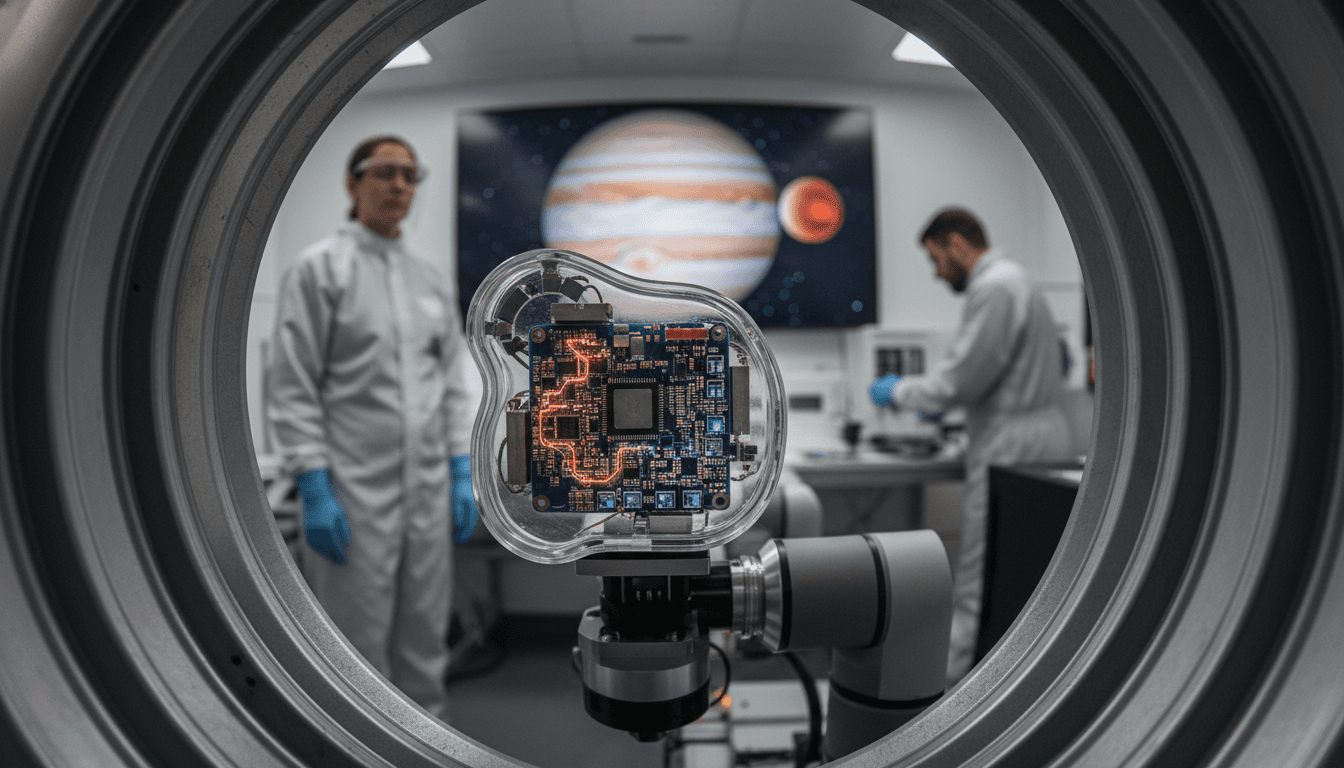
A self-healing CMOS imager is poised to revolutionize space exploration, particularly for missions to harsh environments like Jupiter’s radiation belt. Ionizing radiation, comprised of electrons, protons, and gamma rays, inevitably degrades standard CMOS circuits over time, damaging the oxide layer and disrupting the lattice structure. This constant bombardment poses a significant challenge for long-duration space-based electronics, often leading to costly mission failures or reduced operational lifespans.
Traditional approaches to mitigate radiation damage involve extensive shielding or employing radiation-hardened components, both of which add considerable weight and cost. However, the development of a self-healing CMOS imager offers a groundbreaking alternative, promising enhanced durability and reliability for future spacecraft.
The Challenge of Radiation in Space
Space is an unforgiving environment for electronic components. Beyond the vacuum and extreme temperature fluctuations, the pervasive ionizing radiation is a silent killer of circuitry. Electrons, protons, and gamma rays can cause a cascade of problems, from transient errors to permanent damage. This includes ‘single event effects’ (SEEs) like bit flips, and ‘total ionizing dose’ (TID) effects which accumulate over time, leading to performance degradation and eventual failure. For missions venturing beyond Earth’s protective magnetosphere, such as to Jupiter, these effects are dramatically amplified, necessitating innovative solutions.
How Self-Healing Technology Works
The core innovation behind a self-healing CMOS imager lies in its ability to detect and repair damage autonomously. While specific mechanisms can vary, general principles often involve integrated redundant pathways, on-chip diagnostic sensors, and reconfigurable architectures. When radiation damage occurs, disrupting a specific circuit element or degrading its performance, the system can identify the fault and reroute signals through an undamaged path or even initiate localized repair processes. This adaptive capability significantly extends the operational lifespan of critical components.
“This self-healing capability represents a monumental leap in space-hardened electronics, promising unprecedented longevity for deep-space missions.”
For financial stakeholders in the aerospace and defense sectors, this technology offers a compelling value proposition. Reduced mission risk, extended operational periods for valuable assets, and the potential for more ambitious, longer-duration missions all translate into significant economic benefits. Investing in advanced materials and autonomous repair systems for electronics becomes a critical strategic move for companies looking to lead in the related Industries news of space exploration.
A Self-Healing CMOS Imager for Jupiter
Jupiter’s intense radiation belts are notoriously hostile, presenting one of the toughest tests for any electronic system. An imager capable of self-healing is not just an incremental improvement; it’s a fundamental shift in design philosophy. Instead of simply trying to prevent damage, this technology embraces the inevitability of damage and builds in resilience. This could enable more detailed and prolonged observations of the gas giant, providing invaluable scientific data without the constant threat of component failure.
The implications extend beyond scientific research. Commercial space ventures, including future resource extraction or tourism platforms, will also benefit from electronics that can withstand prolonged exposure to harsh environments. The development of a self-healing CMOS imager marks a pivotal moment, ushering in an era of more robust and reliable space technology.