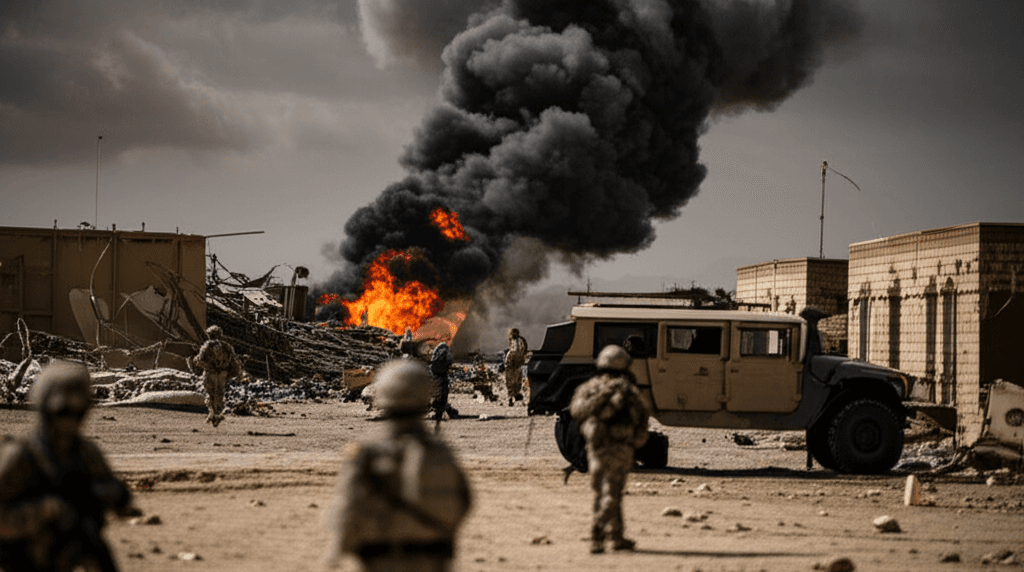
Regional war erupts as the US and Israel launched unprovoked airstrikes against Iran, prompting swift retaliation. Iran has retaliated quickly by launching missiles and drones not just at Israel but also at US bases across the region, igniting widespread conflict. This marks a significant escalation in Middle East tensions, with potentially devastating consequences for global markets and stability.
Escalation in the Middle East
Reports indicate missile interceptions in Qatar and explosions in Abu Dhabi, Kuwait, and Saudi Arabia. A credible source on X reports a mass casualty event at a US base in Saudi Arabia. The immediate impact is being felt across the region, with heightened security measures and widespread anxiety. Tankers have already related Finance news diverted from the Strait of Hormuz, a critical chokepoint for global oil supplies.
President Trump has confirmed major combat operations against Iran, urging Iranians to “take over your government.” The US and Israel plan to carry out several days of intensive attacks, targeting Iran’s missile and nuclear programs. Iran, in response, has unleashed its stockpile of missiles against Israel and US bases in the Gulf.
“The military operation appears to be the US and Israel’s most significant attempt to overthrow the Islamic regime since it swept to power in 1979.”
Iran’s Retaliation: A Regional War Erupts
The Islamic Revolutionary Guard Corps (IRGC) has claimed responsibility for missile and drone attacks on Israel and US bases. Reports suggest that the IRGC targeted the US Navy’s Fifth Fleet headquarters in Bahrain with missiles and drones. These attacks have triggered sirens across Bahrain and raised the specter of a wider regional conflict.
Al Jazeera reports video evidence of plumes of smoke rising after Iran targeted a United States military base in Bahrain, following Israel–US attacks across Iran. The situation is rapidly evolving, with nonstop sirens and alarms throughout Israel, indicating an unprecedented level of intensity.
Global Response and Economic Implications
World leaders are reacting to the unfolding crisis. The EU Commission President Ursula von der Leyen calls for maximum restraint and respect for international law. Russia’s foreign ministry describes the US and Israel’s actions as “reckless” and calls for a return to political and diplomatic solutions. The economic implications are significant, with oil prices already rising and concerns about the potential closure of the Strait of Hormuz. A closure would severely disrupt global oil supplies and trigger a major economic shock.
The Threat of a Wider Regional War
The current situation is fraught with risk. Iran may utilize its strategy of sending slower, older missiles and drones initially to deplete enemy air defenses, followed by more potent weapons to overwhelm remaining defenses. This tactic, observed in past conflicts, could lead to higher penetration rates and greater damage. The potential for miscalculation and escalation is high, raising serious concerns about the possibility of a wider regional war erupts.
In conclusion, the coordinated US and Israeli strikes against Iran, and Iran’s subsequent retaliation against Israel and US bases in the region, have triggered a dangerous escalation. The immediate consequences include rising tensions, potential disruptions to global oil supplies, and a heightened risk of a larger regional war erupts, with potentially devastating geopolitical and economic ramifications. The international community is now grappling with the urgent need to de-escalate the conflict and prevent further bloodshed.