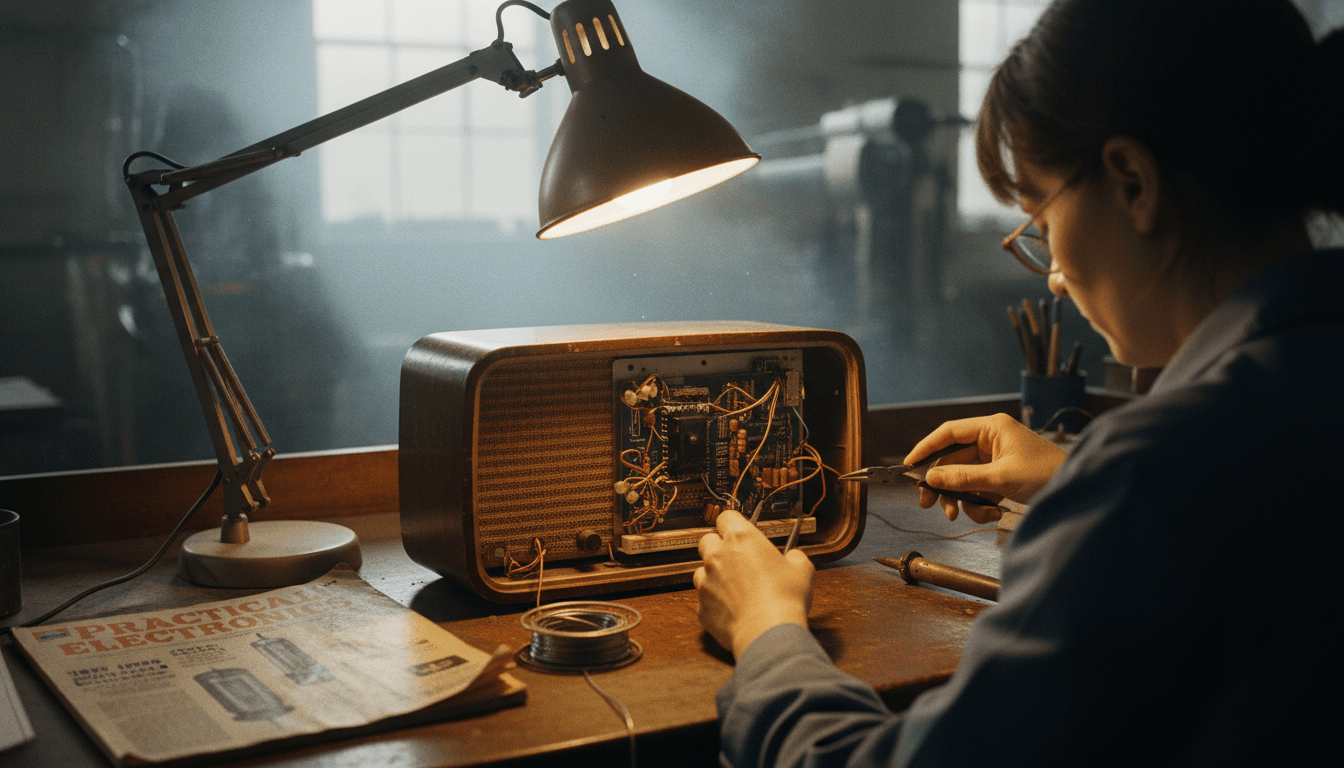
The Reactalyser resurgence is captivating electronics enthusiasts, as vintage projects from old magazines experience a remarkable comeback. This exciting trend, dubbed ‘retromagging’ by some, sees hobbyists leveraging modern accessibility to parts and PCBs to recreate classic circuits, often with clever contemporary twists. It’s a testament to the enduring appeal of hands-on electronics and the ingenuity of past designs.
A prime example of this phenomenon is Anthony Francis-Jones’ impressive recreation of the “Reactalyser” from a 1968 edition of Practical Electronics. While the original name might suggest a device related to electrical reactance, this intriguing circuit, housed in a retro-look radio case, actually measures reaction speed. Francis-Jones’ build is not a direct copy; he thoughtfully updated the circuit to incorporate an OC71 PNP transistor and replaced a mechanical component with more efficient electronics, maintaining the spirit of the original while improving its functionality.
The Enduring Appeal of Vintage Electronics Projects
The current ease of acquiring components and printed circuit boards has significantly lowered the barrier to entry for these retro builds. Where once locating specific, often obsolete, parts was a challenge, today’s global supply chains and online marketplaces make such endeavors far more feasible. This accessibility, combined with a growing appreciation for the foundational principles of electronics, fuels the popularity of revisiting these historical designs. It’s a bridge between the past and present, allowing new generations to understand the engineering challenges and solutions of a bygone era.
“Recreating these vintage circuits offers a unique blend of historical appreciation and practical electronics skill development.”
Before the widespread availability of microcontrollers, circuits like the “Reactalyser” were common ways to achieve what would now be trivial with a small computer. They represent a different approach to problem-solving, relying on discrete components and clever analog design. Understanding these older circuits can provide valuable insights into fundamental electronic principles that are sometimes overlooked in the age of integrated circuits.
The Reactalyser Resurgence: A Look at Anthony Francis-Jones’ Build
Anthony Francis-Jones’ take on the “Reactalyser” is particularly noteworthy. His decision to use an OC71 PNP transistor, a component synonymous with early transistor radios, further enhances the retro feel of the project. The integration into a vintage radio casing is a stroke of genius, giving the device an authentic period aesthetic that perfectly complements its internal workings. While not a 100% faithful reproduction, the modifications demonstrate a thoughtful engagement with the original design, adapting it for modern builders without losing its core identity. This kind of creative adaptation is a hallmark of the Reactalyser resurgence and similar ‘retromagging’ projects.
For those inspired by these old-school electronics, similar projects have been featured, such as Bettina Neumryr’s magazine transistor tester and her function generator from the past. These builds exemplify the joy and learning potential inherent in bringing vintage designs back to life. The Reactalyser resurgence is more than just nostalgia; it’s about hands-on learning, creative problem-solving, and celebrating the rich history of electronics.
The increasing popularity of recreating classic electronics projects, epitomized by the Reactalyser resurgence, highlights a vibrant community passionate about both history and innovation. These projects offer a tangible connection to the past, while simultaneously allowing for modern enhancements, proving that good design principles are timeless.