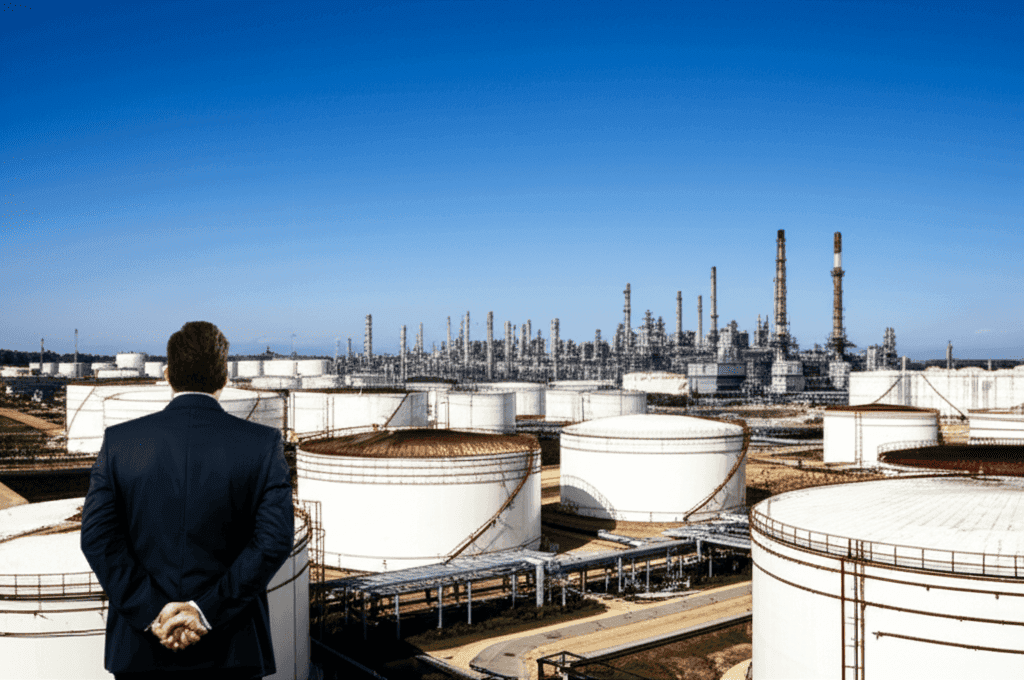
Oil production surge is reshaping the global energy landscape, moving far away from the oil crises of the 1970s. The price of West Texas Intermediate (WTI) recently spiked to $75 per barrel following escalating tensions, but the underlying dynamics are vastly different today. The US has become a major player in the global oil market, a stark contrast to its dependence on OPEC imports decades ago. This transformation is driven by record domestic production and a surge in net exports.
The #1 concern for US oil and gas drillers remains overproduction. Frackers can quickly increase production, often outpacing demand. This overproduction led to significant price crashes in mid-2014 and again in 2020, resulting in bankruptcies for numerous oil & gas companies. “Discipline” in production has become the industry’s guiding principle to prevent another price collapse. Drillers are now aggressively hedging their future production, locking in profitable prices, which also helps to stabilize prices.
Back in the 1970s, the US was heavily reliant on oil imports from OPEC. Today, the US is the world’s largest oil producer and a major exporter of crude oil and petroleum products, exporting far more than it imports. Imports further declined in 2025, with Canada supplying 57% and OPEC only 14%. A significant portion of the oil trade involves importing crude oil, refining it, and exporting value-added products like gasoline and diesel. Even California refineries, despite facing declining gasoline demand, participate in this trade by exporting petroleum products to Latin America.
US Crude Oil Production Hits Record
Crude oil production in the US increased by 2.7% in 2025, reaching a record 13.6 million barrels per day (MMb/d), a 172% increase since 2008, according to EIA data. This surge in production has reshaped global energy dynamics, providing the US economy with relatively cheap and reliable energy for transportation, commercial use, and the vast petrochemical industry. The dips in production in 2016 and 2020-2021 were due to overproduction-induced price collapses and subsequent bankruptcies.
Exports of crude oil and petroleum products remained stable in 2025 at 10.7 MMb/d, a 495% increase from 2008. Imports decreased to 7.9 MMb/d, significantly lower than the peak of 13.7 MMb/d in 2005. The US became a net exporter of crude oil and petroleum products in 2020. In 2025, net exports reached a record 2.8 MMb/d, a stark contrast to the 12.6 MMb/d deficit in 2005. This shift highlights how US oil production has altered global energy dynamics.
The Rise of Net Exports
Exports of petroleum products increased by 1.4% to 6.73 MMb/d, accounting for 63% of total exports, including 2.8 MMb/d of finished motor gasoline, distillate, and jet fuel. Crude oil exports decreased by 2.9% in 2025 to 3.99 MMb/d, representing 37% of total exports. Refineries, even in California, participate in this trade by importing crude oil and exporting gasoline, distillate, and jet fuel, primarily to Latin America. This import-refine-export model is a profitable business for US refiners.
For instance, the US imported 0.50 MMb/d of crude oil from Mexico in 2025 and exported 1.1 MMb/d of petroleum products to Mexico. related Finance news Net exports to Mexico increased to a record 0.59 MMb/d. Among the various petroleum products exported by the US, the largest categories by export volume are distillate (1.26 MMb/d), gasoline (0.80 MMb/d), petroleum coke (0.54 MMb/d), and jet fuel (0.22 MMb/d).
Oil Production Surge: A Key Driver
Exports of propane, ethane, butane, and natural gasoline surged by 7.0% to 3.1 MMb/d in 2025, a significant increase from near zero in 2008. Net exports to Canada are negative, with US exports to Canada rising to 0.87 MMb/d in 2025 and imports from Canada falling to 4.49 MMb/d. The net export deficit with Canada decreased to 3.63 MMb/d. Net exports to Mexico reached a record 0.59 MMb/d, with imports from Mexico falling to 0.50 MMb/d and exports to Mexico dipping to 1.09 MMb/d. In summary, the US has a surplus with Mexico and a deficit with Canada.
“The US has transformed from a major oil importer to a significant exporter, reshaping global energy dynamics.”
Imports from Saudi Arabia decreased to 0.33 MMb/d in 2025, down from the 1.5 MMb/d range before fracking took off. Imports from OPEC overall fell to 1.1 MMb/d, down from the 5-6 MMb/d range before fracking. Imports from Russia dropped to zero in mid-2022 and have remained there.
In conclusion, the oil production surge in the US has fundamentally altered its position in the global energy market. The nation has transitioned from a heavy reliance on imports to becoming a net exporter of crude oil and petroleum products. This shift provides the US economy with relatively cheap and reliable energy, while also presenting new challenges, such as managing overproduction and navigating geopolitical complexities.