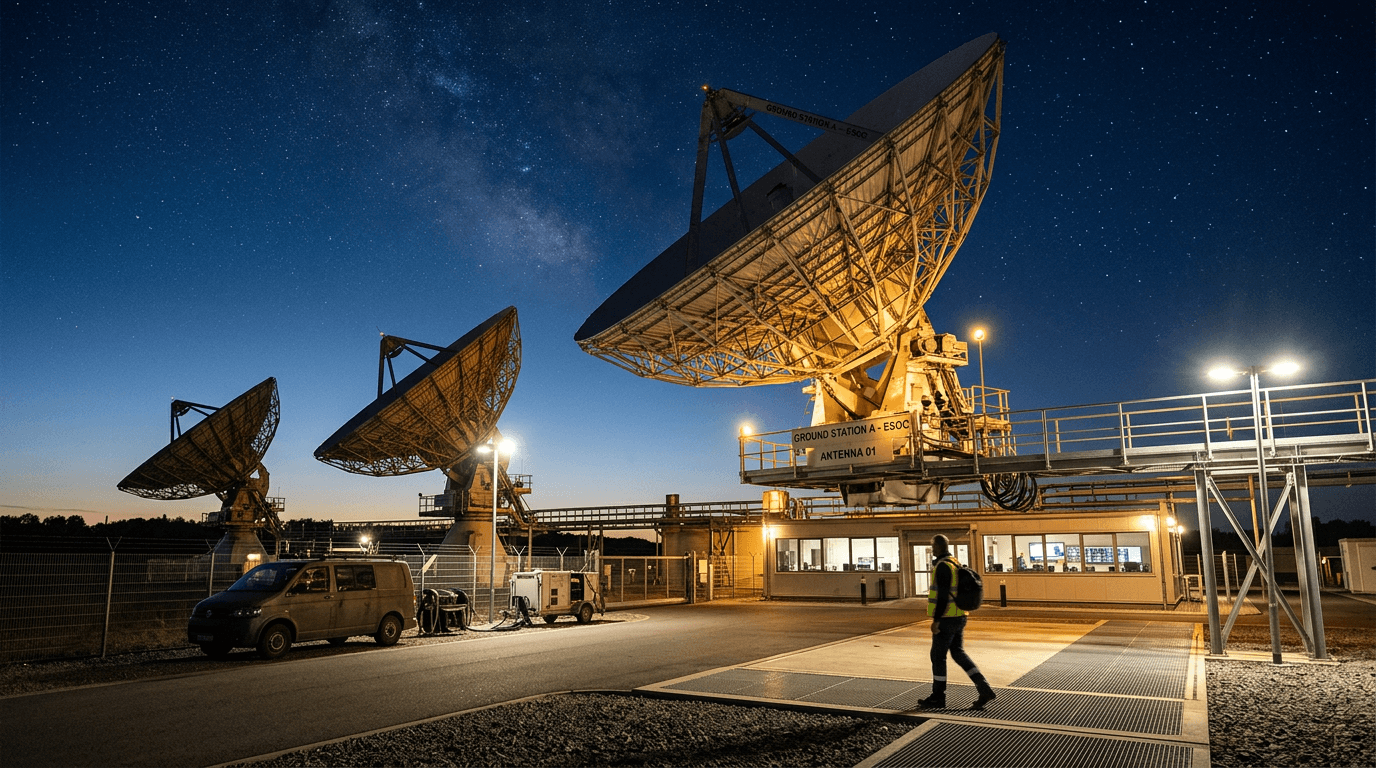
Non-Terrestrial Networks are currently undergoing a massive transformation as telecommunications giants pivot toward space-based infrastructure to solve global connectivity gaps. As the race for orbital dominance intensifies, the financial sector is paying close attention to the technical hurdles that define the next generation of satellite and high-altitude communications. For investors and stakeholders, the shift from terrestrial-only models to hybrid ecosystems represents a multi-billion dollar shift in capital expenditure and infrastructure strategy.
The Evolution of Satellite Connectivity
The telecommunications industry has reached a saturation point with traditional ground-based towers. To reach the remaining third of the global population, companies are looking upward. This transition involves more than just launching hardware; it requires a fundamental rethink of how signals are transmitted across vast distances and through varying atmospheric conditions. The integration of these systems into our daily lives marks a pivotal moment for related Industries news and market forecasts.
“The ability to simulate complex orbital environments before launch is the single greatest factor in reducing the financial risk of new satellite constellations.”
Engineers are now focusing on the intersection of software-defined networking and physical hardware. By creating digital twins of the orbital environment, companies can predict exactly how a signal will behave when traveling from a low-earth orbit satellite to a handheld device in a remote region. This precision is what will eventually drive down the cost of data for the end-user.
Modeling Success for Non-Terrestrial Networks
The deployment of Non-Terrestrial Networks is no longer a theoretical exercise but a rigorous engineering challenge involving advanced scenario modeling. These models must account for the high velocity of satellites, the Doppler shift of frequencies, and the handoff between different orbital assets. Without precise modeling, the risk of signal degradation or total link failure becomes a significant liability for the operating company. This is where array design becomes the hero of the story.
Sophisticated antenna array design allows for beamforming, a technique that focuses a wireless signal in a specific direction rather than broadcasting it in all directions. This maximizes power efficiency and increases the capacity of the network. For financial analysts, these technical efficiencies translate directly into better margins and a faster path to profitability for satellite operators who have historically struggled with high overhead costs.
The Financial Impact of Array Innovation
As we look toward the 2030s, the scalability of these networks will depend on the maturity of phased array technologies. These systems allow for multiple beams to be managed simultaneously, serving thousands of users from a single platform. The cost of manufacturing these arrays has plummeted over the last five years, thanks to advancements in semiconductor materials and automated assembly processes. This reduction in cost is opening the door for smaller players to enter the market, fostering a more competitive and innovative environment.
Furthermore, the convergence of 5G and 6G standards with satellite protocols ensures that the hardware being built today will remain relevant for the next decade. By integrating Non-Terrestrial Networks into the existing global telecommunications framework, providers can offer seamless transitions between cellular towers and satellite links. This interoperability is the “holy grail” for logistics companies, maritime operators, and aviation firms that require constant, high-speed uptime regardless of their geographic coordinates.
In conclusion, the future of Non-Terrestrial Networks remains one of the most exciting frontiers in both technology and finance. The combination of advanced scenario modeling and innovative array design is bridging the gap between high-altitude potential and ground-level reality. As these technologies mature, they will not only provide a significant return on investment for early adopters but will also fundamentally democratize access to information on a global scale, proving that the sky is no longer the limit for the telecommunications industry.