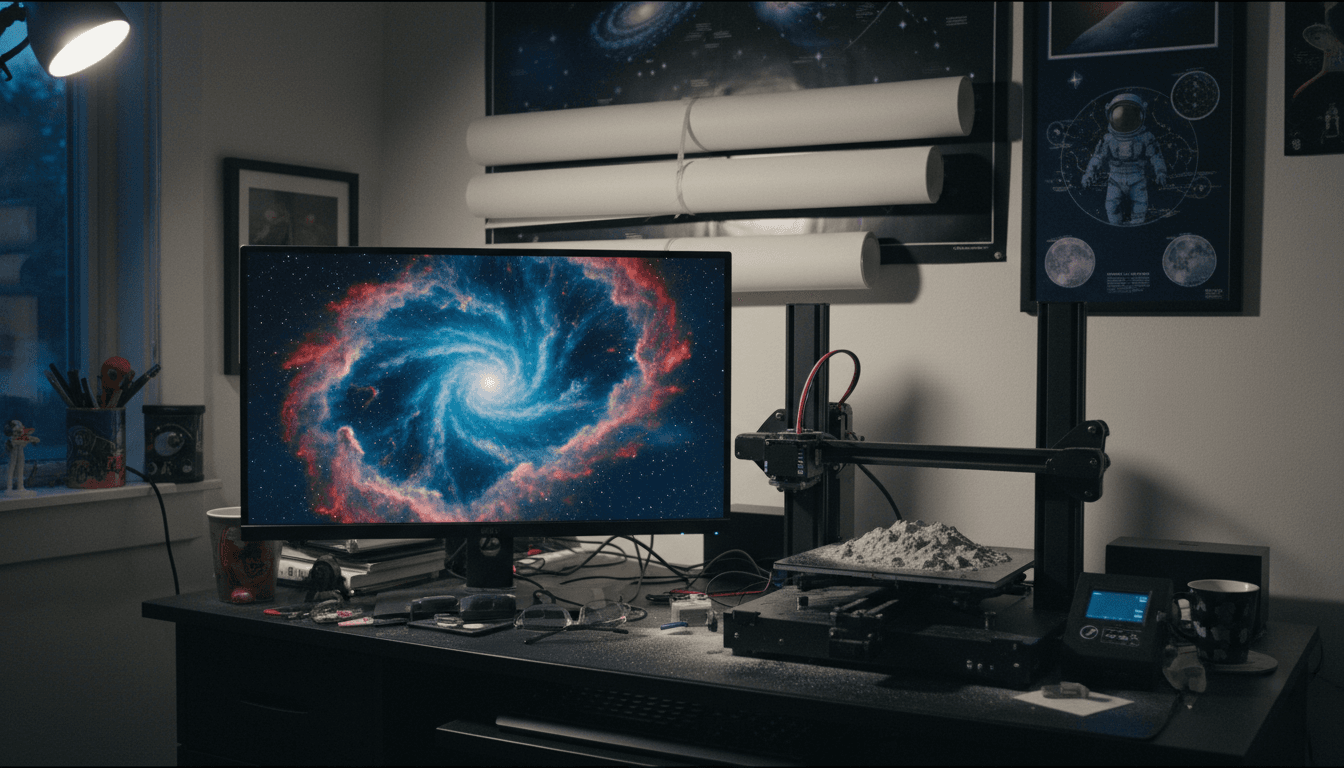
NASA 3D models are transforming how enthusiasts engage with the cosmos, as highlighted in a recent Hackaday article titled “A Nebula Straight From The Stars To Your Table.” Published on March 31, 2026, the piece by Ian Bos details the significant expansion of NASA’s catalog of downloadable 3D models and other space-related files, enabling individuals to bring the marvels of deep space directly into their homes.
The Hackaday article underscores the remarkable evolution of NASA’s digital resource since 2016. What began as a simple GitHub repository has blossomed into a sophisticated, user-friendly interface complete with filtering capabilities. A crucial enhancement is the inclusion of detailed descriptions for most 3D models, offering invaluable background information on the celestial objects they represent, such as the iconic Crab Nebula. Beyond intricate 3D renditions, the catalog also provides a wealth of non-3D files, including comprehensive star maps and full planetary maps, making astronomical exploration more accessible than ever.
The Wonders of Celestial Objects at Your Fingertips
Nebulae, central to many of these digital offerings, are immense clouds of gas and dust scattered across space, playing a pivotal role in the life cycle of stars. They serve as stellar nurseries where new stars are forged, or as expanding remnants of gas and dust ejected by dying stars. Prominent examples frequently discussed in astronomy include the Orion Nebula, a dynamic star-forming region located approximately 1500 light-years away, and the Ring Nebula, which represents the outer atmosphere of a star in its final stages. The Crab Nebula, a supernova remnant, is famously situated in the constellation Taurus.
“NASA’s expanded digital catalog offers unprecedented access to the universe, bridging the gap between scientific discovery and public engagement.”
While the Hackaday article primarily focuses on the accessibility and user-friendliness of these digital resources, it also humorously alludes to NASA’s broader and more critical missions, such as ensuring “the Moon doesn’t explode.” This light-hearted mention reminds us of the diverse and vital work undertaken by the space agency, from groundbreaking scientific research to fostering public interest through initiatives like these comprehensive NASA 3D models. The article was part of Hackaday’s regular blog content, published alongside other intriguing topics like an “LED Matrix Clock” and “How Small Can A Linux Executable Be?”.
Impact on Education and Engagement
The availability of these high-quality NASA 3D models is not just a boon for hobbyists; it represents a significant advancement for educational institutions and science communicators. Imagine students exploring the intricate structures of the Orion Nebula or mapping the surface of Mars with models derived directly from NASA’s own data. This democratization of scientific data fosters a deeper understanding and appreciation for space exploration, potentially inspiring the next generation of scientists and engineers. For more insights into how technological advancements are reshaping various sectors, explore our related Industries news.
In conclusion, the expansion of NASA’s downloadable catalog, featuring a rich array of NASA 3D models and other space files, marks a pivotal moment for public engagement with astronomy. By transforming complex scientific data into accessible, interactive experiences, NASA is not only bringing the cosmos closer to home but also igniting curiosity and wonder across the globe.