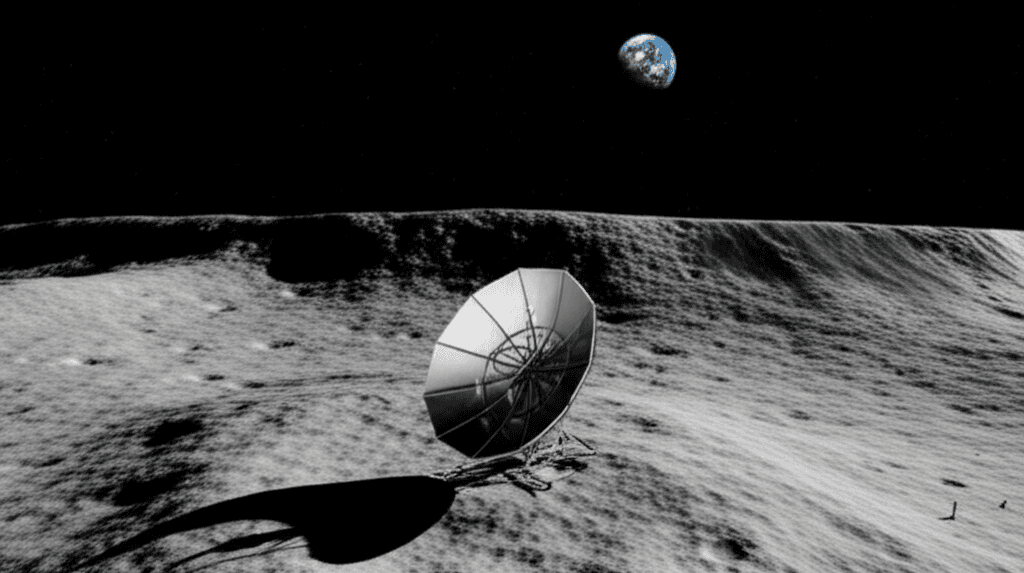
The **moon radio telescope** project, specifically LuSEE-Night, holds immense potential for groundbreaking astronomical discoveries. This ambitious endeavor, detailed in the February issue of IEEE Spectrum, aims to place a radio telescope on the far side of the Moon, shielded from Earth’s radio interference.
Unlocking the Universe’s Secrets
The far side of the Moon presents a unique environment for radio astronomy. Free from the constant barrage of terrestrial radio waves, a **moon radio telescope** can detect faint signals from the early universe, potentially revealing insights into the formation of the first stars and galaxies. This could revolutionize our understanding of cosmology and astrophysics.
LuSEE-Night is designed to capture low-frequency radio waves that are blocked by Earth’s atmosphere and increasingly obscured by human-made radio noise. By operating in this pristine environment, the telescope will be able to probe the so-called “dark ages” of the universe, a period before the first stars ignited and ionized the surrounding gas. This era holds crucial clues about the initial conditions of the cosmos.
“The far side of the Moon offers an unparalleled opportunity to study the early universe without the interference of Earth’s radio emissions.”
Challenges and Technological Innovations
Placing and operating a telescope on the Moon is no easy feat. The extreme temperatures, vacuum conditions, and lack of infrastructure present significant engineering challenges. LuSEE-Night requires innovative solutions in areas such as power generation, thermal management, and robotic deployment. Moreover, ensuring reliable communication with Earth is paramount, necessitating advanced communication technologies. related Industries news.
The mission also necessitates overcoming logistical hurdles, including transporting the telescope to the Moon and deploying it autonomously. This calls for close collaboration between engineers, scientists, and space agencies. The knowledge gained from LuSEE-Night will not only advance our understanding of the universe but also spur technological advancements in space exploration and robotics.
The Financial Implications of Lunar Exploration
While the primary goal of LuSEE-Night is scientific discovery, the project also has potential financial implications. The development of new technologies for lunar exploration can create opportunities for commercial space companies. Furthermore, the potential discovery of valuable resources on the Moon could lead to future economic activities. Investment in lunar research and development can therefore provide long-term economic benefits.
The Future of Moon Radio Telescope Missions
LuSEE-Night is just the beginning. Its success could pave the way for more ambitious lunar observatories in the future. Imagine a network of radio telescopes scattered across the far side of the Moon, working together to create a giant virtual telescope. Such a facility could provide unprecedented insights into the universe, transforming our understanding of cosmology, astrophysics, and even the search for extraterrestrial life. The quest to understand our place in the cosmos is an ongoing journey, and the far side of the Moon may hold the key to unlocking some of its deepest secrets. The **moon radio telescope** represents a significant step forward.
Source: IEEE Spectrum