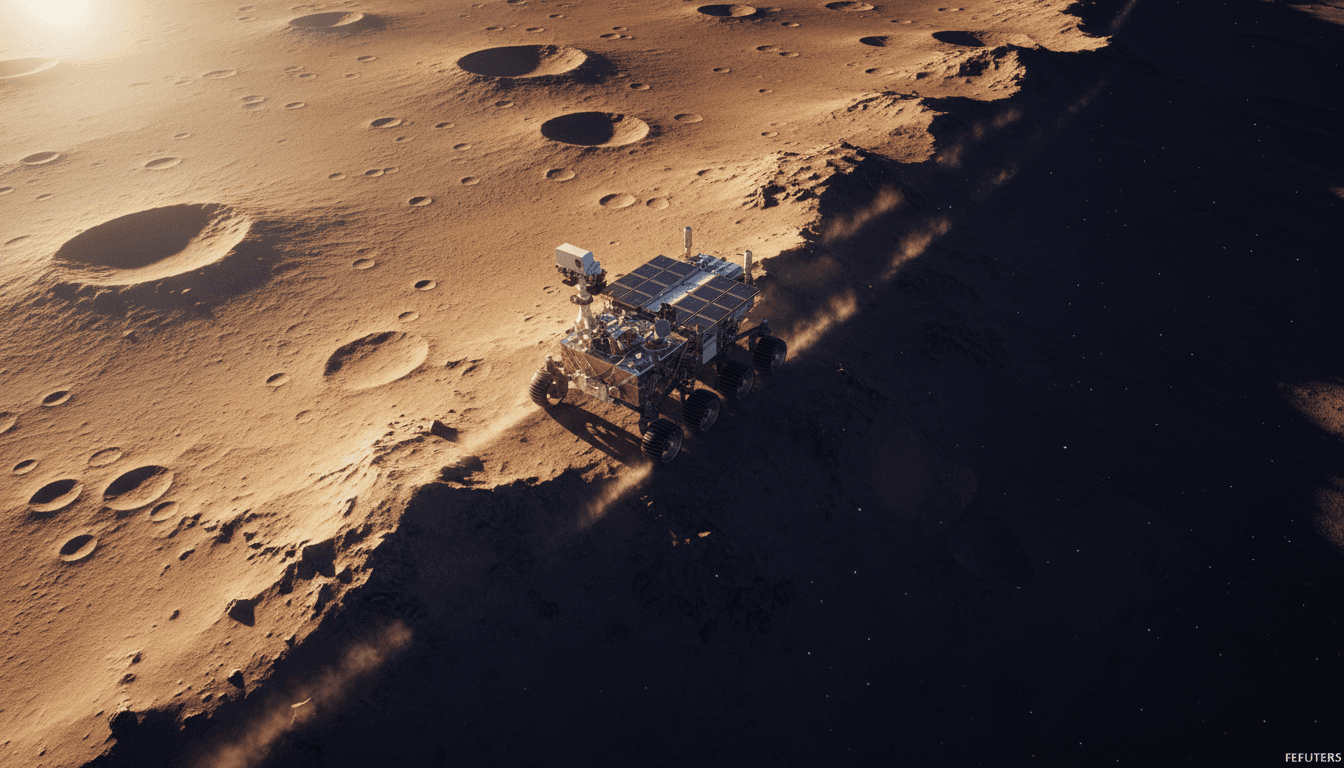
A **Mercury rover exploration** could soon become a reality, with new research proposing a groundbreaking strategy: sticking to the planet’s ‘terminator’ line. While Mars boasts a legacy of successful rover missions, the extreme conditions on other planets have largely precluded similar direct surface exploration. Venus, for instance, presents an insurmountable challenge with its crushing atmosphere and scorching surface. However, Mercury, often overlooked due to its proximity to the Sun, might just be a plausible candidate for a wheeled explorer, according to a recent study by M. Murillo and P. G. Lucey, highlighted by Universe Today.
The benefits of deploying a rover on a planetary surface are undeniable. Unlike orbiting or fly-by probes, rovers offer the invaluable opportunity for direct geological sampling and in-situ analysis, providing a deeper understanding of a planet’s composition and history. Yet, translating this success to Mercury – a world akin to a slightly larger Moon positioned perilously close to the Sun – introduces a unique set of engineering hurdles.
Navigating Mercury’s Extreme Environment
Mercury’s lack of a substantial atmosphere leaves its surface brutally exposed to the Sun’s relentless radiation and extreme temperature fluctuations. While it does possess a magnetic field, roughly 1.1% the strength of Earth’s, this only slightly mitigates the intense ionizing radiation. The primary challenge for any **Mercury rover exploration** lies in enduring temperatures that swing wildly from a frigid -173 °C on the night side to a blistering 427 °C in direct sunlight at the equator, all within an 88 Earth-day day/night cycle. This stark contrast makes Venus’s constant mean temperature of 464 °C almost seem uniform by comparison.
The Terminator Strategy: A Path to Survival
To overcome these formidable environmental challenges, the researchers propose an ingenious solution: a rover designed to perpetually follow the ‘terminator’ – the dynamic boundary between Mercury’s day and night sides. This constant motion would allow the rover to maintain a more stable, albeit still challenging, temperature range, avoiding the destructive extremes of prolonged day or night exposure. The concept is reminiscent of strategies for maintaining optimal conditions for delicate instruments in orbit.
“Successfully navigating Mercury’s terminator requires unprecedented levels of autonomy and speed, pushing the boundaries of current robotic exploration capabilities.”
For a solar-powered rover, this strategy demands continuous energy harvesting from a perpetually low-angle sun. Crucially, the rover would need to maintain a minimum speed of 4.25 km/h to keep pace with the terminator’s movement. Falling behind and becoming stranded on either the searing day side or the freezing night side would spell certain doom. This relentless pace would allow little room for the leisurely, extensive exploration common on Mars. Instead, it would necessitate a high degree of autonomous navigation and decision-making, building upon the advanced capabilities currently being developed for Martian rovers, such as NASA’s pioneering work in global localization for the Perseverance rover. This level of robotic independence represents a significant leap forward in interplanetary exploration, potentially opening new frontiers for direct study.
Implications for Future Space Missions
The prospect of a **Mercury rover exploration** marks a significant advancement in our quest to understand the solar system’s inner workings. While technically demanding, the rewards of direct geological sampling and environmental data from Mercury would be immense, offering critical insights into planetary formation and evolution in extreme environments. This bold approach could redefine our capabilities for robotic exploration beyond Mars and open doors to similar missions in other challenging, yet scientifically rich, celestial bodies. This innovative strategy underscores a future where robotic ingenuity overcomes even the most hostile extraterrestrial conditions, pushing the boundaries of what’s possible in space science. For more on cutting-edge space technology, explore our related Industries news.