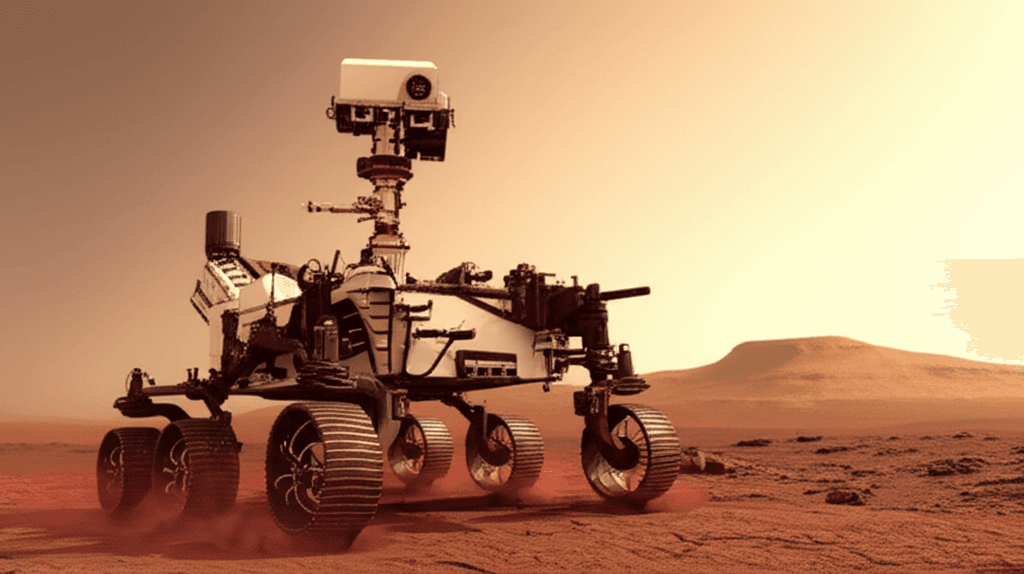
Mars rover navigation has taken a significant leap forward as NASA’s JPL engineers have successfully implemented Mars Global Localization on the Perseverance rover, effectively providing it with autonomous navigation capabilities. This innovative approach offers a crucial alternative to relying on Earth-based commands for determining the rover’s location on the Martian surface.
The key to this breakthrough lies in repurposing the rover’s Helicopter Base Station (HBS) processor, originally intended for communication with the Ingenuity helicopter. With Ingenuity now a stationary testbed after a propeller-damaging landing, the HBS became available for a new mission. Engineers reprogrammed it to run an algorithm that compares panoramic images from the rover’s navigation cameras with onboard orbital terrain maps.
This terrain-based navigation system, similar to those used in cruise missiles on Earth, offers high accuracy, contingent on the precision of the terrain maps. Previously, this mapping process was conducted on Earth, but recent advancements have empowered the rover to perform this task independently, significantly enhancing its operational efficiency. This advancement could be a game-changer for future Mars missions, reducing reliance on Earth-based control and increasing the rovers’ autonomy.
Repurposing Hardware for Martian Exploration
Utilizing the off-the-shelf processor in the HBS presented a unique opportunity. The HBS processor’s speed significantly outstrips that of the custom, radiation-hardened processors that govern the rover’s core functions. This made it an ideal candidate for running the computationally intensive localization algorithm. Moreover, repurposing this hardware provided a valuable means of assessing the impact of radiation on standard components in the harsh Martian environment. related Industries news
“This innovative approach offers a crucial alternative to relying on Earth-based commands for determining the rover’s location on the Martian surface.”
Validating Reliability in a Hostile Environment
To ensure reliability, the localization algorithm was run multiple times on the HBS, with the results cross-validated by the rover’s main computer. This process revealed discrepancies attributed to damage affecting approximately 25 bits within the 1 GB of RAM. By isolating these compromised bits, the algorithm’s functionality was restored, demonstrating the resilience and adaptability of the system. The fact that Mars rover navigation can now be automated is a major step forward.
The Ingenuity Legacy and Mars Rover Navigation
The success of this initiative also underscores the ingenuity of the Ingenuity program. Originally conceived as a relatively low-budget add-on to the Perseverance mission, Ingenuity’s technological contributions have paved the way for new capabilities, including autonomous Mars rover navigation. The ability of the rover to self-localize is transformative.
Autonomous Navigation: A Paradigm Shift for Mars Exploration
The successful implementation of Mars Global Localization on the Perseverance rover represents a paradigm shift in Martian exploration. By enabling autonomous Mars rover navigation, NASA has reduced the rover’s dependence on Earth-based instructions, enhancing its efficiency and extending its operational range. This breakthrough not only advances the Perseverance mission but also lays the foundation for future robotic exploration of Mars and beyond. The implications for improved Mars rover navigation are significant.