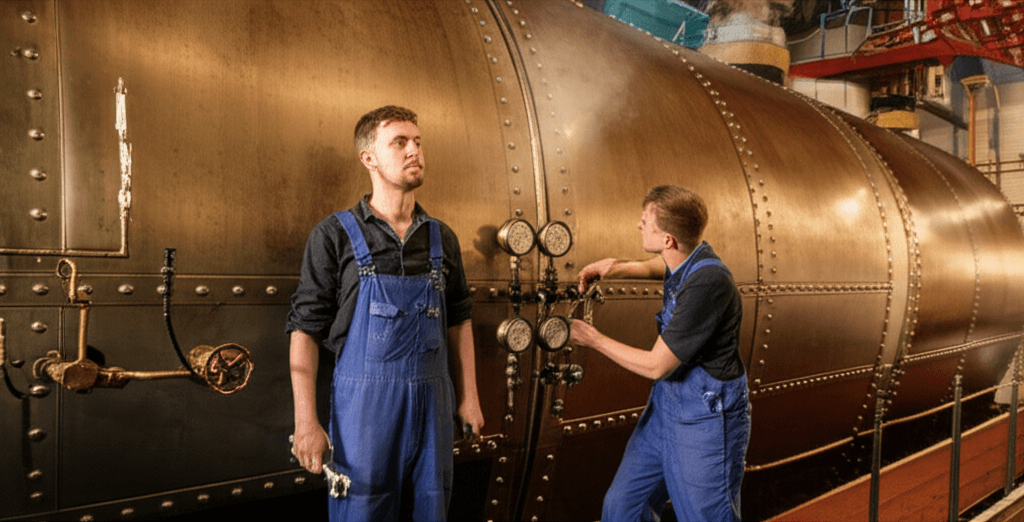
Lancashire boiler restoration is a critical process for maintaining historical industrial equipment and ensuring safe operation. The Industrial Revolution relied heavily on steam power, making boilers essential, though potentially dangerous due to high pressures. At Claymills Pumping Station, volunteers are diligently working to restore five Lancashire boilers, which, while operating at a relatively benign 80 PSI compared to high-pressure steam locomotives (200-300 PSI), still require meticulous attention to detail.
The Victorian-Era Pumping Station
The Claymills Pumping Station, a relic of the Victorian era, houses five twin-flue Lancashire boilers. These boilers, approximately 90 years old after a 1930s replacement, are gradually being brought back into service. Boiler 1, the focus of a recent restoration effort, was last operational in 1971 before the station was decommissioned. Boilers 2 and 3 were known to be in poor condition, necessitating a replacement for Boiler 5, which was soon due for maintenance.
The efficiency of a Lancashire boiler lies in its design. related Industries news have shown similar restoration projects are often costly, but worthwhile investments. It’s engineered to maximize fuel efficiency by using two flues to extract thermal energy from burning coal, which then heats the surrounding water. This process generates steam, and the resulting pressure necessitates robust safety mechanisms to prevent dangerous over-pressurization. The focus keyphrase is essential to understanding the process.
“Restoring these boilers isn’t just about preserving history; it’s about understanding the ingenuity of Victorian engineering and the importance of safety in industrial operations.”
Hydraulic Testing and Safety Margins
After decades of neglect, the restoration process began with the removal of scale, grime, and detritus. Subsequently, all safety mechanisms were thoroughly inspected, repaired, or replaced. Following this, a hydraulic pressure test simulated steam pressure without the hazards. After several attempts, addressing leaks in old piping and ominous creaking, the boiler successfully reached the 1.5x safety margin of 120 PSI. It maintained this pressure for the required thirty minutes without further issues. Lancashire boiler restoration is a complex process.
This successful hydraulic test clears Boiler 1 for an official inspection by a boiler inspector. Upon approval, the boiler can resume its operations, picking up where it left off in 1971 when the pumping station was decommissioned. Lancashire boiler restoration is a step back in time.
Ensuring Longevity and Operational Readiness
The successful restoration of Boiler 1 at Claymills Pumping Station highlights the dedication and expertise required to preserve these historical machines. The process, involving meticulous cleaning, safety inspections, hydraulic testing, and regulatory approvals, ensures the boiler’s safe and efficient operation for years to come. This painstaking work underscores the importance of preserving industrial heritage and the value of understanding the engineering principles of the past. The Lancashire boiler restoration represents a significant achievement in industrial preservation.
The ongoing efforts at Claymills Pumping Station serve as a testament to the enduring legacy of steam power and the ingenuity of Victorian engineering. By restoring these Lancashire boilers, volunteers are not only preserving history but also providing a valuable educational resource for future generations. The focus keyphrase has been an important part of this article.
Source: Hackaday