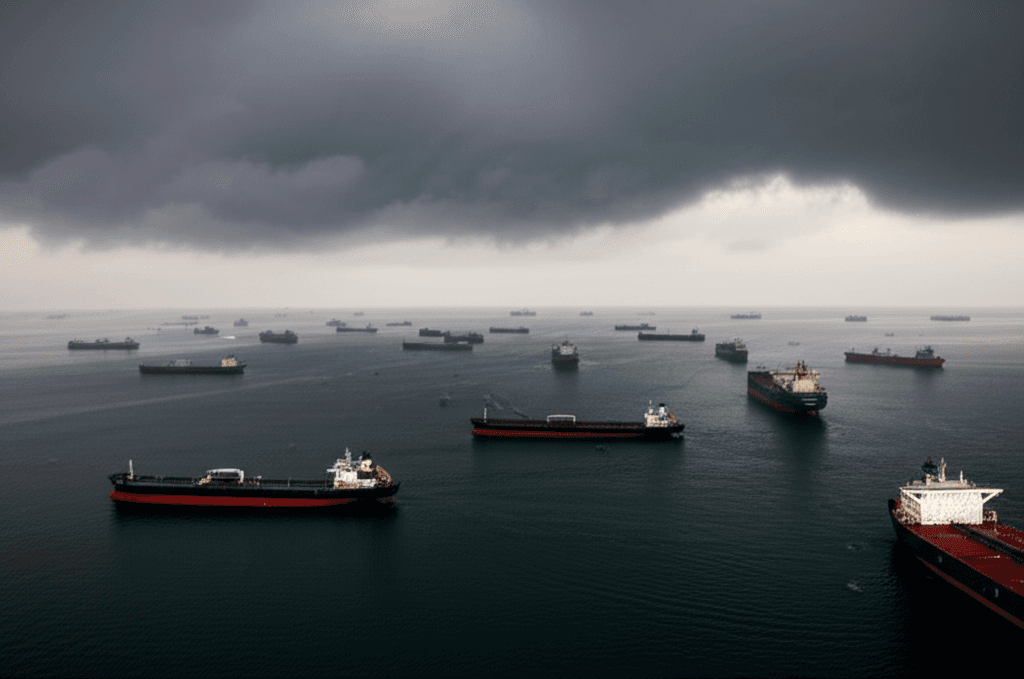
The **Iran war risk** is escalating rapidly, and the potential systemic implications of a Strait of Hormuz closure are becoming increasingly clear. Before delving into the kinetic war updates and related political developments, it is crucial to examine Craig Tinsdale’s article, “Systemic Risk: A 12-Order Cascading Analysis of a Zero-Flow Strait of Hormuz Closure.” This analysis underscores the urgent need for the investor class to recognize the gravity of the situation and the potential for significant market disruption.
Tinsdale’s analysis is not only credible but also deeply alarming. He argues that the modern world, built on efficiency, cost minimization, and logistical precision, has created a system of extreme dependence, making it vulnerable to disruptions in critical supply chains. The related Finance news highlights the growing anxiety amongst investors.
The Cascading Effects of a Strait of Hormuz Closure
The closure of the Strait of Hormuz would trigger a series of cascading effects, starting with fuel inflation and leading to fertilizer inflation, followed by food inflation. This, in turn, could result in urban instability, sovereign subsidy exhaustion, and ultimately, widespread hunger. As Tinsdale warns:
“In this sequence, food shortages are not a secondary humanitarian issue. They are one of the central political outcomes of the crisis, because modern populations do not experience systemic breakdown first through grand strategy, but through unaffordable bread, intermittent power, empty pharmacies, and possibly the collapse of public order. A globalised Arab Spring.”
Hyperinflation would emerge as a social expression of real physical bottlenecks, impacting household budgets and state ledgers alike. The destruction of planning would follow, as firms struggle to quote prices, governments struggle to provide subsidies, and populations lose the ability to calculate the future. Credit markets would seize up, foreign-exchange reserves would deplete, and sovereign spreads would widen, blurring the lines between economic and political crises.
Systemic Risk: A Looming Threat
Modern technical systems amplify, rather than dampen, this disorder. The closure of a maritime strait could reach into the server rack, the hospital network, the payment system, the electrical substation, and the defence-industrial base. The idea that digital civilization floats above heavy industry would be extinguished, revealing that compute rests on copper, transformers, stable voltage, LNG, and ships. The **Iran war risk** is a serious threat to global stability.
While import-dependent and fiscally weak societies would experience the most immediate suffering, advanced economies would also face industrial contraction, infrastructure delays, AI and semiconductor bottlenecks, strategic stockpiling, and the permanent repricing of security over efficiency. The globalization we know will be hardened into armed blocs. The implications of this **Iran war risk** are widespread and severe.
The Potential for Global Cooperation
Tinsdale emphasizes that the ultimate danger is the transition from a globally integrated commercial order into a world system governed by scarcity, coercion, and administrative triage. To prevent this, the whole world, including China, the US, and Europe, must work together to bring the situation under control immediately. The political cycle over the coming days and weeks will be crucial. The **Iran war risk** requires immediate and coordinated action.
The potential cascades include: Polyester -> apparel; Natural gas -> fertilizer -> food; Sour crude / sulfur -> sulfuric acid -> copper; Propylene -> polypropylene -> medical and packaging; Salt + power -> chlorine / caustic soda -> water treatment; Natural rubber + synthetic rubber -> tires -> freight; Iron ore + metallurgical coal -> steel -> construction and machinery; Bauxite + alumina + cheap power -> aluminum -> transport and packaging; Soda ash + natural gas -> glass -> buildings, autos, solar; High-purity gases and chemicals -> semiconductors -> electronics and autos.
In conclusion, the potential closure of the Strait of Hormuz presents a grave and immediate threat to the global economy. A failure to address the **Iran war risk** and its potential consequences could lead to a catastrophic transformation of the world order, characterized by scarcity, coercion, and administrative triage. Immediate, coordinated action is essential to mitigate this systemic risk.