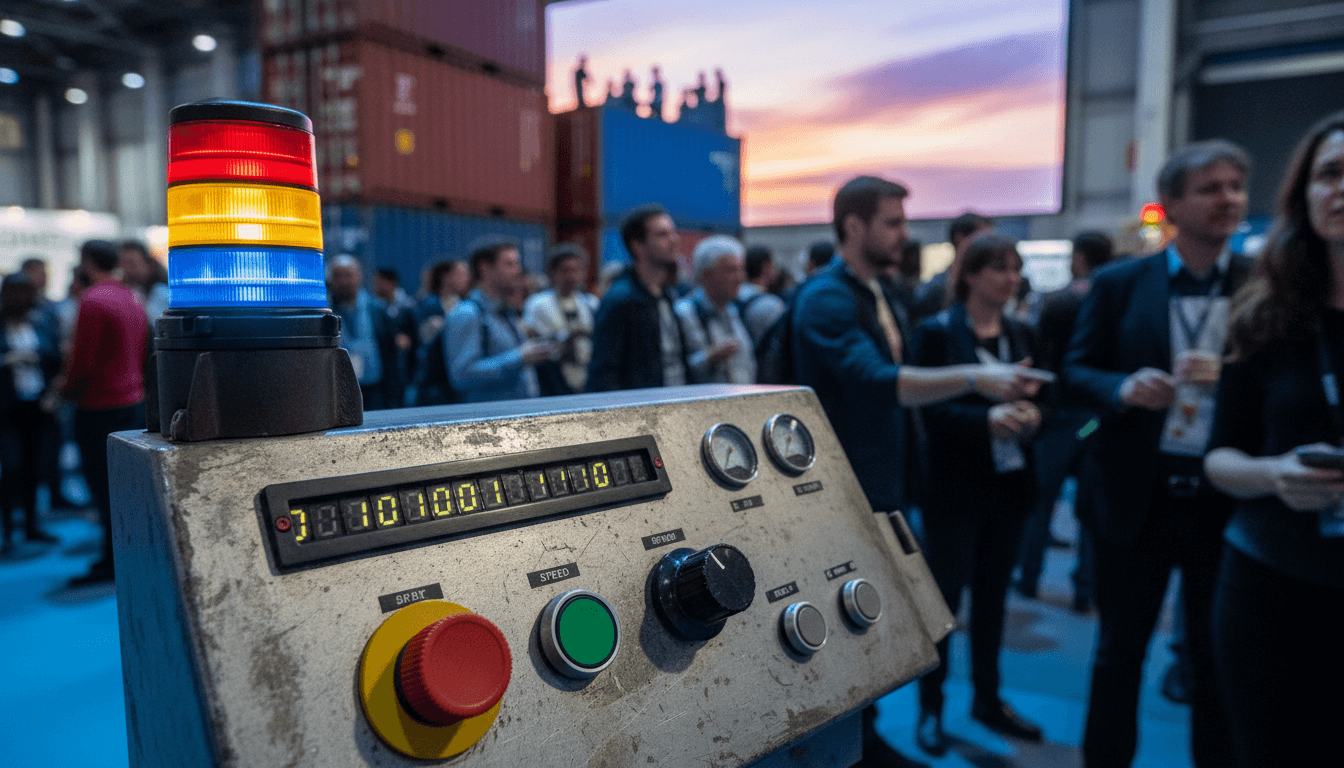
A fascinating related Industries news project visually demonstrating industrial Gray codes has recently come to light, showcasing an innovative application of this critical binary system. This initiative, highlighted in a recent Hackaday article, features an individual named [Attoparsec] who leveraged an industrial display to bring the abstract concept of Gray codes to life, reportedly inspired by Donald Knuth’s seminal work, “The Art of Computer Programming.”
Understanding Industrial Gray Codes
Gray codes, also known as reflected binary codes, represent a unique binary numeral system where the transition between any two successive values involves only a single bit change. This inherent property is paramount in mitigating errors during shifts between digital states, effectively preventing the ambiguity that can arise when multiple bits simultaneously change in standard binary code. Frank Gray, a physicist at Bell Labs, pioneered and patented a method in 1953 to convert analog signals into reflected binary code groups, solidifying the widespread adoption of the term “Gray code.”
The Ingenious Demonstration Project
[Attoparsec]’s project serves as a practical, visual aid for grasping the intricacies of industrial Gray codes. The setup cleverly employs an industrial signal light, commonly found in factory environments to communicate machinery status. This light is then programmed to cycle through various code sequences. A standard binary counter operates in parallel, providing a direct point of comparison between standard binary and Gray code, as well as other algorithms tackling similar challenges.
“The deliberate choice of robust industrial equipment for this Gray code demonstration underscores a practical approach to technical education and problem-solving in real-world settings.”
The decision to utilize an industrial display and older industrial equipment for the project’s construction was a strategic one. [Attoparsec] developed this interactive display specifically for the Open Sauce festival in San Francisco, necessitating a durable and rugged design. Beyond its resilience, the industrial aesthetic perfectly complements the signal light itself, with the thoughtful inclusion of a speed controller and an emergency stop button further enhancing the overall industrial motif.
Pervasive Applications of Gray Codes
The utility of industrial Gray codes extends across numerous applications where precision and error minimization are paramount. These include:
- Rotary Encoders: Essential in robotics and industrial machinery for measuring the position of rotating objects, these devices depend on Gray codes to ensure accurate tracking and prevent misinterpretation from simultaneous bit changes.
- Error Correction: Gray codes play a vital role in algorithms designed for detecting and correcting errors in digital communications, from satellite links to digital terrestrial television, by significantly reducing the probability of multiple concurrent errors.
- Analog-to-Digital Converters (ADCs): They are instrumental in minimizing errors during the crucial conversion of analog information into digital data.
- Digital Sensors and Control Systems: By simplifying hardware design and reducing ambiguity, Gray codes ensure reliable state detection in complex systems.
- Genetic Algorithms: Their single-bit change property makes them invaluable in genetic algorithms, allowing for incremental changes in the code and minimizing Hamming distances.
The visual demonstration of industrial Gray codes by [Attoparsec] not only demystifies a fundamental computer science concept but also highlights its enduring relevance and practical applications in the modern industrial landscape. This project serves as a testament to the power of hands-on learning and the enduring impact of foundational texts like those by Donald Knuth.