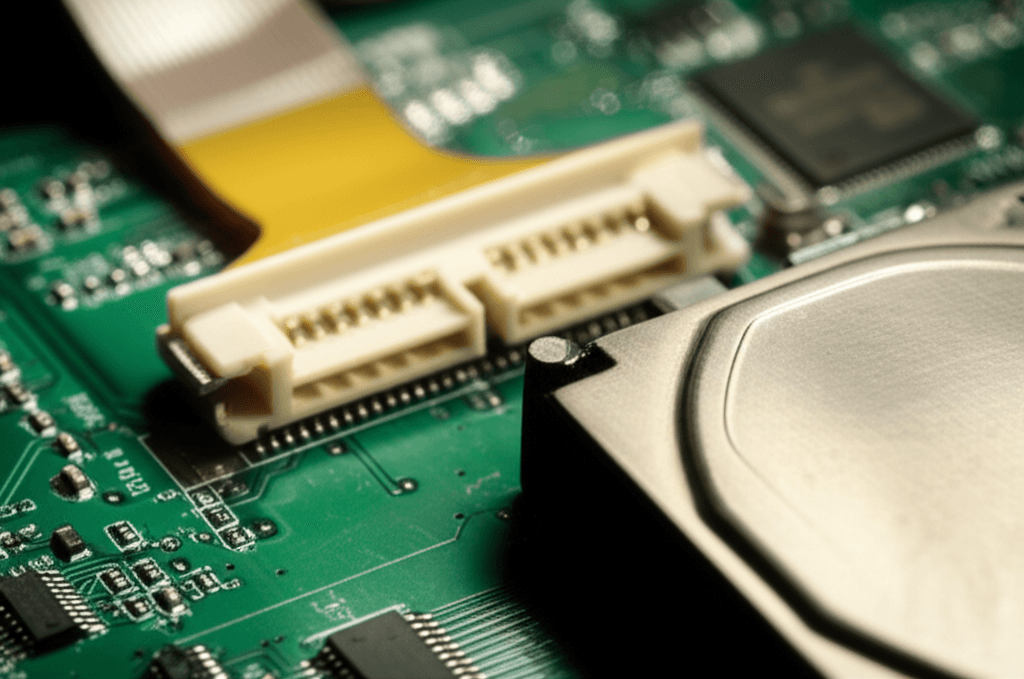
The **IDE USB bridge** market just got a major boost thanks to a new open-source project called ATABoy. You can often find IDE to USB bridges, but they frequently fail with older drives because they need logical block addressing (LBA), which didn’t become standard until the mid-1990s. JJ Dasher, also known as redruM0381, created ATABoy, an open-source IDE bridge that can handle even the oldest drives.
The RP2350 is at the heart of the build, functioning as both IDE and USB host controller. After a simple setup, the drive connected to ATABoy is recognized as a standard USB mass storage device. The vintage of these drives means some setup is necessary. Fortunately, JJ has included a BIOS-themed configuration utility accessible via any serial console. According to JJ, “Auto Detect & Set Geometry” usually works, but you can manually input the Cylinder-Head-Sector (CHS) values if needed, bringing back nostalgic memories.
ATABoy: A Solution for Legacy Drives
While the custom PCB has a USB-C connector, ATABoy doesn’t include power delivery, even though the USB-C standard could power older spinning rust drives. You can use the PSU in your desktop if you’re using it with one; MOLEX hasn’t changed. You’ll need a separate power supply if you’re using a laptop.
“ATABoy offers a crucial bridge to the past, allowing access to data stored on legacy IDE drives that would otherwise be inaccessible.”
Alternatively, if you’re using a Raspberry Pi or similar SBC, you can bypass USB and use the GPIO for PATA IDE. See related Industries news for more on retro tech solutions.
Open Source Advantage
The fact that ATABoy is open source is a significant advantage. This allows users to modify and improve the design, ensuring its longevity and adaptability to future needs. The **IDE USB bridge** market is often dominated by proprietary solutions, making this open-source alternative a breath of fresh air for tech enthusiasts and data recovery specialists.
Configuration and Setup
Setting up ATABoy may require some familiarity with older drive technologies, but the included BIOS-themed configuration utility simplifies the process. The ability to manually input CHS values is a welcome feature for those dealing with particularly old or unusual drives. This level of control is often lacking in commercial **IDE USB bridge** solutions.
The Continued Relevance of Legacy Technology
Even in 2026, the need to access data from legacy storage devices persists. Businesses and individuals often have valuable information stored on older IDE drives that needs to be retrieved. The ATABoy project highlights the importance of preserving access to this data and the ingenuity of the open-source community in addressing this challenge. This new **IDE USB bridge** is sure to make waves in the retro-computing community. As data security becomes increasingly important, having reliable access to older systems can be a crucial part of overall data management.
Source: Hackaday