
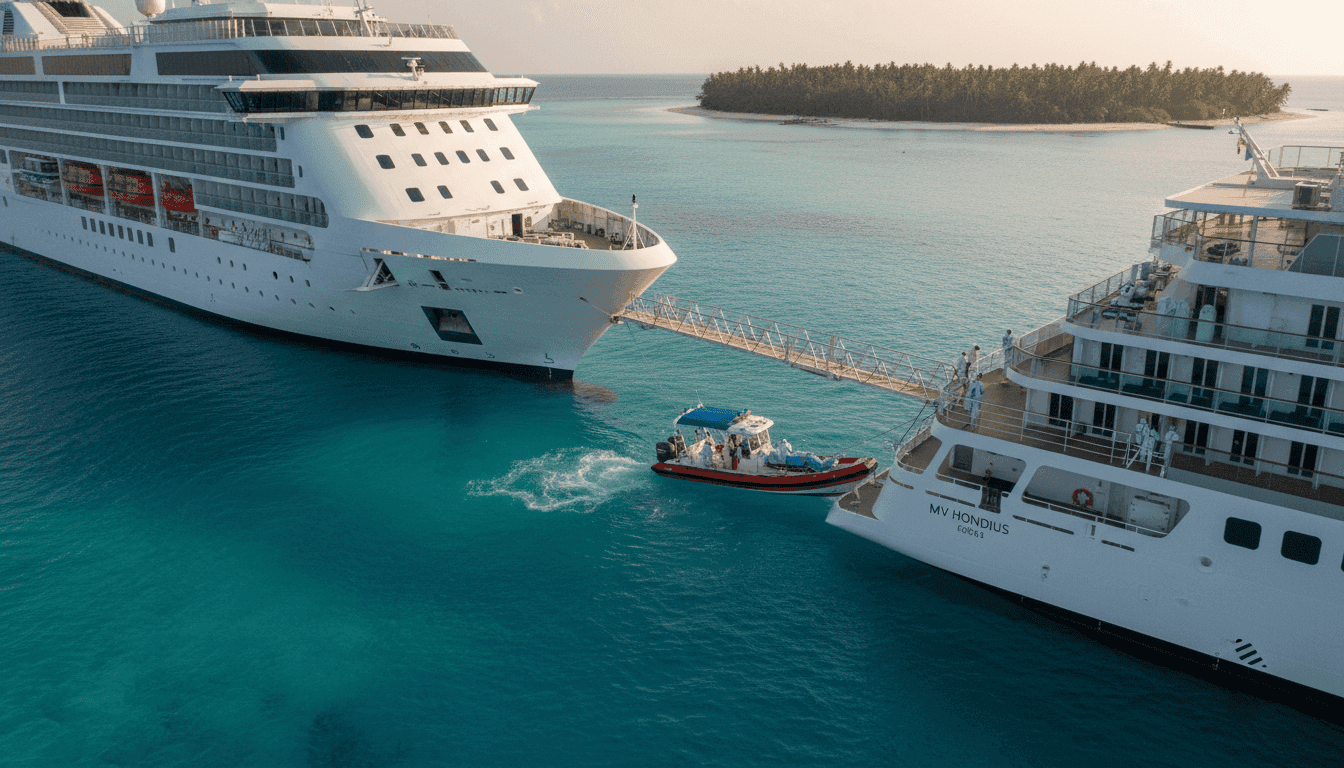
A hantavirus outbreak complicates public health efforts aboard the Dutch cruise ship MV Hondius, following its departure from Ushuaia, Argentina, on April 1, 2026. This serious situation, involving the rare Andes strain of hantavirus, has led to multiple confirmed deaths and a growing number of cases, posing significant challenges for international health authorities and the cruise industry.
As of May 6, 2026, the MV Hondius, owned by Oceanwide Expeditions, has recorded three confirmed deaths, five confirmed infections, and three suspected cases, bringing the total infections to at least eight. The vessel carried 147 to 149 individuals from 23 nationalities, with a passenger manifest primarily from Spain, the UK, and the US, and a crew predominantly from the Philippines. The Andes virus is particularly concerning due to its approximate 40% fatality rate and its unusual ability to transmit from person to person through close and prolonged contact, making the cruise ship environment a high-risk setting.
Understanding the Andes Virus Threat
Hantavirus pulmonary syndrome (HPS), caused by the Andes virus, presents symptoms typically within one to eight weeks post-exposure. These can include fever, muscle pain, headache, coughing, nausea, vomiting, chills, and dizziness. Severe manifestations involve fluid accumulation in the lungs, dangerously low oxygen levels, and respiratory failure. The ongoing investigation into the origin of the outbreak on the MV Hondius suspects initial exposure in Argentina, a region where the Andes virus is known to be prevalent. Health officials are actively tracking and monitoring all disembarked passengers, a critical step given the absence of vaccines or specific treatments, with care limited to supportive measures.
“The person-to-person transmission capability of the Andes strain elevates this cruise ship incident into a truly complicated public health situation, demanding swift international coordination.”
Timeline of a Developing Crisis Aboard the MV Hondius
The unfolding events on the MV Hondius paint a stark picture of the escalating crisis. The first fatality, a 70-year-old Dutch passenger, occurred on board on April 11, 2026. His body was removed in Saint Helena on April 24, the same day 24 passengers disembarked, including his wife. Tragically, his 69-year-old Dutch wife succumbed to the virus on April 26 in a Johannesburg hospital after flying to South Africa. A British passenger was evacuated to Johannesburg for treatment on April 27, reported in critical but stable condition. On May 2, a third passenger, a German woman, died on board. The ship anchored off Praia, Cape Verde, on May 3.
The situation further intensified on May 6, when three more individuals – a 56-year-old British expedition guide, a 41-year-old Dutch ship’s doctor, and a 65-year-old German passenger – were medically evacuated and flown to the Netherlands for treatment. Concurrently, a Swiss man who had disembarked in late April and returned to Switzerland was confirmed with the Andes strain and hospitalized in Zurich. Following these evacuations, the MV Hondius departed Cape Verde for the Canary Islands, leaving behind a trail of concern and a significant related Finance news implications for the global cruise industry. This hantavirus outbreak complicates public health strategies for cruise lines operating in high-risk regions.
The ongoing hantavirus outbreak complicates public health responses, highlighting the vulnerabilities of international travel to rare but deadly infectious diseases. The MV Hondius incident serves as a critical reminder of the need for robust health protocols and rapid response mechanisms to mitigate the spread of pathogens, especially those with person-to-person transmission capabilities, within confined environments like cruise ships. This hantavirus outbreak complicates public health efforts and underscores the global interconnectedness of health security.


