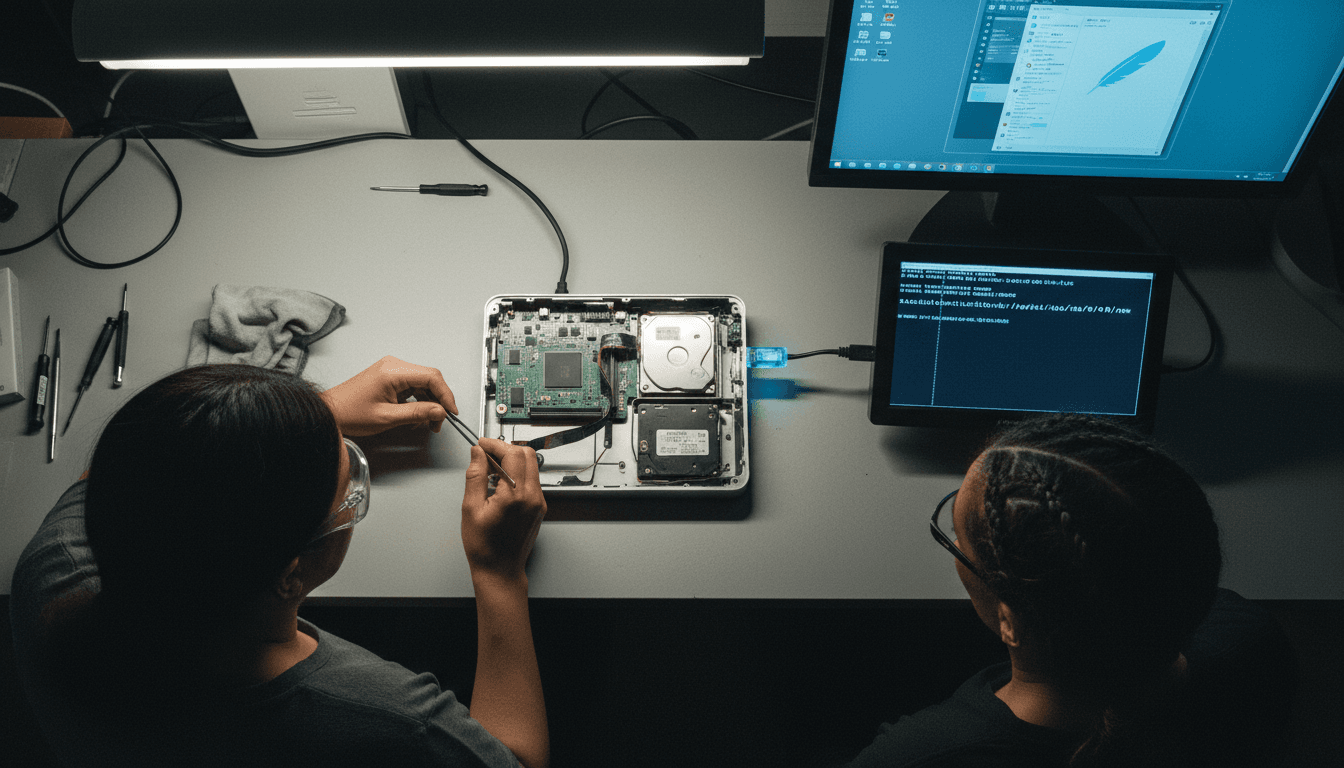
A recent Haiku OS Mac Mini install project, detailed in a Hackaday article published on April 12, 2026, explores the intriguing viability of running the open-source Haiku OS on a vintage 2009 Mac Mini. This ambitious undertaking by retro hardware enthusiast “The Phintage Collector” sought to breathe new life into older Apple hardware, leveraging Haiku’s lightweight and responsive architecture.
The core of this experiment centered on installing Haiku OS, specifically the 2024 Beta 5 release and a current nightly build, onto the compact desktop. Haiku, an operating system inspired by the legacy of BeOS, is renowned for its speed, efficiency, and modular design, making it a compelling choice for systems with modest specifications. The motivation was clear: find a practical and engaging use for a 2009-era Mac Mini, a machine whose modern application is increasingly limited.
Navigating EFI Challenges on Vintage Apple Hardware
A significant technical hurdle encountered during the installation was the 2009 Mac Mini’s reliance on EFI (Extensible Firmware Interface) rather than a traditional BIOS. This necessitated either leveraging the often-unreliable Compatibility Support Module (CSM) “classical BIOS” mode or finding a way to make Haiku fully compatible with EFI. The experiment primarily focused on the 32-bit build of Haiku, chosen for its binary compatibility with BeOS applications, though the 64-bit version was also installed. Interestingly, the Mac Mini’s 64-bit EFI BIOS presented difficulties in directly booting the 32-bit Haiku.
“The ingenuity required to bypass EFI limitations for a niche OS on vintage hardware highlights the dedication of the retro computing community.”
The installation workaround involved a clever approach: the 64-bit Haiku installer surprisingly facilitated the installation of the 32-bit version. However, direct booting via EFI remained problematic. The solution involved using a USB key with a fallback loader and quickly accessing Haiku’s boot options to select the 64-bit partition, a testament to the persistence required for such projects. This detailed account of the Haiku OS Mac Mini install provides valuable insights for anyone considering similar retro computing endeavors.
Performance and Limitations of Haiku on Mac Mini
While the 64-bit Haiku generally functioned after the intricate installation process, several hardware limitations became apparent. Crucially, audio did not work, even with an external USB dongle, significantly impacting the user experience. Furthermore, the absence of hardware acceleration for graphics meant the system was unsuitable for gaming or other graphically intensive tasks. Previous attempts to install Haiku on similar Mac models have also highlighted persistent issues with Wi-Fi and trackpad drivers, underscoring the challenges of achieving full compatibility on older, proprietary Apple hardware.
The 2009 Mac Mini, typically featuring a 2.26 GHz Intel Core 2 Duo processor, 2 GB of 1066MHz DDR3 RAM (expandable to 8 GB), and an Nvidia GeForce 9400M GPU, offers a modest platform. Despite these specifications, Haiku’s design principles allow it to deliver a remarkably fast and responsive experience, even without full hardware support. This makes the Haiku OS Mac Mini install a compelling case study for maximizing the utility of aging technology.
The Future of Retro OS on Vintage Hardware
This detailed exploration into a Haiku OS Mac Mini install demonstrates the vibrant efforts within the retro computing community to extend the lifespan and utility of older hardware. While challenges persist, particularly with driver compatibility and EFI booting, the project successfully showcased Haiku’s potential as a lightweight and efficient operating system for vintage Apple machines. Such projects not only provide interesting use cases for forgotten hardware but also contribute to the ongoing development and testing of open-source operating systems like Haiku. For those interested in related Industries news, this niche area of tech offers a unique perspective on innovation and sustainability in computing.