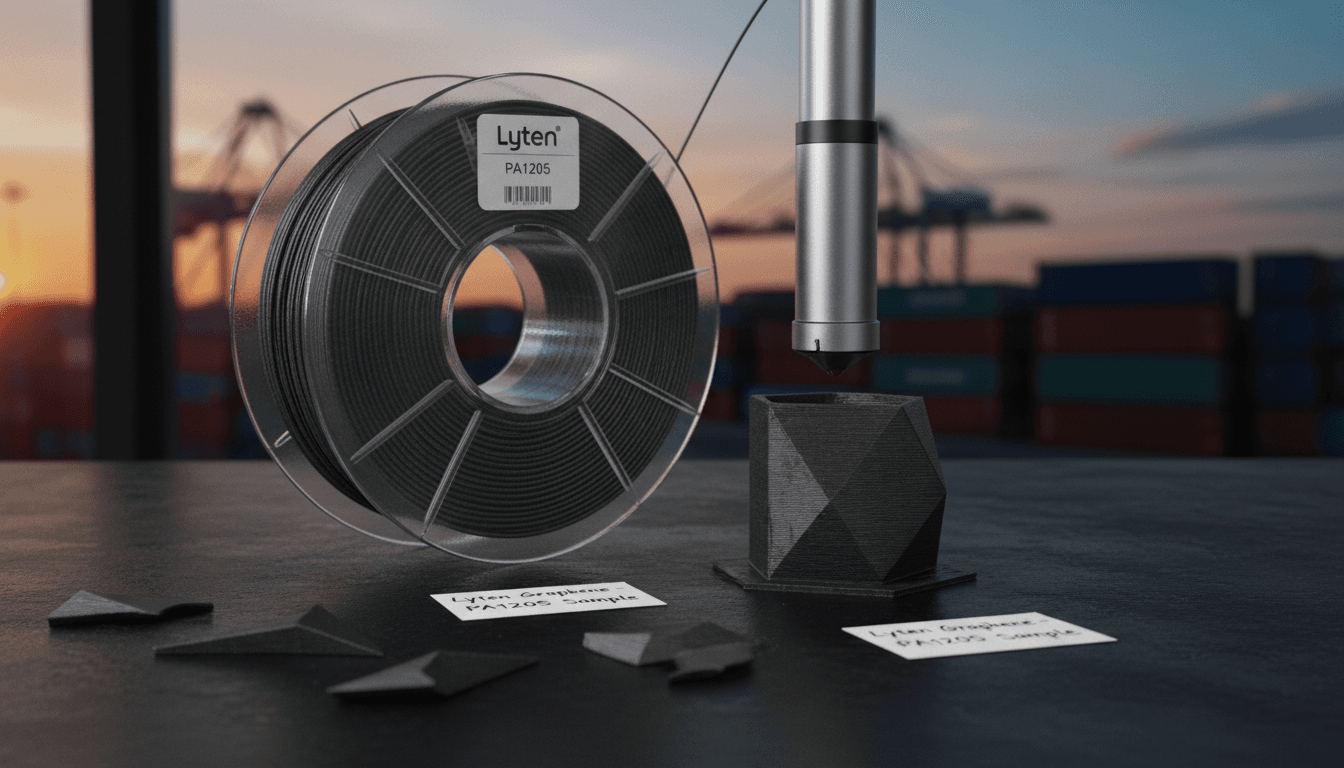
Graphene filament testing by Dr. Igor Gaspar of My Tech Fun has unveiled compelling insights into Lyten’s expensive PA12-based Lyten 3D graphene filament (PA1205). This advanced material, priced at $150 for a 1 kg spool, represents a significant leap in high-performance 3D printing, as detailed in a recent Hackaday article published on March 24, 2026.
Lyten, a Silicon Valley-based advanced materials and battery technology company, manufactures the PA1205 filament. Its core innovation lies in the proprietary 3D Graphene reinforcement, which diverges from traditional carbon fiber. Instead of stiff, brittle fibers, Lyten’s 3D Graphene creates a nano-scale, three-dimensional carbon network throughout the nylon. This approach is specifically designed to enhance strength and impact resistance, particularly addressing the notorious Z-axis weakness in FDM (Fused Deposition Modeling) parts.
The Promise of 3D Graphene in Advanced Manufacturing
The motivation behind Dr. Gaspar’s rigorous evaluation was to scrutinize Lyten’s bold assertions: that PA1205 is the strongest, most lightweight, and heat-resistant nylon filament available. Traditional carbon fiber reinforced nylons, while offering increased stiffness, often lead to parts that are more brittle, especially along the Z-axis, a critical limitation for demanding applications. Lyten’s 3D Graphene aims to transcend these shortcomings by reinforcing the material at a molecular scale. This leads to more uniform strength across all print directions and dramatically higher impact resistance, a crucial factor for components subjected to dynamic stresses.
The filament’s base material, PA12 (Nylon 12), is inherently less moisture-sensitive than PA6, further enhancing its appeal for industrial applications where environmental stability is key. Lyten claims impressive performance metrics for PA1205, including approximately 100% higher X- and Y-axis strength, a 43% increase in Z-axis strength, and roughly 500% higher impact strength compared to PA12-CF. With a heat deflection temperature of approximately 162 °C and a density of 1.08 g/cm³, these figures paint a picture of a material engineered for extreme conditions.
Graphene Filament Testing: Performance and Price Considerations
Dr. Gaspar’s testing, though challenged by the filament’s limited availability in the EU, confirmed many of Lyten’s claims. The PA1205 performed exceptionally well in load testing compared to average PA filaments and demonstrated significantly less brittleness than PA-CF. Both horizontal and vertical orientations showed robust performance during tensile and shear tests, underscoring the effectiveness of the 3D Graphene reinforcement in creating isotropic material properties.
“The uniform strength across all print directions and dramatically higher impact resistance of Lyten’s 3D Graphene filament represents a significant breakthrough for engineers.”
Despite its formidable performance, particularly in impact resistance and layer adhesion, the $150 per kg price point positions this material as a ‘tough ask’ for general 3D printing use. Lyten acknowledges this, strategically targeting demanding sectors such as motorsports, aerospace, and defense. In these industries, where weight reduction, extreme heat resistance, and uncompromised mechanical reliability are paramount, the premium cost can be justified by superior performance and enhanced safety. Lyten Motorsports is already leveraging 3D printed parts from this material in high-stakes programs like the IndyCar Experience, showcasing its real-world applicability.
The successful graphene filament testing confirms Lyten’s PA1205 as a high-performance material pushing the boundaries of what’s possible in additive manufacturing. While its cost limits widespread adoption, its unique properties make it an invaluable asset for critical applications where conventional materials fall short, signaling a new era for advanced engineering components.