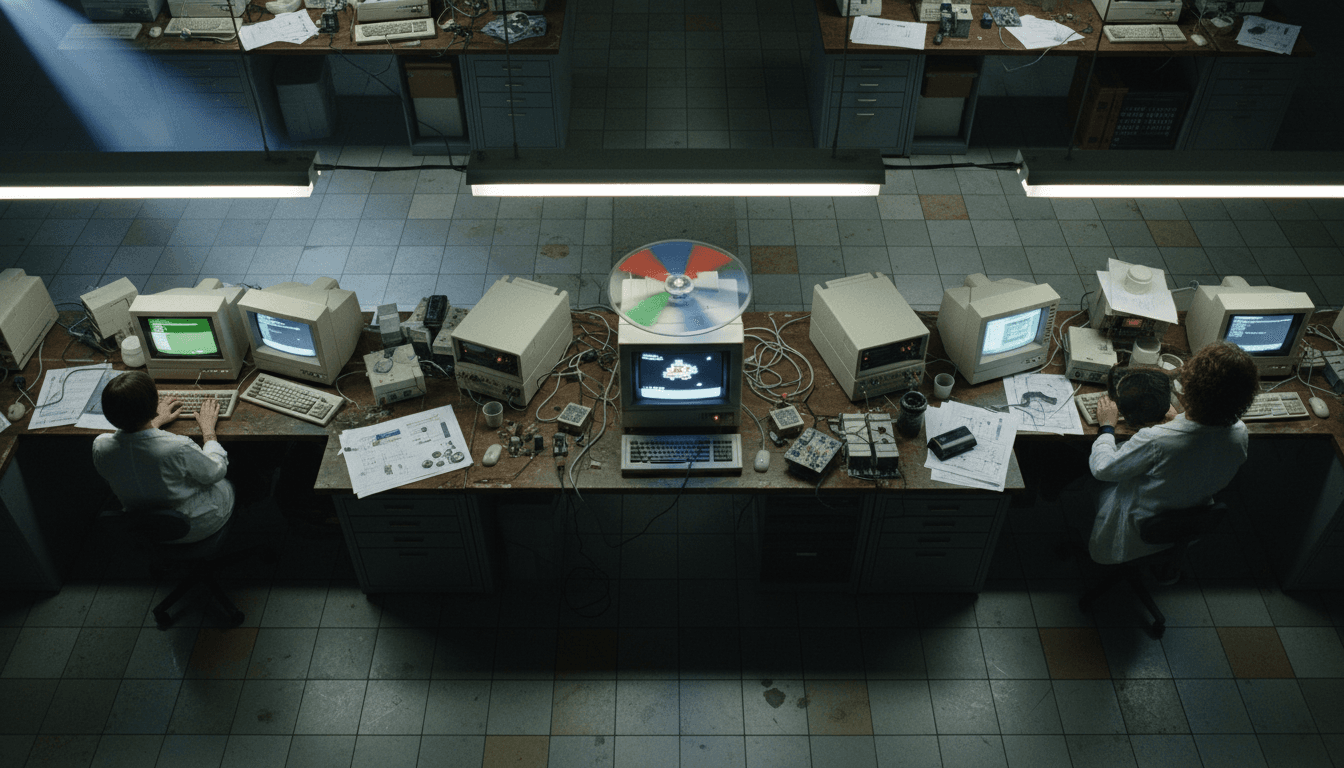
How a field sequential home computer might have operated is a fascinating exploration into an alternate technological timeline, where the CBS field-sequential color system, rather than the NTSC standard, prevailed in early home computing. This concept, recently highlighted by Hackaday, delves into a road not taken, offering insights into the technical constraints and potential outcomes of such a path.
The CBS field-sequential system, developed by Peter Goldmark for CBS in 1940, was a pioneering mechanical color television technology. It relied on a rotating disk equipped with red, green, and blue filters positioned in front of both the camera and the receiver. Color information was transmitted in successive images, with the human eye’s persistence of vision merging these sequential frames into a cohesive, full-color picture.
The Rise and Fall of CBS Field-Sequential Color
The system was first demonstrated to the press on September 4, 1940, with live color studio camera feeds showcased in 1941. Its prominence grew, leading the Federal Communications Commission (FCC) to adopt the CBS system as the U.S. standard for color television on October 11, 1950. Regular broadcasts commenced on June 25, 1951.
Technical specifications of the CBS system included a reduced vertical resolution of 405 lines, down from the standard 525, and a rapid 144 fields per second to fit within a 6-MHz bandwidth. This yielded 24 complete color pictures per second, contrasting with NTSC’s 525 lines and 60 fields per second. However, a significant hurdle was its incompatibility with existing black-and-white televisions, necessitating an adapter or a new color set for viewers.
“The incompatibility of the CBS field-sequential system with existing black-and-white televisions proved to be a critical factor in its commercial failure, limiting widespread adoption.”
CBS ended color broadcasting on October 20, 1951, partly due to the Korean War’s impact on color TV development and the scarcity of compatible sets, with only about 200 manufactured for commercial sale. By March 1953, CBS withdrew its system as a standard, paving the way for RCA’s all-electronic, NTSC-compatible system, which allowed existing black-and-white sets to receive color broadcasts in monochrome – a decisive market advantage. The FCC ultimately approved RCA’s NTSC system on December 17, 1953.
Unexpected Legacy: NASA’s Adoption
Despite its commercial failure in broadcast television, a modified version of the CBS field-sequential system found an unexpected second life. NASA utilized it for color video transmission from Project Apollo Command Modules, beginning with Apollo 10 in May 1969. Westinghouse Electric Corporation developed the specialized camera for this purpose, demonstrating the system’s robustness in niche, high-stakes applications.
How a Field Sequential Home Computer Would Have Worked
The Hackaday article delves into the hypothetical scenario of an 8-bit home computer employing a field-sequential display. Such a machine would likely have faced limitations in pixel resolution compared to its NTSC counterparts. The higher line frequency demanded by the CBS system, combined with the clock speeds of typical 8-bit processors, would have constrained the achievable display capabilities. This suggests that a field sequential home computer would probably have been less practical and less competitive than systems built around the NTSC standard, impacting everything from gaming to graphic design on early machines. This historical ‘what if’ scenario underscores the profound impact of foundational technological choices on subsequent innovation and market dominance within related Industries news.
The Enduring Impact of Standards
The narrative of the CBS field-sequential system is a powerful reminder of how critical technological standards are in shaping industries. While it failed in the consumer television market, its brief life and later specialized use by NASA highlight its inherent strengths for specific applications. The ultimate dominance of NTSC for consumer electronics illustrates the market’s preference for backward compatibility and incremental upgrades over revolutionary, but incompatible, leaps. The thought experiment of a field sequential home computer serves as a valuable lesson in the intricate interplay of technical feasibility, market forces, and strategic decisions in the history of computing and display technology.