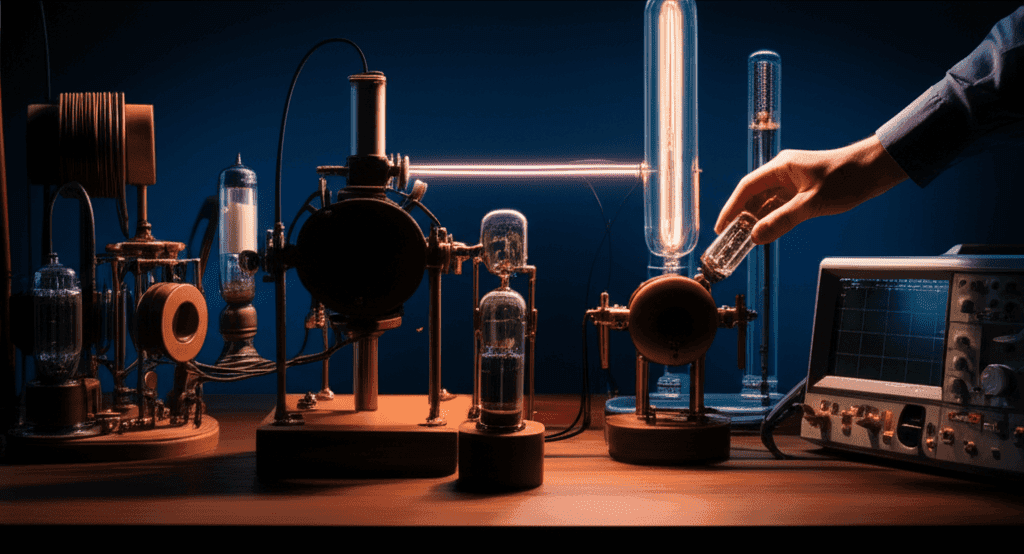
Electron mass measurement is an essential element of modern physics, and a recent demonstration by The Signal Path shows us how to recreate a classic experiment to determine it. Using readily available equipment, unlike J. J. Thomson in 1897, the video ([https://www.youtube.com/watch?v=AI5NuiIAdCY](https://www.youtube.com/watch?v=AI5NuiIAdCY)) walks viewers through the process.
The core principle involves trapping an electron in a circular path using a magnetic field. By calculating the forces needed to maintain this circular motion and applying relevant equations, one can derive the charge-to-mass ratio. This calculation relies on controllable or measurable parameters, such as the radius of the circular path and the electric field strength. Helmholtz coils generate the magnetic field, while a cold cathode tube provides the electrons, giving the setup a vintage, almost cinematic feel.
The Charge-to-Mass Ratio in Electron Mass Measurement
The experiment directly yields the charge-to-mass ratio. To obtain the electron mass, the electron’s charge must be known. While we can easily look this up today, it was unknown in 1897. Robert Millikan’s oil drop experiment, conducted a decade later, provided this crucial value, finally allowing scientists to determine the actual electron mass. The Signal Path’s replication yielded a result very close to the accepted value, demonstrating the accuracy of the original method. This type of experiment is critical in related Industries news.
“Replicating historical experiments provides valuable insights into the evolution of scientific understanding and allows us to appreciate the ingenuity of past researchers.”
Recreating Classic Science Experiments
The presenter also suggests replicating Millikan’s oil drop experiment, showcasing the value of hands-on learning and experimentation. There are many other classic science experiments that can be recreated, some of which are made easier with modern equipment. Performing electron mass measurement is an important step in understanding the underlying principles of physics.
The process of electron mass measurement, while seemingly complex, is based on fundamental principles that are still relevant today. It’s a testament to the power of scientific inquiry and the dedication of researchers who paved the way for our current understanding of the universe. The experiment also underscores the importance of precise measurement and careful analysis in scientific discovery. The experiment to determine electron mass measurement is a cornerstone of modern physics.
Modern Tools for Fundamental Constants
The availability of modern gear simplifies some of these experiments, allowing for the determination of fundamental constants using LEDs and a multimeter. This accessibility makes it easier for students and enthusiasts to engage with these concepts and gain a deeper appreciation for the scientific method. The ability to conduct electron mass measurement and other fundamental experiments at home or in educational settings democratizes scientific exploration and empowers individuals to contribute to our collective understanding.
Source: Hackaday