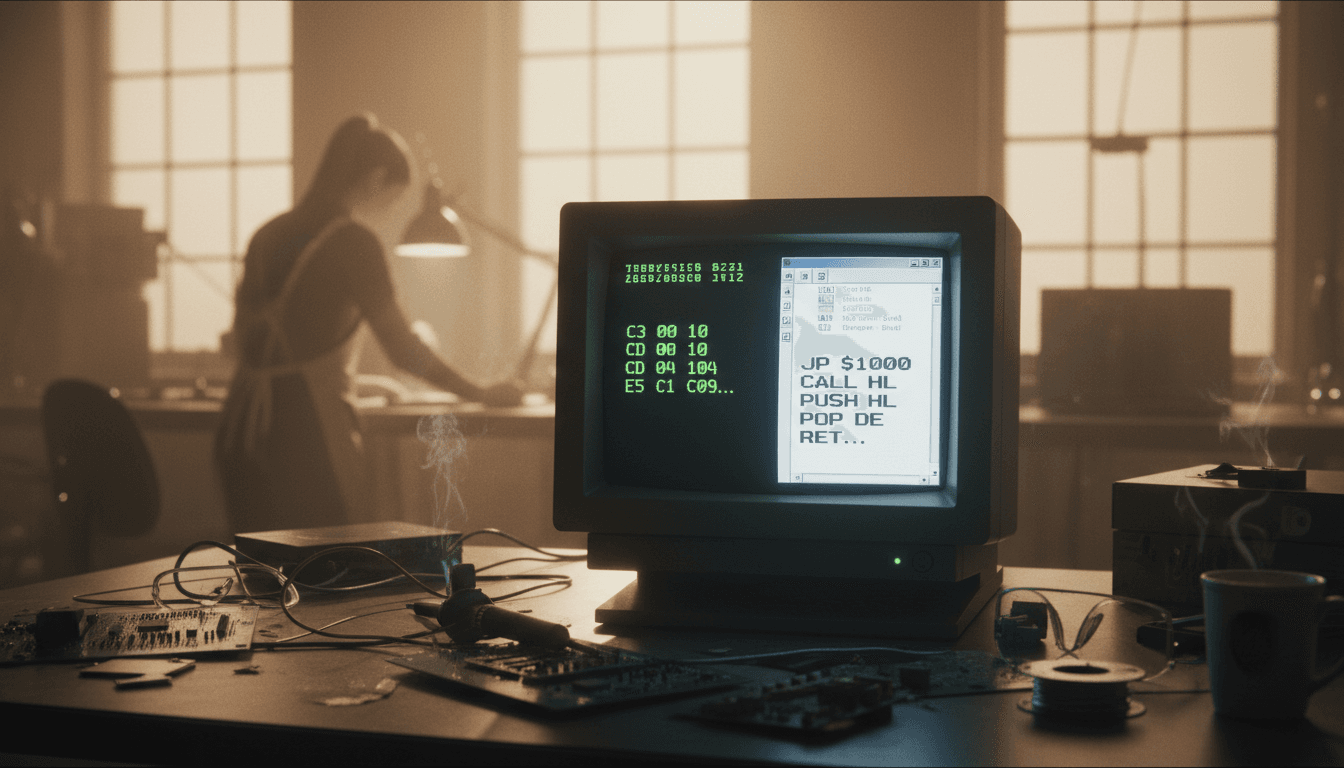
Disassembling opcodes with a font has emerged as a groundbreaking innovation in the realm of reverse engineering, offering a novel method to translate complex machine code into human-readable assembly mnemonics. A recent article published on Hackaday on March 15, 2026, by Aaron Beckendorf, details this ingenious approach using a specialized font called Z80 Sans, leveraging the often-overlooked intricacies of font rendering to demystify Z80 opcodes.
The technical ingenuity behind Z80 Sans lies in its sophisticated manipulation of the OpenType standard’s Glyph Substitution Table and Glyph Positioning Table. While fonts typically map characters to their graphical representations, the hidden depths of font rendering, particularly features like ligatures where character display is context-dependent, reveal a surprising capacity for complex operations. This capability, often seen in languages like Arabic or even in English ‘æ’, is precisely what Z80 Sans exploits.
The Arcane World of Font Rendering
Z80 Sans ingeniously defines all possible glyphs for each nibble (half-byte) of Z80 opcodes. It then employs a recursive descent parser to generate substitution rules, allowing the font to display the correct assembly mnemonics dynamically. When Z80 opcodes are pasted into a word processor and Z80 Sans is applied, the raw machine code visually transforms into understandable assembly language. This transformation occurs seamlessly, simply by changing the font in a document.
The Hackaday article underscores the ‘convoluted and arcane’ nature of font rendering, citing examples such as LaTeX being a Turing-complete programming language, Unicode’s inclusion of over eighty invisible characters, and the existence of libraries capable of executing WebAssembly within a font. This context is crucial for appreciating the advanced capabilities of Z80 Sans, which effectively bridges the gap between raw machine code and human comprehension through a seemingly simple typographical change.
“The ability to visually translate machine code into assembly mnemonics by simply applying a font is a paradigm shift for reverse engineering.”
This innovative technique not only streamlines the process of understanding legacy code but also highlights the untapped potential within seemingly mundane technologies like font design. For developers and engineers working with older systems, the efficiency gained from instantly readable opcodes could be substantial, reducing errors and accelerating development cycles. The implications extend beyond just Z80, suggesting a future where similar font-based tools could simplify complex data visualization across various technical domains.
Impact on Legacy Systems and Development
The development of Z80 Sans marks a significant step forward in making complex technical data more accessible. By transforming raw machine code into a more understandable format, the tool not only assists in reverse engineering but also offers a unique educational aid for those learning about assembly language. The elegance of this solution lies in its simplicity of application, requiring only a font change rather than specialized software or extensive manual lookup. This approach to disassembling opcodes with a font could pave the way for similar innovations across other instruction sets, fostering greater efficiency and understanding in the world of computing. This innovation, while niche, demonstrates the power of creative problem-solving in unexpected technical areas, potentially saving countless hours for developers working on related Industries news projects.